
Nineteen numbers, seventeen particles, one theory that will not break
The theory rests on nineteen numbers no one can derive from anything deeper, and it has survived every test aimed at it, including the two anomalies that were supposed to end it. Its real failures are elsewhere: neutrino mass, dark matter, and the missing antimatter.

The Standard Model takes nineteen numbers it cannot explain and produces every cross-section, branching ratio and decay width in particle physics. Between September 2024 and June 2025 the two anomalies that were supposed to break it both closed in its favour. What actually breaks it was never in the collider data at all.
One sentence, and everything follows
Stated precisely, the Standard Model is a renormalisable quantum field theory of spin-½ matter fields whose interactions are fixed by a local gauge symmetry, SU(3)C × SU(2)L × U(1)Y, spontaneously broken at roughly 246 GeV to SU(3)C × U(1)EM by the vacuum expectation value of a single complex scalar doublet. Almost every distinctive feature of the theory follows from that one sentence.
Gauge invariance dictates the form of every interaction vertex, so once the three coupling constants are measured the entire dynamics is fixed. There is no freedom left to tune a cross-section to fit. Renormalisability means the theory stays predictive to arbitrarily high energy without new input. And because SU(2)L acts only on left-handed fields, an ordinary Dirac mass term is not gauge invariant: fermion masses are forbidden by the symmetry, and must be manufactured by the Higgs field instead.
That last point is why the Higgs boson is not an optional extra. Without it the theory has no way to give the electron a mass, and no way to stop longitudinal W–W scattering from violating unitarity at high energy. A new particle was required to regulate that process. The Higgs is that particle.3
What “the Standard Model predicts X” means
Nineteen numbers go in. Everything else comes out. The muon’s anomalous magnetic moment is the cleanest demonstration. It is a pure prediction, computed to five loops in QED and to the limits of lattice QCD in the hadronic sector, now confronted by a measurement good to 127 parts per billion.7, 9 No other theory in science is tested at that resolution.
Nineteen numbers from nowhere
The parameter count is the most-cited structural complaint about the theory, and it is worth getting precise. Nineteen is the count for the model as originally written, with massless neutrinos.1 Physical parameters are those that survive every field redefinition. You cannot rotate them away.
- Three gauge couplings. The strengths of the strong, weak and hypercharge interactions. Their apparent convergence near 1016 GeV is the entire motivation for grand unification.
- Nine charged-fermion masses. Six quarks and three charged leptons, equivalently nine Yukawa couplings. They span six orders of magnitude, from the top quark’s coupling of roughly 1 down to the electron’s 3 × 10⁻⁶, with no pattern the theory explains.
- Four CKM parameters. Three mixing angles and one complex phase. That single phase is the model’s only source of CP violation.1
- Two Higgs potential parameters. The vacuum expectation value at 246 GeV and the self-coupling. The Higgs mass is not predicted; it had to be measured.5
- One θQCD. A CP-violating angle allowed in the strong sector. Nothing forbids it, yet experiment puts it below roughly 10−10.
Neutrino mass adds more. Three masses, three PMNS mixing angles and a Dirac phase take the count to twenty-six; two further Majorana phases take it to twenty-eight if neutrinos turn out to be their own antiparticles.2 Which of those is right is unknown.
Where the ignorance is concentrated
Fifteen of the nineteen parameters attach to the Higgs sector: the nine fermion masses, the four CKM parameters, and the two potential terms. Most of what the Standard Model cannot explain about itself sits in one field.
Seventeen particles, and nothing new since 2012
Twelve fermions, four gauge bosons, one scalar. The count flatters the theory: once colour, chirality and antiparticles are counted separately, the Standard Model carries roughly ninety propagating degrees of freedom. But seventeen is the honest headline number, and every one of them has been observed.
The masses span twelve orders of magnitude with no explanation for the spread. The electron sits at 0.511 MeV, the up quark at 2.16 MeV, the muon at 105.66 MeV, the tau at 1.777 GeV. Then the heavy end: the W at 80.3692 GeV, the Z at 91.1880 GeV, the Higgs at 125.20 GeV, the top quark at 172.6 GeV.4 The photon and gluon are exactly massless, and that masslessness is a structural prediction of unbroken gauge symmetry rather than a measured value.
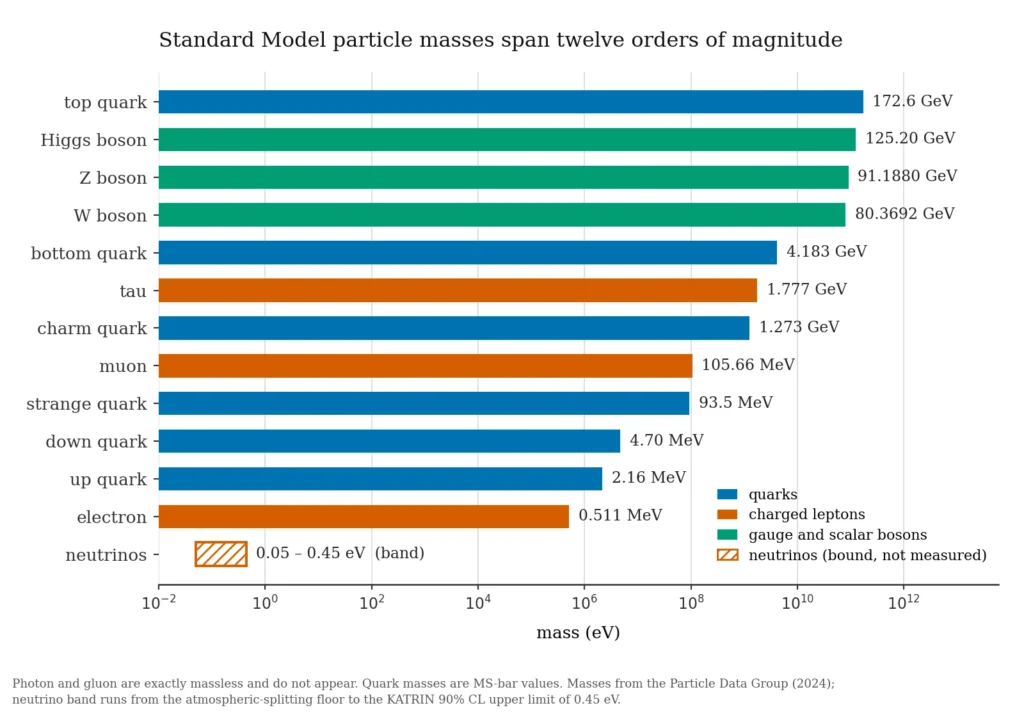
The neutrinos are the exception on the chart, and the exception matters. Their entry is a bound, not a measurement, sitting somewhere between the oscillation-derived floor and KATRIN’s upper limit.14 The Standard Model as written says they should be at exactly zero.
The shape of the discovery record is worth noting on its own. Thomson identified the electron in 1897. Charm, the tau and the bottom quark arrived within three years of each other in the mid-1970s. The W and Z followed in 1983, the top quark in 1995, the tau neutrino in 2000. ATLAS and CMS observed the Higgs boson in 2012, completing the table. Nothing has been added since. A fifty-year burst of discovery, then a long consolidation.
A closed constraint
The Z boson’s decay width fixes the number of light neutrino species at three.4 It is one of the model’s sharpest closed doors: a fourth ordinary generation is not a matter of not having looked hard enough.
The two anomalies that died
For most of the last five years the two best-publicised cracks in the Standard Model were the muon’s magnetic anomaly and the mass of the W boson. Both closed. The manner of closing is worth studying, because they closed on opposite sides of the theory–experiment divide.
Muon g−2 closed on the theory side. Fermilab’s final measurement reached 127 parts per billion, better than its 140 ppb design goal and four times sharper than Brookhaven’s.7, 9 The experiment did not move. The prediction did. The Theory Initiative’s 2025 white paper switched the dominant hadronic-vacuum-polarisation input from electron–positron cross-section data to lattice QCD, shifting the predicted value by a full 3σ from the Initiative’s own 2020 number.8, 9 Theory and experiment now agree.10
That is a resolution, but not a clean one. The data-driven method was set aside because of an unexplained tension in the CMD-3 measurement, which stands against decades of prior data. The origin of that tension remains unknown.11 What makes the case strong is that multiple independent lattice groups agree with each other and with the measurement.11 But the field has not finished explaining why the two methods disagreed in the first place.
The W mass closed on the experimental side. CDF’s 2022 measurement sits about seven standard deviations above the Standard Model prediction.13 In September 2024 CMS measured 80,360.2 ± 9.9 MeV against a prediction of 80,357 ± 6 MeV, nearly matching CDF’s stated precision and agreeing with the theory.12 CDF’s result is now an isolated outlier among ten measurements, and scrutiny has turned to its drift-chamber momentum resolution.13
What would reopen them
For the muon: the data-driven hadronic calculation returning in credible form and disagreeing with lattice again. J-PARC’s independent measurement begins taking data from 2030.9 For the W: a second experiment reproducing CDF’s high value. Neither is expected, but neither is impossible.
The only break confirmed in a laboratory
Neutrinos have mass, and in the Standard Model as written they cannot. There is no right-handed neutrino field to pair with, so the Yukawa mechanism has nothing to act on and flavour oscillation is forbidden outright. It happens anyway. On the assessment of the current literature this remains the only laboratory detection of physics beyond the Standard Model.18 Everything else that fails is inferred from the sky.
Oscillation fixes the mass-squared differences, not the masses themselves. Three independent probes now bracket the absolute scale from opposite directions, and they are beginning to collide. KATRIN’s tritium beta-decay spectroscopy, based on 259 days of data, puts the direct kinematic limit below 0.45 eV at 90% confidence. That is a factor-of-two improvement, and model-independent,14 with final sensitivity expected near 0.3 eV.15 Cosmology is far tighter: Planck CMB data combined with DESI DR2 baryon acoustic oscillations gives a summed mass below 0.064 eV at 95% confidence. That sits at the normal-ordering floor and in 2–3σ tension with the inverted-ordering floor of 0.10 eV.18
Note what the tension is between. The cosmological bound is not a measurement of neutrinos; it is an inference that assumes ΛCDM. If dark energy evolves, that bound loosens, which is exactly why several recent analyses treat the neutrino-mass and dark-energy questions as one problem rather than two.18
The newest data point comes from JUNO. Its first 59 days of running beat every previous measurement of θ12 and Δm²21 combined, by a factor of 1.6, giving sin²θ12 = 0.3092 ± 0.0087.16 It also confirmed a mild 1.5σ discrepancy between solar and reactor determinations of the same parameters. The discrepancy is small and longstanding, and worth watching precisely because JUNO can measure both sides itself.17
Still open
The absolute mass scale, the ordering, and whether neutrinos are Dirac or Majorana particles are all unresolved. The question is no longer whether the Standard Model fails here. It is which mechanism replaces it.
Forty years of dark matter, and no particle
Roughly 85% of the matter in the universe is not in the census of seventeen. The favoured explanation for four decades has been a weakly interacting massive particle, attractive because a new particle at the electroweak scale with electroweak-strength couplings automatically freezes out with about the right relic abundance. The arithmetic was too neat to ignore.
That specific hypothesis is now in serious trouble. LZ’s 4.2 tonne-year exposure found no excess and set the strongest spin-independent limit to date: 2.2 × 10−48 cm² at 90% confidence for a 40 GeV/c² WIMP.19, 20 The collaboration’s own framing is the useful one: if WIMPs were in the searched region, they would have been seen.21 Sensitivity has descended more than three orders of magnitude since 2012, and the parameter space that motivated the search is now behind us.
Two things follow, and they need separating. A null result of this quality is information: it excludes model space and redirects effort toward axions, sterile neutrinos and sub-GeV candidates. But none of it touches the evidence for dark matter, which comes from galactic rotation curves, gravitational lensing, and the CMB power spectrum. What is failing is a specific candidate, not the observation.
The clock on the paradigm
LZ runs toward 1,000 live days by 2028.21 After that, xenon direct detection meets the irreducible solar-neutrino background known as the neutrino fog, and the WIMP paradigm as conventionally defined effectively concludes, one way or the other.
Why there is any matter at all
The observed baryon-to-photon ratio is about 6 × 10⁻¹⁰. Generating it dynamically requires Sakharov’s three conditions: baryon-number violation, C and CP violation, and a departure from thermal equilibrium. The Standard Model contains all three ingredients. It fails on magnitude, twice over.
A reparametrisation-invariant estimate of CP violation from the CKM phase at electroweak temperatures gives a dimensionless measure of order 10−20, against the roughly 10−8 the mechanism requires.26, 27 Separately, at the measured Higgs mass the electroweak phase transition is a smooth crossover rather than the strongly first-order transition needed to stop sphalerons washing the asymmetry back out. Both failures are structural, not statistical.
Against that backdrop, LHCb’s March 2025 result matters more for what it opens than what it settles: the first observation of CP violation in a baryon, with an asymmetry of (2.45 ± 0.46 ± 0.10)% in Λb0 decays, at 5.2σ.25 Baryons are what the visible universe is actually made of, and until then CP violation had only ever been seen in mesons. The result is consistent with the CKM mechanism. The honest caveat, stated by the collaboration itself, is that Standard Model predictions for baryon decays are not yet precise enough to permit a sharp comparison.24
Ten orders of magnitude
The gap between the matter–antimatter asymmetry the Standard Model can generate and the one the universe contains. This is not a tension at the edge of statistics. It is a quantitative failure that no refinement of the existing theory can close.
The crack that may be opening
Dark energy is not a Standard Model failure in the same sense. It is a failure of the theory to have anything to say. The vacuum energy the Standard Model does contain, computed naively, exceeds the observed value by a famously absurd margin, and no mechanism in the theory sets it.
What is new is that the cosmological constant itself may not survive. DESI’s second data release finds a 3.1σ preference for an evolving equation of state over ΛCDM from BAO and CMB data alone, rising to 2.8σ, 3.8σ or 4.2σ depending on which supernova compilation is added.22, 23 All combinations point the same way: toward dark energy that is weakening today.22
The significance is contested, and the disagreement is instructive. The 4.2σ headline depends on a supernova catalogue whose calibration has been re-examined; independent re-analyses argue the preference is driven predominantly by the lowest-redshift anchor, raising the possibility of residual local-universe systematics. Bayesian model comparison, which penalises the extra parameters, gives a weaker verdict than the frequentist test. The 3.1σ BAO+CMB figure is the robust number; 4.2σ is the upper bracket.
Where the next break is most likely
Successive DESI releases with recalibrated supernova compilations will either consolidate the evolving-dark-energy preference past 5σ or dissolve it. On the current evidence this is the most probable site of the next genuine break, and it is in cosmology, not particle physics.
The complaints that are not evidence
Three long-standing discontents belong in a different category, and conflating them with the anomalies above is the most common error in popular accounts. Anomalies are failures of prediction. These are failures of ambition. Only the first kind can be falsified.
The hierarchy problem. The Higgs mass receives no symmetry protection, so naive expectation places it near whatever cutoff scale the theory breaks down at, rather than at 125 GeV. Proposed resolutions include a new symmetry such as supersymmetry, or a composite rather than fundamental Higgs.6 None has experimental support. This is an argument from expectation, not a failed prediction.
Strong CP. θQCD could take any value; experiment bounds it below roughly 10−10. It is a parameter that is inexplicably zero rather than inexplicably arbitrary. The axion is the leading explanation and is now a major search programme in its own right.
Gravity. The Standard Model does not contain it, and quantising general relativity in the same framework fails at high energy. This is the one gap everyone agrees is real, and the one with the least experimental traction. No laboratory experiment currently probes the regime where the two theories must be reconciled.
What would actually move this
JUNO expects to determine the neutrino mass ordering with at least 6.5 years of nominal exposure;17 DUNE and Hyper-Kamiokande follow with long-baseline searches for CP violation in the lepton sector. If leptonic CP violation turns out to be large, leptogenesis becomes the leading account of the baryon asymmetry, and the ten-order-of-magnitude gap acquires a candidate explanation.
J-PARC’s g−2/EDM experiment plans data-taking from 2030 with an independent method, targeting the muon electric dipole moment at around 10−21 e·cm. Any signal at all there would be unambiguous new physics: Standard Model predictions sit near 10−38 e·cm.9 The Higgs sector remains the least-explored part of the theory. Whether the Higgs is fundamental or composite, and whether there is one doublet or several, are both open.6 The High-Luminosity LHC is the only facility that will address them within the decade.
The pattern across all of it is consistent. The Standard Model is not going to break on its own terms. Nineteen unexplained numbers and the absence of gravity are reasons to expect something deeper, not evidence against what exists. The theory will not fail a collider test; it will be superseded by a framework that explains where its numbers came from. On current evidence, the first hard push toward that framework is more likely to arrive from a telescope than from an accelerator.
References
Structure and parameter counting
- J. Zupan, Introduction to flavour physics, arXiv:1903.05062. The nineteen-parameter count, §2.4. arxiv.org
- A. Kronfeld, Twenty-first Century Lattice Gauge Theory, arXiv:1203.1204. The 28-parameter count with massive neutrinos. arxiv.org
- P. Nath, The Standard Model of Particle Physics and What Lies Beyond: A View from the Bridge, Condens. Matter 10, 34 (2025). mdpi.com
- S. Navas et al. (Particle Data Group), Review of Particle Physics, Phys. Rev. D 110, 030001 (2024). pdg.lbl.gov
- CERN, ATLAS sets record precision on the Higgs boson’s mass. mH = 125.11 ± 0.11 GeV. home.cern
- Experimental Particle Physics Priorities 2025, arXiv:2505.12965. Higgs naturalness and the open Higgs-sector questions. arxiv.org
The two closed anomalies
- Muon g−2 Collaboration, final measurement, arXiv:2506.03069 (2025). arxiv.org
- R. Aliberti et al. (Muon g−2 Theory Initiative), The anomalous magnetic moment of the muon in the Standard Model: an update, arXiv:2505.21476. arxiv.org
- CERN Courier, Fermilab’s final word on muon g−2, 8 July 2025. cerncourier.com
- APS Physics 18, 150, Muon Experiment Calls It a Wrap (2025). aps.org
- Physics World, Muon g−2 achieves record precision, but theoretical tensions remain, July 2025. physicsworld.com
- Fermilab News, New results from the CMS experiment put W boson mass mystery to rest, 17 September 2024. fnal.gov
- CERN Courier, CDF addresses W-mass doubt, March 2025. cerncourier.com
Neutrino mass
- KATRIN Collaboration, Direct neutrino-mass measurement based on 259 days of KATRIN data, Science (2025). science.org
- Physics World, KATRIN sets tighter limit on neutrino mass, May 2025. physicsworld.com
- JUNO Collaboration, First measurement of reactor neutrino oscillations at JUNO, arXiv:2511.14593; Nature (2026). arxiv.org
- IHEP, JUNO experiment delivers first physics results two months after completion, November 2025. eurekalert.org
- Measuring Cosmic Neutrino Masses Independently of Dark Energy, arXiv:2607.24742. The laboratory-versus-cosmology tension. arxiv.org
Dark matter and dark energy
- LZ Collaboration, Dark Matter Search Results from 4.2 Tonne-Years of Exposure, arXiv:2410.17036; Phys. Rev. Lett. 135, 011802 (2025). arxiv.org
- APS Physics, Dark Matter Detector Releases Best-Yet Result (2025). aps.org
- Berkeley Lab, LZ Experiment Sets New Record in Search for Dark Matter, 26 August 2024. lbl.gov
- DESI Collaboration, DESI DR2 Results II: BAO and Cosmological Constraints, arXiv:2503.14738. arxiv.org
- Nature Astronomy, The inconstant cosmological constant (2025). nature.com
CP violation and the baryon asymmetry
- LHCb Collaboration, Observation of charge–parity symmetry breaking in baryon decays, Nature 643, 1223 (2025). nature.com
- LHCb outreach, Observation of the different behaviour of baryonic matter and antimatter, 25 March 2025. cern.ch
- D. B. Kaplan, lecture notes on baryogenesis, University of Washington. The CP-violation measure against the observed asymmetry. washington.edu
- B Decays, the Unitarity Triangle, and the Universe, arXiv:hep-ph/9908520. The required enhancement. arxiv.org
Note on sourcing
Every numerical claim traces to a collaboration publication, a collaboration release, or a peer-reviewed journal. Particle masses follow the Particle Data Group. Quark masses are scheme- and scale-dependent quantities, quoted in the MS-bar scheme; because quarks are confined, a pole mass is not defined. The DESI evolving-dark-energy significance genuinely varies with dataset choice and with frequentist versus Bayesian treatment; that spread is reported rather than averaged. The framing that separates empirical failures from structural discontents, and the judgement that dark energy is the most likely site of the next break, is this publication’s analysis rather than a claim any single source makes.
2 responses