
JUNO’s First Result and the Neutrino Mass Ordering
In 59 days of running, JUNO caught 2,379 antineutrinos and pinned down two oscillation parameters 1.6 times more precisely than every previous experiment combined. It was not built for either of them. It was built to settle whether the third neutrino is the heaviest or the lightest. That answer hides in a ripple pattern so fine the detector has to measure energy to better than 3 percent. Here is what the ordering question is, how a spectrum shape encodes it, and why one measurement takes weeks and the other takes years.
Cite this article
Quantum Nature (2026). JUNO’s First Result and the Neutrino Mass Ordering. Quantum Nature. https://quantum-nature.com/juno-neutrino-mass-ordering/
Which neutrino is the odd one out
Neutrinos come in three mass states, labelled 1, 2 and 3. Oscillation experiments do not measure the masses. They measure the differences between the squares of the masses, and only two of those are independent.
What is known. States 1 and 2 sit close together, separated by a mass-squared difference near 7.5 × 10⁻⁵ eV2. State 3 sits far from that pair, separated by about 2.5 × 10⁻³ eV2, roughly thirty times larger. Solar neutrino measurements fixed the sign of the small splitting, so we know state 2 is heavier than state 1.
What is not. Nobody knows the sign of the large one. If state 3 sits above the close pair, the ordering is normal. If it sits below, the ordering is inverted. Oscillation probabilities in vacuum depend mostly on the squares of these differences, which erases the sign. Recovering it requires either matter effects or a very careful look at interference.
What 59 days already bought
JUNO began taking physics data on 26 August 2025. The collaboration reported two numbers in Nature, from events collected through 2 November.
- sin2θ12 = 0.3092 ± 0.0087
- Δm221 = (7.50 ± 0.12) × 10-5 eV2
Both come from 2,379 antineutrino candidates and 59.1 effective days. Both beat the combined precision of everything that came before by a factor of 1.6.
Those numbers are about the detector’s readiness, not its purpose. The engineering behind them, light yield, radiopurity, the full construction timeline, is covered separately in JUNO First Results: Record Precision in 59 Days. What follows here is the physics case: why the mass ordering is so much harder to extract than the two numbers above, and what answering it would settle.
One tension got sharper. Solar neutrino experiments and reactor experiments have long disagreed slightly on the value of Δm221, at about the 1.5 sigma level. JUNO’s reactor measurement confirms the gap rather than closing it. JUNO can eventually measure both solar and reactor neutrinos in one detector. That removes the cross-experiment systematics making the comparison awkward today.
How you catch a reactor antineutrino
Eight reactor cores at the Yangjiang and Taishan power plants pour electron antineutrinos into the surrounding rock. JUNO sits 52.5 km away, a 35.4-metre acrylic sphere holding 20,000 tonnes of liquid scintillator, watched by 17,612 twenty-inch photomultiplier tubes and 25,600 three-inch ones.
The signature is two flashes. An antineutrino strikes a proton and converts it into a neutron and a positron. The positron deposits its energy immediately and annihilates, giving a prompt flash. The neutron wanders for a couple of hundred microseconds, then gets captured by a hydrogen nucleus and releases a 2.2 MeV gamma ray, giving a delayed flash. Demanding both flashes close together, in space and time, removes almost all background, the same inverse-beta-decay tagging that lets Double Chooz count antineutrinos from a reactor that is not even running.
The prompt flash carries the energy information. Its brightness maps onto the antineutrino energy, minus a fixed 0.78 MeV. That mapping is the entire measurement, which is why the energy scale matters as much as the resolution.
Two oscillations at once
Antineutrinos leaving a reactor start as pure electron flavour. Along the way the three mass states drift out of step, and the chance of still finding electron flavour at the far end rises and falls with energy. At JUNO’s distance two separate oscillations are running simultaneously.
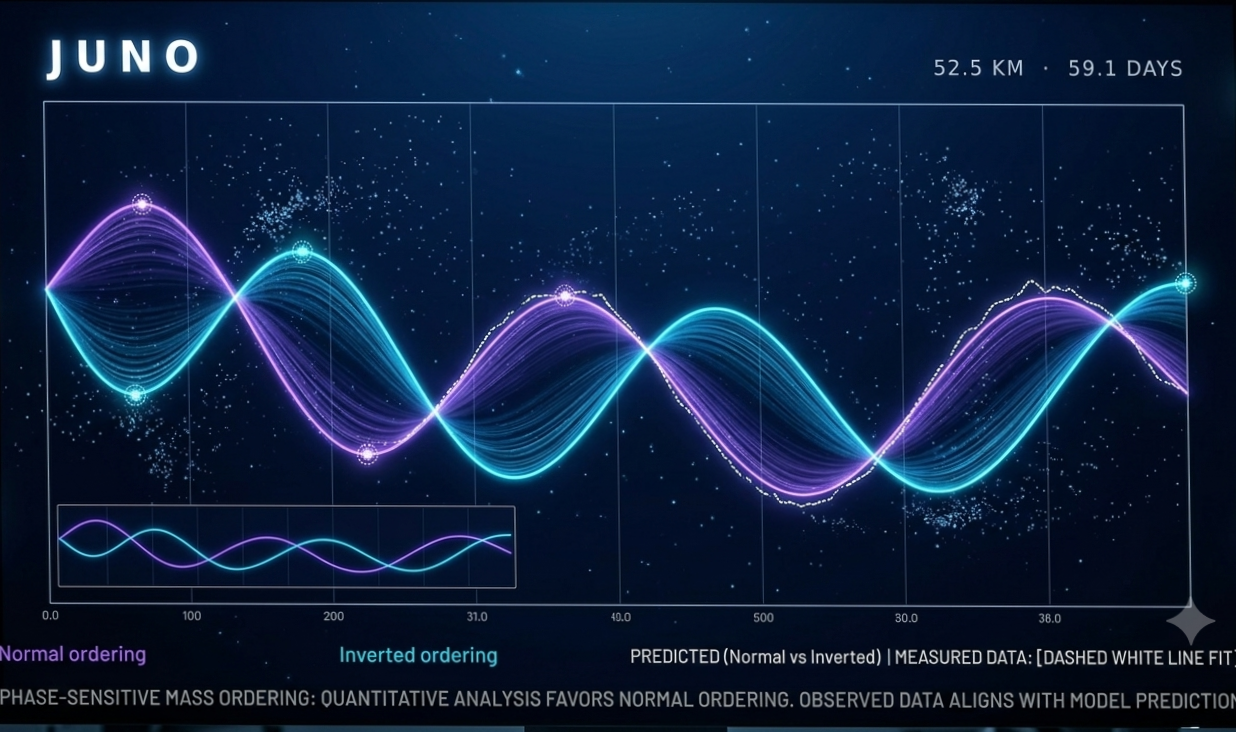
The slow one. Driven by the small splitting, it produces a single broad dip that bottoms out near 3.2 MeV and removes most of the signal. JUNO’s baseline was chosen to put that minimum right where reactor antineutrinos are most plentiful.
The fast one. Driven by the large splitting, it completes about ten full cycles between 2 and 8 MeV. These are the ripples riding on the slow dip. They are small, rapid, and they carry the answer.
Figure 1
The ordering hides in the phase, not the depth
Fraction of reactor antineutrinos surviving the 52.5 km trip to JUNO. The slow dip is the solar oscillation. The ripples on it carry the mass ordering.
The two curves have the same envelope. They differ only in where the ripples sit, by at most about 4 percentage points in survival probability. Resolving that shift is the entire mass-ordering measurement, and it is why the detector needs energy resolution better than 3 percent at 1 MeV.
Computed from the three-flavour vacuum survival probability at L = 52.5 km, using sin²θ₁₂ = 0.3092 and Δm²₂₁ = 7.50 × 10⁻⁵ eV² from the first JUNO measurement, sin²θ₁₃ = 0.0220, and |Δm²ee| = 2.487 × 10⁻³ eV² held equal between the two orderings. Detector resolution and reactor spectrum shape are not folded in.
The survival probability for reactor antineutrinos at JUNO’s baseline. About ten rapid oscillations, driven by the atmospheric mass splitting, ride on the single deep dip produced by the solar splitting. Normal and inverted ordering produce the same depth and differ only in the phase of the ripples, which is why the measurement demands exceptional energy resolution rather than more events. Sources: Nature (2026) · arXiv:2405.17860
The ordering is a phase, not a depth
Here is the subtlety that makes JUNO hard. There are really two fast oscillations, not one. State 3 beats against state 1 and against state 2, and those two beat frequencies differ by exactly the small splitting. The survival probability adds them with fixed weights: roughly 69 percent for the first and 31 percent for the second.
Where the sign hides. In normal ordering the heavier weight lands on the larger frequency. In inverted ordering it lands on the smaller one. The sum is still a fast oscillation of the same amplitude, but its phase creeps across the spectrum in opposite directions in the two cases.
The consequence is unforgiving. The two hypotheses predict spectra with the same depth, the same envelope and the same number of ripples. They differ only in where the ripples sit, by at most about 4 percentage points in survival probability. No amount of extra statistics helps if the detector smears the ripples together.
The measurement in one line
Most experiments count how many particles vanish. JUNO measures exactly where in the spectrum they vanish. That is an interference measurement, and it lives or dies on energy resolution.
Two engineering numbers decide everything
Resolution better than 3 percent at 1 MeV. Blur the spectrum by more than that and neighbouring ripples merge into a smooth curve carrying no phase information. JUNO’s full detector simulation predicts 2.95 percent. A calibration-driven analysis reaches 3.02 percent, degrading to 3.12 percent once detector imperfections are included. The sensitivity to this number is brutal: at 3.5 percent, the time needed to reach 3 sigma more than doubles.
Energy scale non-linearity below 1 percent. Resolution controls whether you can see the ripples. The energy scale controls whether you can trust where they are. A systematic distortion in the conversion from light output to energy would shift the whole pattern and mimic the wrong ordering.
There is a third constraint, less discussed. Every reactor core must sit at nearly the same distance. Cores at different baselines produce ripple patterns offset from each other, and adding them washes out the interference. The site was chosen so that both power plants land within a kilometre or so of the same 52.5 km.
The reactor spectrum has to be measured separately
JUNO reads the ordering from wiggles in a spectrum. That only works if the spectrum leaving the reactor is smooth, or at least known. It is neither.
Reactor antineutrino spectra contain fine structure from thousands of individual beta decays, and previous experiments found a bump near 5 MeV that no model predicted. Structure in the source could easily be mistaken for structure from oscillation.
The fix is a second detector. The Taishan Antineutrino Observatory sits close to one Taishan core, near enough that oscillation has barely begun. It measures the reactor spectrum directly at sub-percent energy resolution and supplies JUNO with a reference shape. The published sensitivity figures assume a joint JUNO and TAO analysis, not JUNO alone.
Why JUNO’s answer is independent
Other experiments attack the ordering through matter effects. Neutrinos travelling through the Earth interact with electrons, and that interaction changes oscillation probabilities in a way that depends on the sign of the large splitting. Accelerator experiments and atmospheric neutrino detectors both use it.
The problem with matter effects. They are entangled with two other unknowns: the CP-violating phase and which side of 45 degrees the angle θ23 falls on. This is why current global fits are stuck. NuFIT 6.0 finds inverted ordering disfavoured by a chi-squared difference of 6.1, and notes that the data have 2.5 to 3 sigma sensitivity in principle. In practice T2K and NOvA each prefer normal ordering on their own. They agree with each other better under inverted, and that drains the significance away.
JUNO has none of that. At 52.5 km through crust, matter effects are negligible. The collaboration’s own sensitivity study states the point directly: the measurement is completely independent of the CP-violating phase and of θ23. That makes it an independent determination rather than another entry in the same tangled fit.
What the ordering decides
Whether neutrinoless double beta decay is findable. If neutrinos are their own antiparticles, that decay should occur at a rate set by an effective mass, the same Majorana-mass question that KamLAND-Zen and LEGEND-200 are already probing. Inverted ordering puts a floor under that mass, roughly 15 meV, within reach of the next generation of experiments. Normal ordering allows the contributions to cancel, so the effective mass can fall to zero. In that case a null result would prove nothing.
What cosmology is allowed to see. The ordering sets the minimum possible sum of neutrino masses: about 0.06 eV for normal, about 0.10 eV for inverted. Cosmological surveys are now pressing against the lower of those figures, so the two lines of evidence are converging on the same question from opposite directions.
What the accelerator programme can conclude. Measurements of CP violation in the lepton sector are correlated with the ordering, which is why DUNE and Hyper-Kamiokande’s long-baseline searches depend on JUNO settling it first. Fixing it independently sharpens everything downstream.
Where it stands
Established. The detector performs to specification. Two oscillation parameters are now measured better than the previous world combined, from two months of data.
Expected. A 3 sigma median determination of the ordering at about 6.5 years of exposure, roughly 7.1 years of running, from a joint JUNO and TAO analysis. Combining with atmospheric neutrino data would arrive sooner.
Unresolved. The ordering itself. Also the solar tension, which JUNO has now confirmed without explaining.
The contrast between the two timelines is worth sitting with. Precision on the solar parameters arrived almost immediately because those effects are large and slow. The ordering resists because it sits in a phase shift of a few percent. No quantity of events substitutes for being able to see the ripples at all.
A caution on the timeline
The 6.5-year figure is exposure at full reactor power, which the collaboration translates to roughly 7.1 years of actual running. It assumes design energy resolution and the TAO reference spectrum. An independent 2021 analysis by Forero, Parke, Ternes and Zukanovich Funchal put the probability of JUNO alone reaching 3 sigma by 2030 at 31 percent. Treat any date as a projection, not a schedule.
Note on sourcing
The oscillation parameters and event count come from the peer-reviewed Nature paper. Energy resolution figures are predictions from detector simulation and calibration studies, not measurements from operating data, and the text says so. The sensitivity timeline is a projection from the collaboration’s own sensitivity study. The figure is computed from the three-flavour vacuum survival probability rather than reproduced from a published plot, so it shows the physics without detector response or reactor spectrum folded in.
References
- JUNO Collaboration, Measurement of reactor neutrino oscillation with the first JUNO data, Nature (2026). The 59-day result doi:10.1038/s41586-026-10538-z
- JUNO Collaboration, Potential to identify the neutrino mass ordering with reactor antineutrinos in JUNO, Chin. Phys. C 49, 033104 (2025). Preprint arXiv:2405.18008
- JUNO Collaboration, Prediction of energy resolution in the JUNO experiment, Chin. Phys. C (2025). Preprint arXiv:2405.17860
- JUNO Collaboration, Sub-percent precision measurement of neutrino oscillation parameters with JUNO, Chin. Phys. C 46, 123001 (2022) doi:10.1088/1674-1137/ac8bc9
- JUNO Collaboration, TAO conceptual design report (2020)
- I. Esteban et al., NuFit-6.0: updated global analysis of three-flavor neutrino oscillations, JHEP 12 (2024) 216. Preprint arXiv:2410.05380 doi:10.1007/JHEP12(2024)216
- D. V. Forero, S. J. Parke, C. A. Ternes & R. Zukanovich Funchal, JUNO's prospects for determining the neutrino mass ordering (2021). Independent estimate
- KM3NeT and JUNO Collaborations, Combined sensitivity of JUNO and KM3NeT/ORCA to the neutrino mass ordering
Common questions
What is the neutrino mass ordering?
Neutrinos come in three mass states. We know states 1 and 2 are close and which is heavier, but not whether state 3 sits above the pair (normal ordering) or below it (inverted). Oscillations measure only mass-squared differences, which hide that sign.
What did JUNO measure in 59 days?
Two oscillation parameters, sin-squared theta-12 and the small mass-squared splitting, from 2,379 antineutrino events, 1.6 times more precisely than all previous experiments combined. Those were not its main goal.
How does a spectrum shape reveal the ordering?
Two oscillations run at once in the antineutrino energy spectrum: a broad dip from the small splitting and fast ripples from the large one. The ordering is encoded in those ripples, so JUNO must measure energy to better than 3 percent.
Why is JUNO's result independent?
At 52.5 km through crust, matter effects are negligible, so JUNO's answer does not depend on the CP-violating phase or on theta-23. Accelerator and atmospheric experiments rely on matter effects that entangle those unknowns, which is why their global fits are stuck.
Why do the two measurements take such different times?
The solar parameters come from large, slow effects and arrived almost immediately. The ordering sits in a phase shift of a few percent, so no number of events substitutes for the energy resolution needed to see the ripples; a 3-sigma result needs about 6.5 years of exposure.
What does the ordering decide?
Whether neutrinoless double beta decay has a mass floor (about 15 meV for inverted) within reach of coming experiments, the minimum sum of neutrino masses cosmology can detect (about 0.06 eV normal, 0.10 eV inverted), and how cleanly CP violation can be extracted.
What is TAO?
The Taishan Antineutrino Observatory, a near detector close to one reactor core where oscillation has barely begun. It measures the reactor spectrum directly at sub-percent resolution and supplies JUNO a reference shape; the sensitivity figures assume a joint JUNO-TAO analysis.

1 response