
Neutrino mass: the sky and the laboratory still disagree
Cosmology's bound has fallen beneath the floor oscillations impose. One of the two pictures is wrong.

Neutrinos have mass — that much has been settled since 1998. Twenty-eight years later, no one knows what that mass is, which of the three states is heaviest, or whether the particle is its own antiparticle. Between April 2025 and June 2026, four experiments sharpened all three questions. They also produced a problem: the two most precise statements physics can now make about neutrino mass disagree. The sky says the three masses sum to less than the laboratory says they can. One of the two pictures is wrong.
That disagreement is worth stating carefully, because it is easy to reach for the wrong version of it. Neutrino headlines routinely quote one experiment’s number against another’s as if they were the same quantity. They are not. Before the collision means anything, the four ways of weighing a neutrino have to be told apart.
No two experiments measure the same thing
There are four handles on neutrino mass, and each grips a different quantity. Oscillation experiments — watching neutrinos change type as they travel — measure differences of squared masses, and are blind to the absolute scale entirely. Beta-decay spectrometers read a kinematic mass straight from energy and momentum conservation; it is the only genuinely model-independent handle on the scale. Neutrinoless double-beta-decay searches would measure a coherent sum weighted by unknown phases, and only if the neutrino is its own antiparticle. Cosmology measures the plain arithmetic sum of the three masses, and only through its gravitational effect on the growth of cosmic structure.
A limit from one of these cannot be quoted against another without a translation, and every translation carries assumptions. The tightest bounds are the most model-dependent; the loosest bound assumes almost nothing. Keep that ordering in mind, because the tension at the centre of this story is a collision between the tightest number in the field and a floor set by the loosest kind of measurement.
Why the numbers can’t be compared directly
Oscillations give mass-squared splittings (Δm²), beta decay gives a kinematic mass (mβ), double-beta decay gives an effective Majorana mass (mββ), and cosmology gives the sum (Σmν). Converting a double-beta half-life to a mass needs nuclear matrix elements that differ by a factor of four; converting a cosmological bound to a physical mass assumes a cosmological model. The single most common error in reading neutrino results is treating these four as interchangeable.
The laboratory says: below half an electronvolt
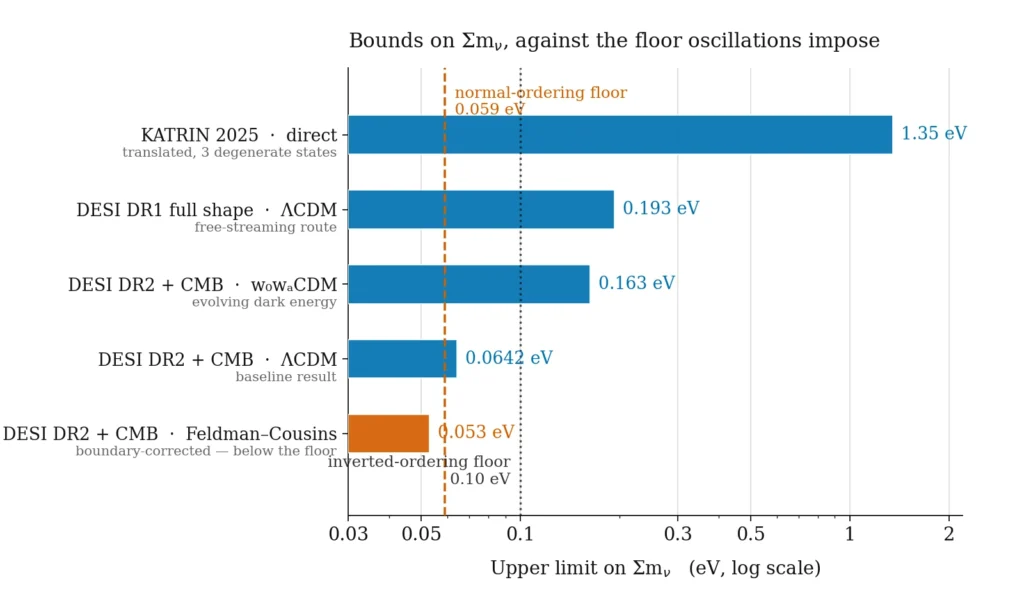
The most direct number comes from KATRIN, a 70-metre spectrometer in Karlsruhe that measures the energy of electrons emitted in tritium beta decay. A neutrino carries off some of each decay’s energy, so the exact shape of the electron spectrum near its endpoint encodes the neutrino’s mass. In April 2025 the collaboration published in Science an upper limit of mβ < 0.45 eV at 90% confidence, drawn from 36 million electrons collected over 259 measuring days in 2019–2021. A halved background and reduced systematics made it a factor of almost two better than KATRIN’s own 2022 bound.
That figure is the weakest in the field — an order of magnitude looser than the cosmological bounds below — and its weakness is exactly the point. Cosmological limits are tighter but rest on a model of the universe; KATRIN’s rests only on kinematics. If the two ever conflict irreconcilably, the laboratory number is the one that survives. It is the anchor the rest of the picture is measured against.
The published dataset is roughly a quarter of what the experiment will ultimately collect. KATRIN’s projected final sensitivity is better than 0.3 eV, and beta scanning passed 1,000 days at the end of 2025. From 2026 the beamline is being rebuilt around a new detector, TRISTAN, to scan the full spectrum for keV-scale sterile neutrinos rather than to push the mass limit further. The same tritium data already produced the field’s strongest laboratory constraints on eV-scale sterile neutrinos, excluding most of the reactor and gallium anomaly parameter space and ruling out the Neutrino-4 claim.
What this rests on
A peer-reviewed measurement with a published systematic budget. The 0.45 eV figure is a limit, not a detection — KATRIN’s best fit for the mass-squared is consistent with zero. Even at its final sensitivity, no direct experiment now running can reach the ~0.05 eV region where the answer actually lives.
Precision arrived; the ordering did not
Oscillation experiments cannot see the absolute mass scale, but they fix the gaps between the three mass states with extraordinary precision — and from those gaps comes a hard minimum for the sum. Two results a year apart sharpened that precision without resolving its central ambiguity.
The first is JUNO, a 20,000-tonne liquid-scintillator detector 700 metres under Guangdong, which published its first physics result in Nature on 10 June 2026. From just 59.1 days of data taken in autumn 2025, it reports sin²θ₁₂ = 0.3092 ± 0.0087 and Δm²₂₁ = (7.50 ± 0.12) × 10⁻⁵ eV², improving on the combination of every previous measurement of those two parameters by a factor of 1.6. The collaboration frames this as validation of the detector and readiness to attack the mass ordering with a larger dataset — not as an ordering measurement itself.
The second is a first joint analysis from NOvA and T2K, the two operating long-baseline accelerator experiments, published in Nature in October 2025. Combining ten years of T2K data with six of NOvA, and exploiting their different baselines and beam energies to break degeneracies neither can break alone, they pin the atmospheric splitting to Δm²₃₂ = 2.43 +0.04−0.03 × 10⁻³ eV² in the normal ordering — an uncertainty below 2%.
What the joint data do not do is choose a mass ordering. The two great unknowns are entangled: the same asymmetry between how neutrinos and antineutrinos oscillate can be produced either by the ordering or by a violation of charge-parity symmetry. The collaborations put it conditionally — if the ordering turns out to be inverted, their result would already constitute evidence of CP violation in the lepton sector; if it is normal, the CP picture stays murky and needs more data. Both statements are theirs, not an inference laid on top.
The floor
The measured splittings set a minimum for the summed mass that no experiment can undercut: Σmν ≥ 0.059 eV if the ordering is normal, ≥ 0.10 eV if it is inverted. This floor is not a bound to be improved on — it is a fixed consequence of the gaps. It is also the number cosmology is about to fall below.
The sky’s answer is too small
Massive neutrinos stream out of the early universe and smooth away some of the structure that would otherwise form, so a large galaxy survey combined with the cosmic microwave background can weigh them collectively. The tightest such measurement is DESI’s DR2 analysis, published in Physical Review D in October 2025. Assuming the standard ΛCDM cosmology and three near-equal masses, it finds Σmν < 0.0642 eV at 95% confidence, together with an effective number of neutrino species consistent with the Standard Model.
Set that against the floor. The normal-ordering minimum is 0.059 eV; the DESI bound sits almost exactly on top of it, and comfortably below the 0.10 eV inverted minimum — which the data therefore already disfavour. Then the pressure increases. When the collaboration corrects for the physical boundary at zero mass using the Feldman–Cousins construction, the 95% upper limit falls to 0.053 eV, beneath the normal-ordering floor. Allowing an effective mass parameter that is permitted to go negative, DESI reports a 3σ tension with the oscillation minimum. The paper’s own reading is deliberately cautious: in the absence of unknown systematics, the finding could be interpreted as a hint of new physics not necessarily related to neutrinos.
“Negative neutrino mass” is a diagnostic, not a claim
The phrase that has attached itself to this result — a cosmological preference for negative neutrino mass — is not a claim that masses are negative. Mass cannot be negative; the preference is a diagnostic, a sign that the data want something the ΛCDM model with positive neutrinos cannot give them. The question is what.
Green and Meyers traced it to its source. The preference is driven by larger-than-expected gravitational lensing of the microwave background, visible in both the two-point and four-point lensing statistics, and it is robust to swapping the survey and optical-depth likelihoods in and out. Their conclusion is that it is likely to persist as more data arrive. In other words, the effect is real and stable in the data — but it lives in the lensing, not obviously in the neutrinos.
Here the measurement and its interpretation part ways, and it is worth keeping them apart. The measurement is solid: the bound is 0.0642 eV, the tension with the floor is 3σ, and both survive scrutiny. The interpretation is wide open, with at least three live readings. It could be the first genuine crack in the standard cosmological model. It could be a sign that dark energy evolves rather than staying constant — DESI’s own w₀wₐCDM fit, which allows exactly that, relaxes the neutrino bound by a factor of 2.5, and if evolving dark energy is confirmed the neutrino tension was never a neutrino problem and the tightest number in this story quietly loses that factor of two and a half. Or it could be an unmodelled systematic in how the lensing of the microwave sky is measured. None of the three is established.
Measurement versus interpretation
The 3σ tension is a measured fact and is reported by DESI itself. What it means — new physics, evolving dark energy, or a lensing systematic — is not settled, and the collaboration does not claim it is. Treat the number as firm and the explanation as open; the two are often quoted as if they were the same, and they are not.
And still, nobody knows if it is its own antiparticle
The third original question is untouched by any of this. Whether the neutrino is a Majorana particle — identical to its own antiparticle — can be settled by one observation: neutrinoless double-beta decay, a nuclear transition that can occur only if it is. KamLAND-Zen has looked hardest. Its complete dataset, an exposure of 2.1 tonne-years of xenon, contains zero such events, setting a lower limit on the decay half-life of 3.8 × 10²⁶ years and constraining the effective Majorana mass to below roughly 28 to 122 meV — the spread reflecting, once again, nuclear matrix elements uncertain by a factor of four. LEGEND-200’s first germanium results, published in Physical Review Letters in January 2026, add to the pressure from a different isotope. No detection means the question stays exactly where it was: open.
What we actually know
The near-term ceiling on the laboratory side is already visible. KATRIN’s final dataset will land below 0.3 eV, and no direct experiment now running can reach the ~0.05 eV region where the true value almost certainly lies. Closing that gap needs the next generation — atomic tritium sources and new detection techniques for the kinematic mass, and LEGEND-1000 and KamLAND2-Zen for the Majorana question.
Until then, the honest summary is short. We know the neutrino’s mass to within about a factor of ten. We do not know its absolute value, its ordering, or whether it is its own antiparticle. And the two most precise statements we can make about it are in tension with each other — a tension that is either the first crack in the standard model of cosmology, a signature of evolving dark energy, or a systematic in the lensing of the microwave sky. It is not yet, with certainty, any of them. That is where the field stands, and it is a more interesting place to stand than it was eighteen months ago.
References
- KATRIN Collaboration, Direct neutrino-mass measurement based on 259 days of KATRIN data, Science 388, 180–185 (2025); DOI 10.1126/science.adq9592 — the 0.45 eV limit.
- KATRIN Collaboration, Sterile-neutrino search based on 259 days of KATRIN data, Nature (2025); PMC 12675297 — Neutrino-4 exclusion, TRISTAN plans.
- KATRIN Collaboration, Input to the European Strategy for Particle Physics update (2025) — sub-300 meV final sensitivity.
- JUNO Collaboration, Measurement of reactor neutrino oscillation with the first JUNO data, Nature (10 June 2026); DOI 10.1038/s41586-026-10538-z — first JUNO physics result, sin²θ₁₂ and Δm²₂₁.
- NOvA and T2K Collaborations, Joint neutrino oscillation analysis from the T2K and NOvA experiments, Nature 646, 818–824 (22 Oct 2025); DOI 10.1038/s41586-025-09599-3 — Δm²₃₂, δCP, mass ordering.
- W. Elbers et al. (DESI Collaboration), Constraints on neutrino physics from DESI DR2 BAO and DR1 full shape, Phys. Rev. D 112, 083513 (6 Oct 2025); DOI 10.1103/PhysRevD.112.083513 — all cosmological limits and the 3σ tension.
- DESI Collaboration, DESI 2024 VII: cosmological constraints from full-shape modelling — the 0.059 / 0.10 eV oscillation floors.
- D. Green and J. Meyers, Cosmological preference for a negative neutrino mass, Phys. Rev. D 111, 083507 (2025); DOI 10.1103/PhysRevD.111.083507 — lensing origin of the preference.
- P. W. Graham, D. Green and J. Meyers, New interpretations of the cosmological preference for a negative neutrino mass, Phys. Rev. D 113, 043514 (2026); arXiv:2508.20999 — single-change resolutions and their signatures.
- KamLAND-Zen Collaboration, Search for Majorana neutrinos with the complete KamLAND-Zen dataset, Phys. Rev. Lett. 135, 262501 (2025); arXiv:2406.11438 — half-life limit and mββ range.
- LEGEND Collaboration, First results from LEGEND-200 on the search for neutrinoless double-beta decay, Phys. Rev. Lett. 136, 022701 (2026); DOI 10.1103/PhysRevLett.136.022701 — germanium limits and background index.
Note on sourcing
Every figure in this article traces to a peer-reviewed paper in Science, Nature, or Physical Review, or to a collaboration’s own communication. Laboratory limits are quoted at 90% confidence and cosmological limits at 95%, as published. The 3σ tension is reported by DESI; its interpretation is contested in the current literature and is presented here as open.
3 responses