
Six antineutrinos a day, measured from a reactor that had been switched off for weeks
A pressurised water reactor that has been offline for three weeks still sends about six antineutrino events a day into a detector 400 metres away. Double Chooz has measured that number for the first time, and the interesting part is not the signal but the prediction it was checked against.

A pressurised water reactor that has been shut down for three weeks still delivers about six antineutrino events per day to a detector 400 metres away. The Double Chooz collaboration has now measured that number for the first time. The result is not that the signal exists, which nobody doubted. It is that a calculation built from nuclear data libraries and beta-decay theory predicted the signal correctly before anyone looked.
What was measured
The Chooz B plant in the French Ardennes runs two 4.25 GWth reactors. In 2017 both were offline simultaneously during four separate periods, totalling 24.4 days. After muon-veto dead time, that left 17.2 days of live data in the near detector at 400 m and 22.2 days in the far detector at 1.05 km.
In the 1 to 3 MeV window, where the residual signal is expected to concentrate, the near detector recorded 106 ± 18 antineutrino candidates after background subtraction. That is a 5.9σ excess over background. The prediction was 88 ± 7 events. The difference is 18 ± 19, which is consistent with zero at just under one standard deviation.
Expressed as a daily rate, the near detector saw 6.2 ± 1.1 events per day against a predicted 5.1 ± 0.4. The far detector saw a smaller excess of 27 ± 13 events against a predicted 14 ± 1, the larger baseline suppressing both rate and significance. Above 3 MeV neither detector saw anything: the near-detector yield there is −2.3 ± 1.5 per day, consistent with zero, which is itself a check that the background model is not inventing signal.
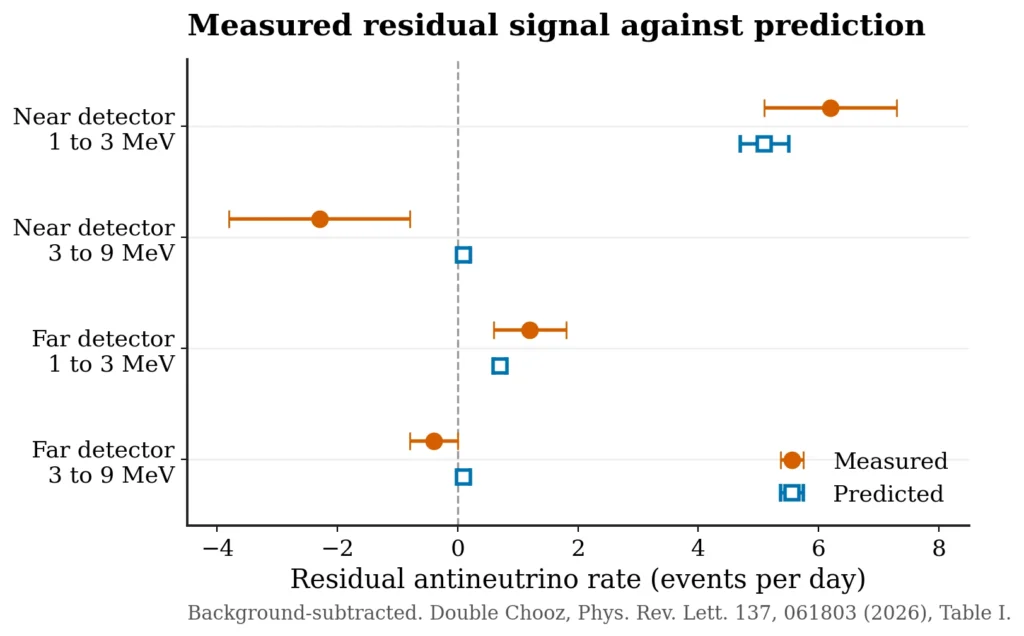
Measurement and prediction
The 106 ± 18 events are measured. The 88 ± 7 is not: it comes from simulating the fuel inventory of every assembly in both cores and both storage pools, then folding predicted fission-product activities through a library of beta-decay spectra. The agreement is a statement about the model as much as about the reactor.
Only three decay chains survive the threshold
Detection uses inverse beta decay, in which an antineutrino converts a proton into a neutron and a positron. The reaction has a 1.8 MeV threshold. Thousands of fission-product beta decays are happening inside cooling fuel at any moment, and almost all of them fall below that line and are invisible.
Some months after shutdown, three chains do essentially all the work. Each pairs a long-lived parent, which sets the clock, with a short-lived daughter, which emits the antineutrino energetic enough to be seen.
| Parent (sets the clock) | Daughter (emits) | Daughter half-life | Endpoint |
|---|---|---|---|
| 144Ce, 285 d | 144Pr | 17.3 min | 3.00 MeV |
| 106Ru, 372 d | 106Rh | 30.1 s | 3.54 MeV |
| 90Sr, 28.9 y | 90Y | 3.19 h | 2.28 MeV |
Within the 1 to 3 MeV measurement window, 144Pr supplies roughly 54% of the flux and 106Rh roughly 38%. The predicted spectrum extends to about 4.5 MeV, but 98.7% of it sits below 3 MeV. On timescales beyond ten years, when the cerium and ruthenium have decayed away, 90Y alone accounts for more than 90% of what remains.
The signal fades fast and softens as it goes. For a single assembly irradiated to 45 GWd/t, the mean inverse-beta-decay cross-section per fission drops by one order of magnitude about ten minutes after shutdown, by two orders after roughly fifteen hours, and by three orders after about 2.5 years. Over the same span the mean antineutrino energy falls from about 4.2 MeV to 3.2 MeV and then to 2.7 MeV.
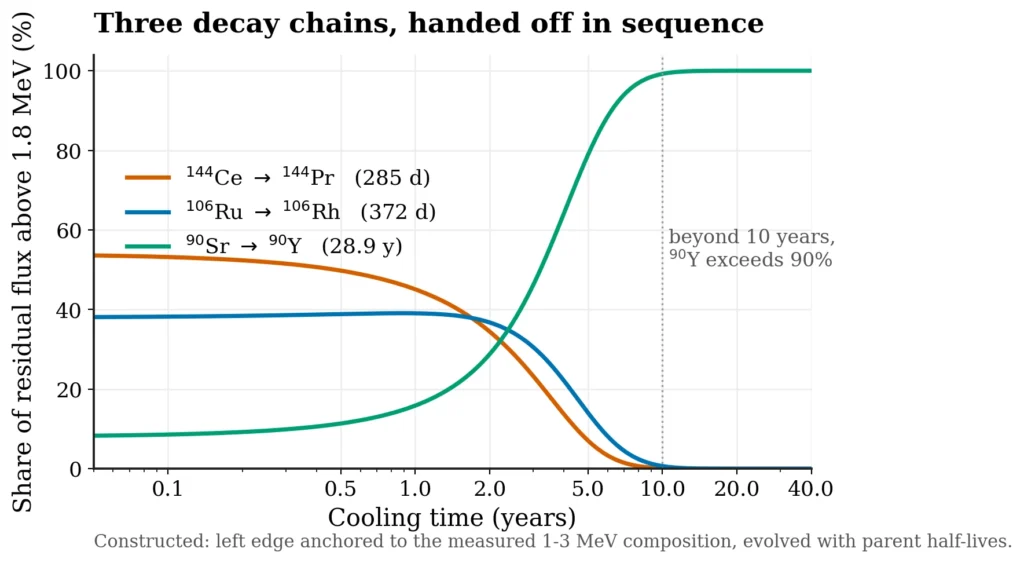
The prediction rests on one awkward transition
Building the prediction takes two stages. Fission-product activities come from the APOLLO-2.8.4 and DARWIN-3 codes running on the JEFF-3.1.1 nuclear data library, simulating each assembly’s individual irradiation history, including cooling gaps between cycles and time already spent in the pool. Those activities are then coupled to the BESTIOLE spectral library, which sums individual beta branches using Fermi theory with electromagnetic corrections, finite nuclear size, atomic screening, and shape factors.
The shape factors are where the difficulty concentrates. 144Pr, the single largest contributor below 3 MeV, decays through a first-forbidden non-unique transition. Its spectrum shape cannot be taken from the standard allowed-decay formula and has to come from explicit nuclear-structure calculation.
The uncertainty budget makes the point plainly. Total normalisation uncertainty on the predicted signal is 7.4%, and 6.0% of that is antineutrino spectrum modelling, driven primarily by nuclear-structure uncertainty in the 144Pr forbidden transition. The collaboration set its 1σ band conservatively: the difference between the shape factor from the detailed nuclear-structure calculation and the one you get from the simplified ξ-approximation, which pretends the transition is allowed. Everything else is smaller. Baseline geometry contributes 2.9%, the simulated fission-product inventory 2.1%, uncertainty in how many assemblies are actually in the pools 2.0%, and all detector systematics together less than 0.8%.
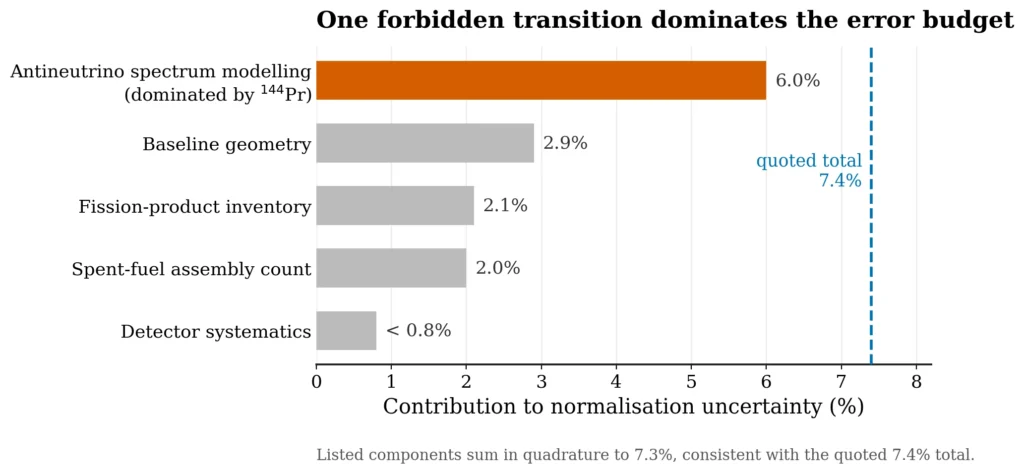
Why this is the interesting part
Reactor antineutrino spectra have a poor track record of being predicted correctly, and forbidden transitions have sat near the centre of that argument for over a decade. The residual flux is a rare clean case: three chains, independently known yields and half-lives, no fission-fraction ambiguity. Getting it right is a test of the beta-decay machinery, not just of the reactor model.
Cores and pools contribute on different clocks
Integrated over energy, the prediction splits 56% from the two reactor cores and 44% from the two spent-fuel pools, which sit in an adjacent building about 38 m away. The two sources behave differently in time. Burnt assemblies still in the core dominate the first tens of hours after shutdown, when short-lived isotopes are still active. The pools contribute a slower, longer component, because they hold assemblies removed across many fuel cycles with a broad spread of cooling times.
One detail shows how directly the model tracks plant operations. The B1 pool contributes less than the B2 pool, because the longest of the four reactor-off periods coincided with B2’s refuelling. A fresh batch of spent assemblies went into that pool during the measurement, and the prediction has it.
For scale: each core holds 205 assemblies of roughly 600 kg of enriched uranium dioxide. A refuelling shutdown lasts six to eight weeks and moves about a third of them out. An assembly goes through three irradiation cycles and reaches roughly 45 GWd/t of burnup before removal, then cools in the pool for several years before leaving the site.
Why this could only be done at Chooz
A reactor-off measurement requires the reactors to be off. Chooz B has exactly two cores, and their refuelling schedules occasionally overlap. At Daya Bay and RENO, which have more cores feeding their detectors, simultaneous shutdowns never occurred. The two-core layout that made Double Chooz’s oscillation analysis possible is the same feature that made this measurement possible.
It also needed enough exposure. A first attempt using 7.5 days of 2011 and 2012 reactor-off data, far detector only, yielded around 20 candidates. That was sufficient to validate the background model for the oscillation analysis and nothing more. The 2017 dataset with the near detector running is what changed the arithmetic.
The size of the effect is worth stating directly. At full power the near detector recorded roughly 900 inverse-beta-decay events per day. The residual signal is 6.2 per day, well under 1% of nominal. Extracting it required background rates known to a few percent: in the 1 to 9 MeV range the near detector saw 30.0 ± 1.4 events per day total against an estimated background of 26.2 ± 1.4. Oscillation still matters even at 400 m, and the prediction applies a mean survival probability of 0.978 ± 0.003 there, against 0.909 ± 0.012 at the far detector.
What it means for safeguards, stated carefully
Using antineutrinos to watch reactors is an old idea. Borovoi and Mikaelyan proposed it in 1978 and it was first implemented at the ROVNO station in 1985. The appeal for IAEA safeguards is that the emission cannot be altered or shielded and is tied directly to what the fuel is doing. Nearly all of that work has concerned operating reactors, where the flux is a hundred times larger.
Two applications have been repeatedly discussed and never quantitatively tested against reactor-off data: verifying spent-fuel inventory, and estimating residual power in a core that is shut down or has suffered an incident. Spent fuel is the harder safeguards problem, because once assemblies leave the core, continuity of knowledge depends on seals, cameras and inspection visits, all procedural rather than physical. This measurement is the first quantitative check that the underlying signal behaves as calculated.
What is not demonstrated
The collaboration calls this a proof of principle, and the wording is exact. Reaching 5.9σ took 17 days of a two-core plant being fully offline, a 10.3 m³ gadolinium-loaded target under 115 metres water equivalent of rock, and 400 m of standoff. No isotope ratio was extracted, no pool inventory was independently determined, and the far detector result rests on 27 ± 13 events. The gap between this and a deployable safeguards instrument is large and the paper does not pretend otherwise.
Where it connects
Residual emission from spent fuel is also a background for anyone trying to measure something else in the same energy range. Antineutrinos from cooling fuel are indistinguishable event by event from geoneutrinos, the signal from uranium and thorium decay in the Earth’s crust and mantle whose spectrum ends near 3.3 MeV, and can only be separated by spectral fitting. Published estimates put the spent-fuel contribution at a percent or a few percent of the low-energy reactor spectrum at sites such as Chooz and Daya Bay, and geoneutrino projections for large detectors already apply corrections for it. Until now those corrections rested on calculation alone.
Other experiments are moving into the same territory. JUNO-TAO presented first reactor-off results at Neutrino 2026. Double Chooz now supplies the published benchmark those measurements can be compared against.
References
- Double Chooz Collaboration, First Measurement of Neutrino Emissions from Spent Nuclear Fuel by the Double Chooz Experiment, Phys. Rev. Lett. 137, 061803 (2026); preprint arXiv:2510.04869
- L. Périssé et al., BESTIOLE beta-spectrum library, Phys. Rev. C 108, 055501 (2023)
- H. de Kerret et al. (Double Chooz), θ13 measurement, Nature Physics 16, 558 (2020); arXiv:1901.09445
- Y. Abe et al. (Double Chooz), earlier reactor-off background validation, Phys. Rev. D 87, 011102 (2013)
- A. Borovoi and L. Mikaelyan, Sov. Atom. Energ. 44 (1978); A. I. Afonin et al., ROVNO, JETP Lett. 41, 435 (1985)
- P. Vogel and J. F. Beacom, inverse beta decay cross section, Phys. Rev. D 60, 053003 (1999)
Note on sourcing
All event counts, rates, uncertainty figures, isotope parameters and simulation details are taken from the Double Chooz paper and its preprint. The geoneutrino background discussion draws on the wider reactor-antineutrino literature and is not a claim made by this paper. The safeguards applications described are stated by the collaboration as prospects, not as demonstrated capability.
1 response