
A particle made of nothing but force
Gluons pull on each other, so they should be able to bind into a particle with no quarks at all. BESIII says X(2370) is dominated by one. The measurements are strong; the confirmation headlines are early.

Physicists have spent nearly fifty years looking for a particle made of nothing but force. On 5 August 2026, the BESIII collaboration told a conference hall in Natal, Brazil, that it had assembled the strongest case yet. The claim is narrower than the headlines that followed it, and the narrow version is the more interesting one.
What a glueball is
Every particle you have heard of contains matter. Protons and neutrons are built from quarks. Gluons are what hold those quarks together, the way photons carry the electromagnetic force between charged particles. But gluons differ from photons in one decisive way: they carry the strong force’s own charge, so they pull on each other. Photons pass through each other without noticing.
That self-attraction means gluons should be able to bind into a particle on their own, with no quarks at all. Quantum chromodynamics, the theory of the strong force, has predicted these glueballs since the 1970s. Nothing else in nature is made purely of force carriers. Finding one is a direct test of the mathematical structure the theory is built on.
Fifteen years of narrowing
The candidate is called X(2370), and it turns up in the decays of the J/ψ particle. J/ψ decays produce a gluon-rich environment, which makes them the natural hunting ground. BESIII, at the Beijing Electron Positron Collider, first spotted X(2370) in 2011.
Mass alone proves nothing, because ordinary quark-antiquark particles also exist in that region. So the collaboration went looking for properties that a glueball would have and a conventional meson would not. In 2024, using a sample of ten billion J/ψ events, it measured the particle’s spin and parity as 0⁻⁺, the values lattice QCD predicts for the lightest glueball of this type. The mass came out at 2395 MeV/c², with a statistical uncertainty of 11 MeV and a systematic uncertainty running from 26 MeV above to 94 MeV below.
The decisive test came this year. Gluons carry no flavour, so a particle made of them should treat strange quarks no differently from up or down quarks. That predicts a specific decay, X(2370) into K*(892) and a kaon, should be strongly suppressed. BESIII looked and found nothing, setting an upper limit of 2.7 in a million at 90% confidence. On that basis X(2370) becomes the first flavour-singlet light hadron ever identified above 1 GeV/c².
What was actually claimed
BESIII’s stated conclusion is that a pseudoscalar glueball is the dominant constituent of X(2370), because no other interpretation explains all its measured properties at once. That is an argument from best available explanation. It is not a direct observation of a pure gluonic bound state, and the collaboration does not claim it is.
Where the agreement is looser than it sounds
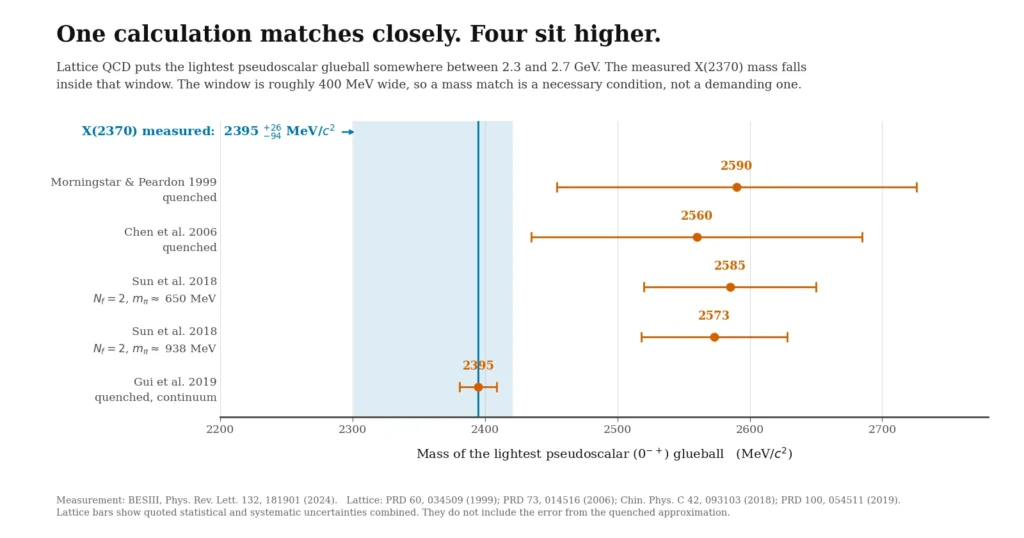
Coverage of the result has described the measured mass as matching theory precisely, citing a lattice calculation of 2.395 GeV with an uncertainty of 14 MeV. That calculation is real. It is also one result among several, and it sits at the low edge of the range.
Three other lattice determinations put the pseudoscalar glueball nearer 2.56 to 2.59 GeV. Taken together, the literature predicts somewhere between 2.3 and 2.7 GeV. X(2370) falls comfortably inside that window, which is a necessary condition rather than a demanding one. A 400 MeV target is not a precision match.
The problem nobody put in the headlines
X(2370) is produced far more often than a pure glueball should be. Lattice QCD predicts that J/ψ decays should yield one about 2.3 times in every ten thousand. The observed rate is higher.
The proposed fix is that X(2370) is not quite pure. If it mixes slightly with charmonium, the quark-antiquark state that sits nearby in mass, its production rate rises sharply, because the lighter particle gets a large kinematic advantage. The mixing needed is small. How small is unsettled: current estimates of the mixing angle disagree by roughly a factor of ten, ranging from about one degree to about eleven.
What would settle it
A mixing angle that different methods agree on, which would fix the glueball fraction as a number rather than a description. Confirmation from a second experiment, since every measurement so far comes from one detector. And the two other predicted glueballs, the scalar and the tensor, which remain unidentified.
None of that diminishes what BESIII has done. Fifteen years of narrowing has taken a bump in a spectrum and turned it into a state with measured quantum numbers, measured decay modes, and a measured flavour structure that conventional explanations struggle to reproduce. The honest summary is that the glueball interpretation is now the one to beat, and that it has not yet been confirmed.
References
- BESIII Collaboration, first observation of X(2370), Phys. Rev. Lett. 106, 072002 (2011)
- BESIII Collaboration, Determination of Spin-Parity Quantum Numbers of X(2370) as 0⁻⁺, Phys. Rev. Lett. 132, 181901 (2024); preprint arXiv:2312.05324
- BESIII Collaboration, Lightest 0⁻⁺ Glueball as Dominant Constituent of X(2370), preprint arXiv:2607.20366 (2026)
- L.-C. Gui, J.-M. Dong, Y. Chen, Y.-B. Yang, Study of the pseudoscalar glueball in J/ψ radiative decays, Phys. Rev. D 100, 054511 (2019)
- C. Morningstar & M. Peardon, Phys. Rev. D 60, 034509 (1999); Y. Chen et al., Phys. Rev. D 73, 014516 (2006); W. Sun et al., Chin. Phys. C 42, 093103 (2018) — lattice glueball spectrum
- Y. Chen, L.-C. Gui, G. Li, W. Sun, Production Rate of Glueball-like X(2370) in J/ψ Radiative Decay, preprint arXiv:2605.01757 (2026)
Note on sourcing
The spin-parity measurement is peer reviewed. The 2026 flavour-singlet result and the production-rate analysis are preprints at the time of writing. Lattice figures are theoretical calculations, and the quoted spread reflects genuine disagreement between methods rather than a single consensus value.
Responses