
What Is a Qubit?
A qubit is not a bit that is somehow both 0 and 1 at once. That line points at the wrong mechanism. A qubit's state is a pair of complex numbers called amplitudes, and amplitudes can cancel each other out the way ripples on water do. That cancellation, not parallel search, is where quantum computation gets its power. This piece covers what a qubit actually is, why measuring it destroys almost everything you could have known, and what the current best fidelity numbers across superconducting, trapped-ion and neutral-atom hardware actually mean for whether any of it works yet.
Cite this article
Quantum Nature (2026). What Is a Qubit?. Quantum Nature. https://quantum-nature.com/what-is-a-qubit/
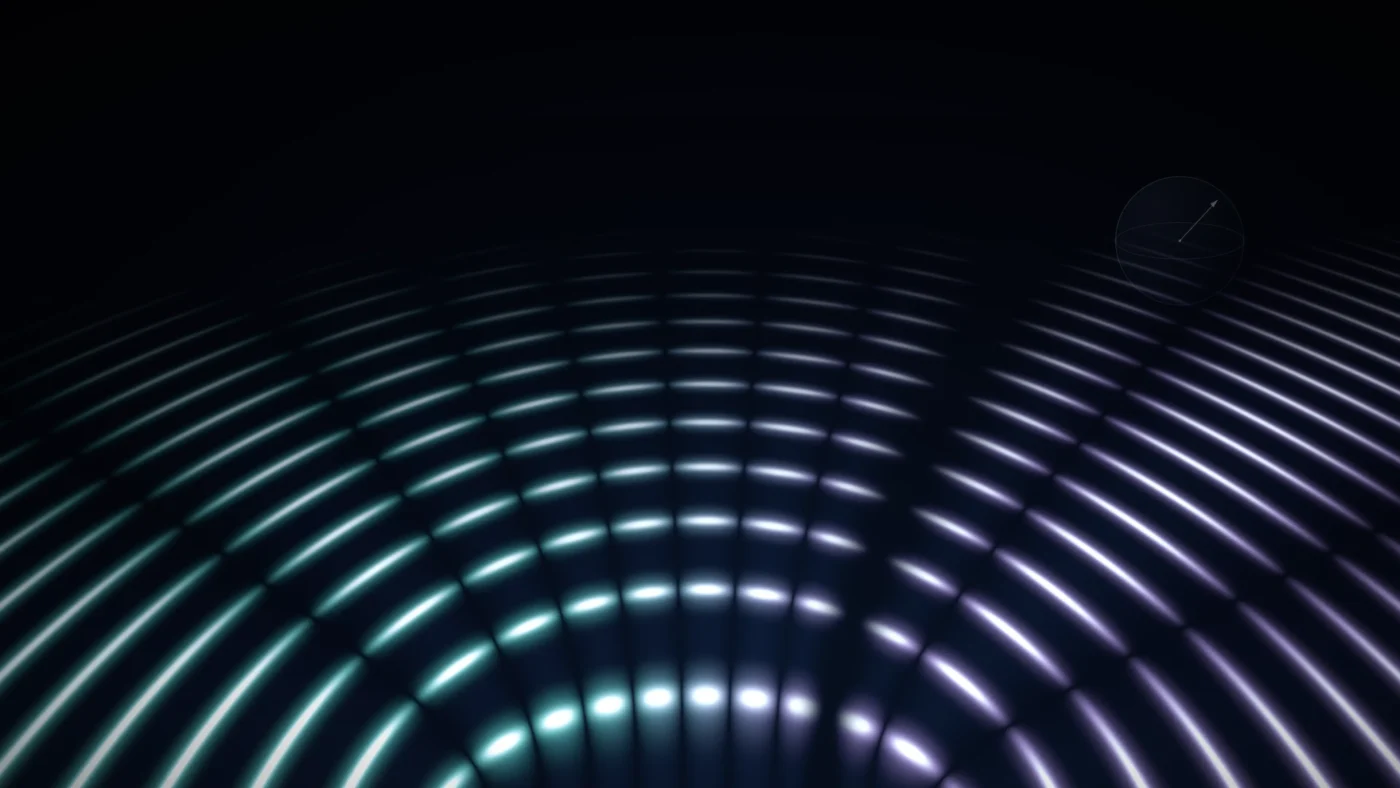
Inside a working quantum computer, the object doing the computing is often a loop of superconducting wire smaller than a grain of rice, chilled to a hundredth of a degree above absolute zero, colder than deep space. Elsewhere it is a single atom, held still in a trap of laser light. These are qubits, and the whole promise of the field rests on one strange fact about them: their state is not a number but a pair of amplitudes, and amplitudes can cancel each other out the way ripples on water do. That cancellation, not some fantasy of holding every answer at once, is where the power comes from.
A qubit is any quantum system with two clean states
The definition is structural, not material. Any quantum system with two reliably distinguishable states can serve as a qubit. Physicists have built them from the ground and excited states of a superconducting circuit, two hyperfine levels of a trapped ion, two electron states in a neutral atom, the spin of a single electron in silicon, and the polarisation of a photon.
Three requirements matter. The system must sit isolated enough that the outside world does not disturb it. It must respond to control signals, so an experimenter can steer its state. It must give a readable answer at the end. Nothing else about the physical substrate is fundamental. That is why the field has half a dozen serious hardware platforms rather than one.
The state is a vector, not a value
A classical bit sits at one of two points. A qubit’s state is a vector in a two-dimensional complex space, written as a weighted combination of two basis states, 0 and 1. The weights are complex amplitudes. Their squared sizes must add to 1, and an overall phase carries no physical meaning, so two real parameters survive.
Those two parameters map onto the surface of a sphere, the Bloch sphere. State 0 sits at the north pole and state 1 at the south. Every other point on that surface is a legitimate qubit state, and there are infinitely many of them.
The jump in descriptive cost follows directly. One classical bit needs one binary digit. One qubit needs two real numbers, each carrying infinite precision in principle.
Superposition is a set of amplitudes, not a set of answers
The word superposition invites a wrong picture: a qubit secretly holding both answers, waiting for someone to read it. The useful picture is different. Amplitudes are complex numbers, and complex numbers can subtract.
Probabilities never go negative. Amplitudes do. When two computational paths arrive at the same outcome, their amplitudes add, and they can cancel. Quantum algorithms exploit exactly this. They arrange the amplitudes so that wrong answers interfere destructively and the right answer survives with high probability.
The distinction that matters
Interference is the resource. Superposition is only the substrate it runs on. A quantum computer that could hold superpositions but not interfere them would offer no advantage over a classical machine.
Measurement returns one bit and destroys the rest
Measure a qubit and a single classical outcome comes back. The Born rule sets the probabilities, fixed by the squared size of each amplitude. The state then collapses onto whichever result appeared. The amplitudes are gone.
This constraint kills the parallel-universe reading. A register of many qubits carries an exponentially large number of amplitudes. Reading it yields one classical bit per qubit and nothing more. Holevo’s theorem makes the limit formal: a set of qubits conveys at most as many classical bits as there are qubits, no matter how the state was prepared.
A quantum computer is not a machine with exponential storage. It is a machine with an exponentially large space to route amplitude through, and one narrow exit.
Entanglement is what makes the state space large
Two qubits carry four amplitudes, three carry eight, and the count doubles with every additional qubit. At 300 qubits that count exceeds the number of atoms in the observable universe. That is the number a classical simulation has to track.
The scaling only bites when the qubits entangle. If a two-qubit state factors into a product of two single-qubit states, describing it costs twice one qubit, not four times. Entangled states refuse to factor. Measuring one qubit changes what the other will do, and no description of the parts alone reproduces the correlations.
Entanglement is therefore not a bonus feature. It is the condition under which the state space becomes genuinely large.
Physical qubits come in five main varieties
- Superconducting circuits. A small anharmonic circuit on a chip, cooled to roughly 10 millikelvin. Its two lowest energy levels form the qubit. Gates run in tens of nanoseconds. Google and IBM build these.
- Trapped ions. Two hyperfine levels of an ion held in an electromagnetic trap. Lasers or microwaves drive the gates, which take microseconds to milliseconds. Quantinuum and IonQ build these.
- Neutral atoms. Individual atoms held in optical tweezers, tightly focused laser beams that grip one atom each. Entanglement comes from driving atoms into bloated Rydberg states so they interact. QuEra and Pasqal build these.
- Spin qubits in silicon. The spin of a single electron confined in a quantum dot. Very small, and compatible with existing semiconductor fabrication.
- Photonic qubits. Information stored in the polarisation or path of single photons. They barely decohere, but making two photons interact is hard.
Coherence sets the clock
Coherence is how long a qubit keeps its state before the environment scrambles it. Two numbers describe it. T1 measures energy relaxation, the decay from the excited state down to the ground state. T2 measures dephasing, the loss of the relative phase between the two amplitudes. T2 usually binds first. The underlying mechanism, the environment quietly measuring the qubit, is quantum decoherence.
The spread across platforms is enormous. Superconducting transmons reach T1 values in the hundreds of microseconds. Trapped ions do far better. A single ytterbium-171 ion showed a coherence time near 5,500 seconds, roughly an hour and a half, after the group suppressed magnetic field fluctuations and reference-oscillator noise.
Raw coherence is not the whole story. What matters is how many gate operations fit inside it. Superconducting gates run about a thousand times faster than ion gates, which closes much of the apparent gap.
Fidelity is the number that decides everything
Gate fidelity, not qubit count, determines whether a machine can run anything useful. The current single-qubit record belongs to David Lucas’s group at Oxford: an error rate of about one and a half in ten million, on a single trapped calcium ion steered by microwaves at room temperature, no dilution refrigerator in sight.
Two-qubit gates are the harder problem, and the record keeps moving. Quantinuum reports 99.921 percent two-qubit fidelity on the 98 trapped-ion qubits of its Helios system. Google’s Willow processor averages around 99.9 percent on superconducting hardware. A separate trapped-ion demonstration in October 2025 pushed further still, reporting an error of roughly 8 in 100,000, better than 99.99 percent fidelity, using a new gate technique that works even without cooling the ions to their motional ground state. That result is a preprint and has not yet completed peer review.
That gap still matters, even at these improved numbers. A useful algorithm needs billions of operations, and even today’s best fidelities accumulate enough errors over that length to fail. Adding more qubits does not fix this on its own.
A logical qubit is many physical qubits behaving as one
The fix is error correction. Spread one unit of quantum information across many physical qubits, then run repeated parity checks that catch errors without ever reading the encoded data. The result is a logical qubit: slower, far more expensive, and much more reliable than any of its parts. We cover this in depth in how quantum error correction works.
The precondition is the threshold. Physical error rates must already sit below a critical value, or extra qubits add more noise than the code removes. Google’s Willow processor crossed that line, with logical error falling by a consistent factor for every two-step increase in code size.
Reading a qubit count
Every serious roadmap is now denominated in logical qubits, not physical ones. When a company quotes a qubit count, the first question is which kind. The second is what error rate those qubits sustain. We unpack why the two counts are not comparable in logical qubits explained.
What is still unresolved
No platform has won. Superconducting circuits are fast but hold coherence briefly. Trapped ions are accurate but slow. Neutral atoms scale well but arrived later. Each one has a plausible path and an unproven scaling story.
Two-qubit fidelity is the hard constraint, and progress on it has run slower than progress on qubit count, even accounting for the October 2025 record. Whether any architecture can hold high fidelity while growing to thousands of qubits remains the open question the whole field turns on.
Note on sourcing
The formalism in this piece is textbook material and traces to standard quantum computing references. The coherence and fidelity records trace to peer-reviewed papers, with one exception: the October 2025 two-qubit gate result is a preprint and has not yet passed peer review, which the text states plainly. The Quantinuum figures come from company disclosures rather than the peer-reviewed literature. Platform descriptions reflect hardware in operation as of late 2025 and 2026.
References
- M. A. Nielsen and I. L. Chuang, Quantum Computation and Quantum Information, 10th anniversary edition, Cambridge University Press (2010). Standard reference for the Bloch sphere, the Born rule and the no-cloning theorem
- A. S. Holevo, Bounds for the quantity of information transmitted by a quantum communication channel, Problems of Information Transmission 9, 177 (1973)
- P. Wang et al., Single ion qubit with estimated coherence time exceeding one hour, Nature Communications 12, 233 (2021) doi:10.1038/s41467-020-20330-w
- M. C. Smith, A. D. Leu, K. Miyanishi, M. F. Gely and D. M. Lucas, Single-qubit gates with errors at the 10 to the minus 7 level, Physical Review Letters 134, 230601 (2025) doi:10.1103/42w2-6ccy
- A. C. Hughes, R. Srinivas, C. M. Loschnauer et al., Trapped-ion two-qubit gates with greater than 99.99 percent fidelity without ground-state cooling, preprint, October 2025. Not yet peer-reviewed
- Google Quantum AI and Collaborators, Quantum error correction below the surface code threshold, Nature 638, 920 (2025) doi:10.1038/s41586-024-08449-y
- Quantinuum, Helios system specifications, company disclosure, November 2025. Not peer-reviewed
Common questions
What is a qubit, in plain terms?
A quantum system with two clean, distinguishable states, described by two complex numbers called amplitudes rather than a single value of 0 or 1.
Does a qubit really hold 0 and 1 at the same time?
Not in the way that phrase suggests. Its state is a combination of amplitudes, and the useful physics is that those amplitudes can cancel each other out, similar to waves, which is what quantum algorithms actually exploit.
What happens when you measure a qubit?
You get exactly one classical result, 0 or 1, with a probability set by the size of the corresponding amplitude, and the rest of the information in the state is gone.
Why does entanglement matter?
It is the reason the state space of many qubits grows exponentially rather than just adding up, which is what makes a large quantum system hard for a classical computer to simulate.
What actually limits quantum computers today?
Gate fidelity, not qubit count. Even the best two-qubit gates, at roughly 99.99 percent fidelity in the best current demonstration, are not yet reliable enough to run algorithms needing billions of operations without error correction.
What is a logical qubit?
Many physical qubits combined through an error-correcting code so they behave as one much more reliable qubit. Nearly every current hardware roadmap is now stated in terms of logical qubits rather than physical ones.
Which hardware platform is winning?
None yet. Superconducting circuits are fast but short-lived, trapped ions are accurate but slower, and neutral atoms scale well but are newer to the field. Each has an unproven path to large scale.

4 responses