
How Quantum Error Correction Works
You cannot copy a qubit to protect it, and you cannot look at it to check on it, since both acts destroy the information you are trying to save. Quantum error correction solves that impossible-sounding problem by asking qubits whether they agree with each other rather than what value they hold, which turns an infinite space of possible errors into a small, correctable set. This piece covers how that trick works, why Google's Willow chip finally crossed the break-even threshold in 2025, and why a Google collaboration's December 2025 hardware demonstration of magic state cultivation may be the more important, quieter result of the two.
Cite this article
Quantum Nature (2026). How Quantum Error Correction Works. Quantum Nature. https://quantum-nature.com/how-quantum-error-correction-works/
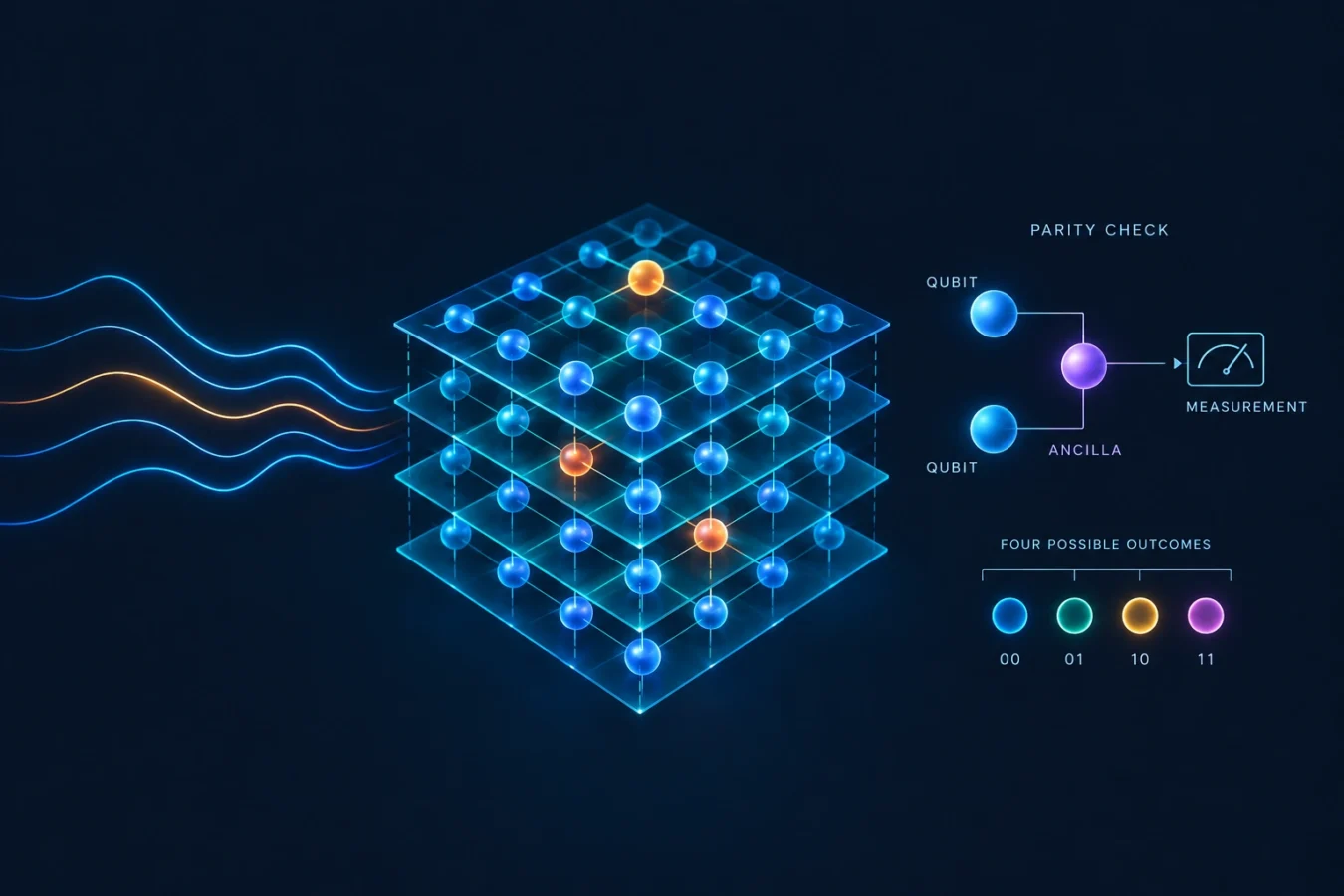
Here is the problem in one sentence. To protect a piece of quantum information you would like to make a backup copy, and to check whether it has been corrupted you would like to look at it. Quantum mechanics forbids both. You cannot copy an unknown quantum state, and looking at one destroys it. For decades this made reliable quantum computing sound not merely hard but impossible in principle. The way out was worked out in the 1990s and finally demonstrated on real hardware in the last two years. It is one of the most ingenious ideas in modern physics: never look at the data at all, and ask the qubits only whether they still agree with each other.
Classical error correction does not transfer
A classical computer corrects errors by copying. Store a bit three times, read all three, take the majority. Three quantum obstacles block that approach outright.
The first is the no-cloning theorem, which Wootters and Zurek proved in 1982. No operation can copy an unknown quantum state. Triple redundancy fails at the first step.
The second is measurement. Reading a qubit to check on it collapses the superposition and destroys the computation you were trying to protect.
The third is that quantum errors are continuous. A classical bit either flips or it does not. A qubit can rotate by any small angle, in any direction. There is an infinite space of possible errors, and a finite code has to handle all of them.
Measure the relationship, never the value
The solution is to ask a question whose answer reveals an error without revealing the data. Take two qubits and ask only whether they agree. That parity is a single classical bit. It says nothing about the underlying state of either qubit, and nothing about the amplitudes.
In hardware, an extra qubit called an ancilla performs the check. The ancilla couples to the data qubits, absorbs the parity information, and then goes to measurement. The data qubits keep their superposition throughout.
Run many such checks across the code and the pattern of results forms a syndrome, a classical fingerprint pointing at where an error struck. The operators these checks evaluate are the code’s stabilisers. Gottesman, Calderbank, Shor and Steane built the whole framework on them in the mid-1990s.
The core idea in one line
Error correction never asks a qubit what value it holds. It asks a group of qubits whether they still agree with each other, and infers the damage from the pattern of disagreements.
Measuring the syndrome makes continuous errors discrete
This step makes the whole enterprise possible, and it is the part most summaries skip. Any error acting on a single qubit, however small the rotation, decomposes mathematically into four basic operations: doing nothing, a bit flip, a phase flip, and both at once.
Measuring the syndrome projects the system onto one of those four cases. A tiny fraction-of-a-degree over-rotation does not remain a tiny over-rotation. The measurement forces it to become either no error at all or a full bit flip, with probabilities set by the size of the original rotation.
A continuum of errors therefore collapses into a finite set. Correct the finite set and you have corrected everything. This result, error discretisation, is the reason analogue noise does not defeat quantum error correction.
The surface code and the price of distance
The surface code dominates the field because it asks so little of the hardware. Qubits sit on a two-dimensional grid. Data qubits hold the encoded information. Measure qubits sit between them and run parity checks on their four nearest neighbours only. It needs no long-range wiring at all.
Half the checks catch bit flips and half catch phase flips. The code distance is the length of the shortest error chain that can corrupt the logical state without tripping a single check. A code of distance d corrects errors up to roughly half that distance, and costs on the order of two times d squared physical qubits.
That scaling is the problem. Distance 3 costs 17 qubits, distance 7 costs 97, distance 25 costs over 1,200. Useful algorithms want logical error rates near one in ten billion from hardware sitting near one in a thousand, which needs distances in the twenties or thirties. Per logical qubit.
The threshold theorem sets the entry price
Error correction only helps if the hardware is already good enough. That is the threshold theorem, proved in the late 1990s by Aharonov and Ben-Or, by Kitaev, and by Knill, Laflamme and Zurek.
Below a critical physical error rate, raising the code distance suppresses logical error exponentially. Above it, the extra qubits and extra gates inject more errors than the code removes, so larger codes perform worse. Under realistic circuit-level noise, the surface code threshold sits near 1 percent.
The experimental figure of merit is called lambda, the factor by which logical error drops when code distance increases by two. A lambda above 1 means below threshold. Its size tells you how many doublings separate today’s hardware from a target error rate.
Willow crossed the threshold
Google’s Willow processor produced the first clean demonstration. Reporting in Nature, the team ran surface code memories on 72-qubit and 105-qubit superconducting chips. Logical error fell by a factor of 2.14 for each two-step increase in distance, reaching 0.143 percent per correction cycle on a 101-qubit distance-7 code. It was one of several results we track in the latest in quantum computing.
The memory also passed break-even, outliving its best individual physical qubit by a factor of 2.4. Real-time decoding held up as well: 63 microseconds of average decoder latency at distance 5, against a 1.1 microsecond cycle time, sustained across a million cycles.
One result in that paper deserves more attention than it received. Running repetition codes out to distance 29, the team found performance limited by rare correlated error events, roughly once an hour, or once every three billion cycles. The leading suspect is cosmic rays: a stray particle from space striking the chip and dumping energy across many qubits at once, an error no local code was built to survive.
Decoding is a real-time classical problem
Every correction cycle emits a syndrome, and classical software has to interpret it quickly. The standard algorithm, minimum-weight perfect matching, treats the syndrome as a graph problem and finds the most likely error consistent with the observations.
Speed is not optional here. If the decoder runs slower than syndromes arrive, the backlog grows without bound and the computation stalls. Surface code cycles take around one microsecond on superconducting hardware, which imposes a hard latency budget on the classical side.
This is why decoder engineering now sits alongside qubit engineering in every serious programme, and why quantum hardware companies have started partnering with GPU vendors.
Protecting a memory is not the same as computing
Everything above protects stored information. Running an algorithm means applying gates to logical qubits, and that is a harder problem.
Some gates come cheap. Transversal gates act on each physical qubit independently, so an error on one qubit cannot spread to its neighbours inside the same block. Many codes offer the everyday, easy-to-simulate gates this way.
Those easy gates alone are not enough. The Gottesman-Knill theorem shows that a classical computer can efficiently simulate any circuit built only from them. Universal computation needs at least one harder gate, usually called the T gate.
The Eastin-Knill theorem then closes the obvious door: no quantum code has a transversal gate set that is universal. Something more expensive is always necessary.
Magic states are where the cost concentrates
The standard workaround prepares a special resource state offline, then consumes it to execute the T gate. These are magic states, and in most resource estimates they dominate the qubit budget of a fault-tolerant machine.
Preparing them cleanly is the hard part. Magic state distillation takes several noisy copies and yields one better copy, discarding the rest. In 2025 a QuEra, Harvard and MIT team ran the first distillation performed entirely on logical qubits, using a five-to-one protocol on small colour codes in a neutral-atom system. That result is peer-reviewed and published in Nature.
A cheaper route exists in theory: magic state cultivation, proposed by Gidney, Shutty and Jones in 2024, grows the state directly inside a small code and skips distillation entirely. That original proposal remains a preprint. Then in December 2025 a large Google Quantum AI collaboration moved it from theory to hardware. They ran cultivation on a superconducting processor and grafted the result into a distance-5 surface code through code-switching. The measured state fidelity reached 99.99 percent, a 40-fold reduction in error compared with simple state injection, while keeping about 8 percent of attempts through post-selection. That hardware result is also still a preprint.
qLDPC codes broke the overhead scaling
The surface code’s overhead is not a design flaw. A 2010 bound proved by Bravyi, Poulin and Terhal shows that any code restricted to two-dimensional nearest-neighbour connectivity must pay roughly this price. Escaping it requires escaping the flat grid.
Quantum low-density parity-check codes do exactly that, permitting a few long-range connections. IBM’s gross code, published in Nature in 2024, encodes 12 logical qubits into 288 physical qubits total, with a threshold around 0.7 percent. Matching that protection with separate surface code patches would take close to 3,000 physical qubits.
The trade is connectivity. The gross code needs a richly connected wiring graph across two layers. That is harder to fabricate than a flat grid, though not out of reach for superconducting chips.
Where the overhead actually stands
Reported ratios have fallen fast, and they need careful reading. Quantinuum’s Helios system, launched in November 2025, produced 48 error-corrected logical qubits from 98 physical qubits, a ratio near two to one. That came from a technique called code concatenation. QuEra reported a comparable ratio on neutral atoms using high-rate qLDPC codes. Why those counts resist head-to-head comparison is the subject of our logical qubits explainer.
How to read an overhead figure
An encoding rate is not a protection level. A ratio near two to one at low code distance does not deliver the error suppression a distance-25 surface code patch delivers. These particular figures also come from company disclosures rather than peer-reviewed papers. The direction of travel is real. The precise multiples are not yet settled.
What is still unresolved
Three problems stand between below-threshold memories and a working fault-tolerant computer.
Correlated errors come first. As the Willow repetition-code data showed, cosmic rays and similar events knock out large regions of a chip at once, roughly once an hour, and no local code handles that.
Decoder scaling comes second. Real-time matching works at distance 7 on about 100 qubits. Nobody has demonstrated it across thousands of logical qubits running a real algorithm.
Logical gate speed comes third. Error-corrected operations run orders of magnitude slower than physical ones, and every magic state consumed adds latency. A machine that corrects errors perfectly but computes slowly may still miss its target applications.
Note on sourcing
The code constructions, threshold results and no-go theorems in this piece all trace to peer-reviewed papers. The Willow, gross code and logical magic state distillation results are peer-reviewed and published in Nature. Magic state cultivation remains a preprint at both stages described here, the original 2024 theoretical proposal and the December 2025 hardware demonstration, and neither has completed peer review as of this writing. The Quantinuum and QuEra overhead ratios come from company disclosures rather than the literature, and this article treats them accordingly.
References
- W. K. Wootters and W. H. Zurek, A single quantum cannot be cloned, Nature 299, 802 (1982) doi:10.1038/299802a0
- P. W. Shor, Scheme for reducing decoherence in quantum computer memory, Physical Review A 52, R2493 (1995) doi:10.1103/PhysRevA.52.R2493
- A. M. Steane, Error correcting codes in quantum theory, Physical Review Letters 77, 793 (1996) doi:10.1103/PhysRevLett.77.793
- A. G. Fowler, M. Mariantoni, J. M. Martinis and A. N. Cleland, Surface codes: towards practical large-scale quantum computation, Physical Review A 86, 032324 (2012). Preprint arXiv:1208.0928
- B. Eastin and E. Knill, Restrictions on transversal encoded quantum gate sets, Physical Review Letters 102, 110502 (2009). Preprint arXiv:0811.4262
- S. Bravyi, D. Poulin and B. Terhal, Tradeoffs for reliable quantum information storage in 2D systems, Physical Review Letters 104, 050503 (2010). Preprint arXiv:0909.5200
- Google Quantum AI and Collaborators, Quantum error correction below the surface code threshold, Nature 638, 920 (2025) doi:10.1038/s41586-024-08449-y
- S. Bravyi, A. W. Cross, J. M. Gambetta, D. Maslov, P. Rall and T. J. Yoder, High-threshold and low-overhead fault-tolerant quantum memory, Nature 627, 778 (2024) doi:10.1038/s41586-024-07107-7
- P. Sales Rodriguez et al., Experimental demonstration of logical magic state distillation, Nature 645, 620 (2025) doi:10.1038/s41586-025-09367-3
- C. Gidney, N. Shutty and C. Jones, Magic state cultivation: growing T states as cheap as CNOT gates, preprint, September 2024. Not peer-reviewed
- E. Rosenfeld, C. Gidney, G. Roberts et al., Magic state cultivation on a superconducting quantum processor, preprint, December 2025. Not peer-reviewed
- Quantinuum, Helios system specifications, company disclosure, November 2025. Not peer-reviewed
Common questions
Why can't quantum computers just copy data to protect it, like classical ones do?
The no-cloning theorem shows no operation can copy an unknown quantum state, and reading a qubit to check it would collapse the superposition being protected. Error correction has to work around both problems at once.
How does quantum error correction actually catch an error without looking at the data?
It uses extra ancilla qubits to measure parity, whether groups of data qubits still agree with each other, which reveals an error's location without revealing what the protected information actually is.
How can this work if quantum errors are continuous rather than simple flips?
Measuring the parity check forces any small rotation error to collapse into one of just four discrete outcomes: no error, a bit flip, a phase flip, or both. That discretisation is what makes a finite code able to correct an infinite range of errors.
What is the surface code and why is it the leading approach?
A grid of qubits where each check only needs to talk to its four nearest neighbours, avoiding long-range wiring. Its downside is that the number of physical qubits needed grows with the square of the desired error suppression.
What did Google's Willow processor actually demonstrate?
That a real device can run below the error-correction threshold, where adding more qubits reduces the logical error rate instead of increasing it, with performance also exceeding the lifetime of the best individual physical qubit.
What is a magic state and why does it matter so much?
A special resource state needed to perform the one type of gate that cannot be done cheaply and safely inside most error-correcting codes. Most estimates of the total cost of a fault-tolerant algorithm are dominated by how many magic states it consumes.
What is magic state cultivation, and has it actually been tested on hardware?
A 2024 proposal to grow high-quality magic states cheaply inside a small code rather than distilling them from many noisy copies. In December 2025 a large Google collaboration ran it on real superconducting hardware, cutting the error rate by a factor of 40, though that result is still a preprint awaiting peer review.

2 responses