
Is the Muon g-2 Anomaly Still an Anomaly?
For twenty years, the muon's magnetism was the most promising crack in the Standard Model: it came out slightly larger than theory predicted, and the gap refused to go away. Then in June 2025 Fermilab delivered its final, most precise measurement, and the theory it was measured against had quietly shifted to meet it. On that comparison the anomaly is gone. But it has not been explained so much as relocated, into a bitter disagreement between two ways of calculating one stubborn quantity. This piece explains what was measured, why the goalposts moved, and why the honest answer to the title question is still "it depends."
Cite this article
Quantum Nature (2026). Is the Muon g-2 Anomaly Still an Anomaly?. Quantum Nature. https://quantum-nature.com/muon-g2-anomaly/
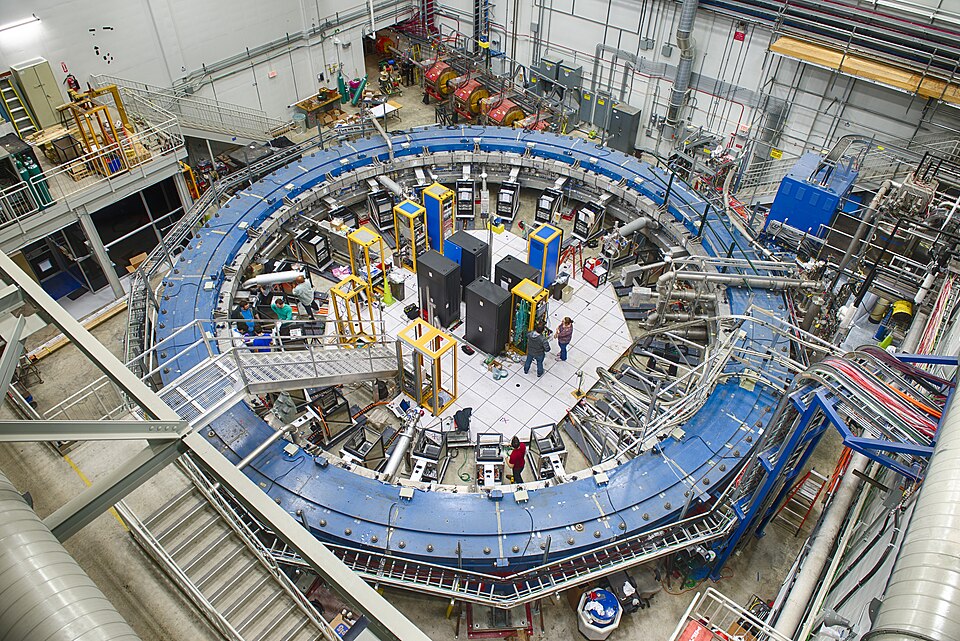
In 2013, workers floated a fifty-foot electromagnet on a barge down the eastern seaboard, hauled it around Florida, and trucked it through the streets of Illinois at night, drawing crowds who had no idea what they were looking at. That magnet was the storage ring for an experiment that held what looked, for two decades, like the most promising crack in the Standard Model. The muon’s magnetism kept coming out slightly larger than theory said it should. In June 2025, after six years of data from that ring, physicists delivered the final, most precise answer yet. The crack did not widen. It appears to have closed, and whether it stays closed now hinges on an argument that has nothing to do with muons at all.
A magnetic moment that should be exactly 2
A spinning charged particle behaves like a tiny magnet. Its magnetic moment is set by a number called g. Paul Dirac’s 1928 equation for a bare electron predicts g = 2 exactly. Real particles are not bare. They sit inside a fog of virtual photons and virtual particle pairs, flickering in and out of existence, and each one nudges g very slightly away from 2. That restless fog is the quantum vacuum.
Physicists track that nudge with the anomaly a = (g − 2)/2. For the muon, a is roughly 0.00116592. The interesting physics lives far out in the decimal expansion, in the ninth and tenth digits. Every virtual particle the Standard Model contains leaves a fingerprint there. So would any particle it does not contain.
Muons make a better probe than electrons for this. A muon is about 207 times heavier. Its sensitivity to heavy new particles scales with mass squared, so the muon is roughly 40,000 times more sensitive to physics beyond the Standard Model than the electron’s magnetic moment.
Two decades of a growing tension
Brookhaven’s E821 experiment measured the muon anomaly in the early 2000s and found a value sitting a few standard deviations above the Standard Model prediction of the time. The tension was suggestive but not conclusive, and it lingered for years. Fermilab then rebuilt the experiment around Brookhaven’s own storage ring. The same fifty-foot magnet travelled 3,200 miles to Illinois, because building a new one would have cost ten times as much.
Fermilab’s Muon g-2 experiment released results in 2021 and 2023. Each confirmed Brookhaven. Each tightened the error bars. By 2023 the combined experimental world average sat more than 5 standard deviations above the 2020 Standard Model value. Five sigma is the field’s conventional threshold for a discovery.
Where the uncertainty actually lives
Nobody disputes the QED and electroweak contributions to the muon anomaly. Both are calculated to extraordinary precision. Every year of controversy has concerned a single piece: the hadronic vacuum polarisation, the contribution from virtual quark-antiquark pairs. It is the hardest term to calculate, and it turned out to be the one that was wrong.
The final measurement: 127 parts per billion
On 3 June 2025 the Muon g-2 Collaboration published its combined result from all six data-taking runs, submitted to Physical Review Letters. The precision reached 127 parts per billion, beating the experiment’s original design goal by ten percent. That is a fourfold improvement on Brookhaven.
The measured value is a = 116,592,070.5 (14.8) × 10⁻¹¹, and the combined world average including Brookhaven reaches 124 parts per billion. Those numbers will likely stand for a generation. Nobody has proposed a next-generation storage-ring experiment capable of doing meaningfully better.
The theory side moved instead
Fermilab’s number held steady. The Standard Model prediction it was being compared against did not. The hadronic vacuum polarisation can be calculated two ways. The traditional data-driven method integrates real electron-positron collision data. The newer method computes the same quantity from lattice QCD, discretising spacetime onto a grid and solving the theory numerically on a supercomputer.
Lattice calculations were once far too imprecise to compete. That changed by 2025. Multiple independent lattice groups reached sub-percent precision and converged on consistent values, close to the Fermilab measurement rather than the older data-driven number. The Theory Initiative’s 2025 White Paper, released in May, adopted lattice QCD as the recommended method for this term. The central prediction shifted upward as a result.
Compare the new numbers directly. Experiment: 116,592,070.5(14.8) × 10⁻¹¹. The 2025 lattice-based theory prediction: 116,592,033(62) × 10⁻¹¹. The difference is under 0.6 standard deviations. The anomaly that dominated a decade of headlines is, on this comparison, gone.
Why “gone” is not the same as “resolved”
The tension has not been explained. It has relocated. Lattice QCD and the data-driven method now disagree with each other, by roughly 4 to 5 standard deviations, on the size of the hadronic vacuum polarisation itself. Nobody has identified why.
Part of the dispute traces to CMD-3, an experiment at the VEPP-2000 collider in Novosibirsk. It remeasured the electron-positron annihilation cross section into pions and found a higher value than earlier measurements from BaBar, KLOE, and CMD-3’s own predecessor, CMD-2. A higher cross section pulls the data-driven prediction toward the lattice value, and toward Fermilab’s measurement.
But CMD-3’s result conflicts with BaBar and KLOE. Averaging incompatible datasets is not a sound way to produce a Standard Model prediction. The 2025 White Paper sidestepped the dispute rather than resolving it. It declined to average the scattered electron-positron data at all, and leaned on lattice QCD for the leading term instead.
Read the current status carefully
Two internally consistent scenarios remain open. In one, CMD-3 and lattice QCD are correct, and there is no evidence for new physics. In the other, the older electron-positron data and the 2020 prediction were right, and something in CMD-3 or in the lattice calculations still needs explaining. A large discrepancy could yet be hiding behind a hadron physics problem rather than a muon physics one.
What would still count as new physics
Even in the no-tension scenario, the result is not empty. A single effective new-physics contribution matching the old central shift would point to a mass scale near 800 TeV for tree-level couplings, or 60 to 70 TeV for loop-suppressed ones. Both sit far beyond anything the Large Hadron Collider can directly probe. That is precisely why precision measurements like this one matter: they reach into mass ranges no collider will touch for decades. The most studied candidate for what might live there, supersymmetry, has so far gone unseen.
The measurement itself is also a genuine achievement, independent of the anomaly’s fate. Physicists now measure and calculate both the electron and muon magnetic moments to remarkable precision. The muon result stands as one of the most stringent tests anywhere in physics of the Standard Model as a complete theory.
Where this leaves the field
The experimental chapter is closed. The Fermilab ring will not run again, and no comparable successor is funded. The theoretical chapter stays open. It now centres entirely on reconciling lattice QCD with electron-positron scattering data, not on muons themselves.
New electron-positron cross-section measurements are the most likely route to a resolution, from BaBar’s successor experiments and from Belle II in Japan. Until that dispute settles, the honest answer is this. Whether the muon g-2 anomaly still stands depends on which Standard Model prediction you compare the measurement to, and the field has not agreed on which one is right.
Note on sourcing
The final Fermilab measurement is peer-reviewed and published in Physical Review Letters. The 2025 Theory Initiative White Paper is a community consensus document rather than a conventional peer-reviewed paper, though it synthesises peer-reviewed lattice QCD results from multiple independent collaborations. The CMD-3 versus BaBar/KLOE dispute is an active, unresolved disagreement in the primary literature, and this article treats it as such rather than adopting either side.
References
- Muon g-2 Collaboration (D. P. Aguillard et al.), Measurement of the Positive Muon Anomalous Magnetic Moment to 127 ppb, Physical Review Letters (2025) doi:10.1103/7clf-sm2v
- Muon g-2 Collaboration, Final Report on the Measurement of the Positive Muon Anomalous Magnetic Moment at Fermilab to 127 ppb, preprint, June 2026. Not yet peer-reviewed
- Muon g-2 Theory Initiative, The anomalous magnetic moment of the muon in the Standard Model: an update (White Paper 2025), May 2025. Community consensus document
- Muon g-2 Collaboration (B. Abi et al.), Measurement of the Positive Muon Anomalous Magnetic Moment to 0.46 ppm, Physical Review Letters 126, 141801 (2021). First Fermilab result doi:10.1103/PhysRevLett.126.141801
- CMD-3 Collaboration, measurement of the e+e- to pi+pi- cross section at the VEPP-2000 collider, 2023. Result in tension with BaBar and KLOE; dispute unresolved at time of writing
Common questions
What is the muon g-2 anomaly?
For two decades, the measured magnetic strength of the muon came out slightly larger than the Standard Model predicted. That gap, which reached more than five standard deviations, was widely seen as a possible sign of undiscovered particles.
Is the muon g-2 anomaly resolved?
On the current best comparison, the gap has closed to under one standard deviation, because the theory prediction shifted rather than the measurement. But the underlying disagreement has moved into a dispute between two calculation methods, so "resolved" is too strong.
Why did the theory prediction change?
The hardest part of the calculation, the hadronic vacuum polarisation, can be done two ways. Newer lattice QCD calculations became precise enough to replace the older data-driven method, and they gave a larger value that agrees with the measurement.
What is the CMD-3 disagreement?
CMD-3, an experiment in Novosibirsk, remeasured a key input cross section and got a higher value than earlier experiments like BaBar and KLOE. Which measurement is right determines whether the older theory prediction was flawed.
Does this mean there is no new physics in the muon?
Not necessarily. If the older data-driven measurements turn out to be correct, a discrepancy would reopen. The current agreement depends on trusting the lattice calculations and CMD-3 over the older data.
How precise is the final Fermilab measurement?
127 parts per billion for the final dataset, and 124 parts per billion for the world average including the earlier Brookhaven result. It is a fourfold improvement on Brookhaven and is expected to stand for a generation.

1 response