
Broken Symmetry Explains Why Particles Have Mass. It Doesn’t Explain Yours.
Spontaneous symmetry breaking is why fundamental particles have mass. It is not why you have mass. Here is what it demonstrably explains, what it does not, and where the measurements actually stand.
Broken symmetry is why fundamental particles have mass. It is not why you have mass. The Higgs field accounts for roughly 1% of the mass of ordinary matter. The remaining 99% comes from a different broken symmetry, operating inside the proton. This article separates what symmetry breaking demonstrably explains from what it does not, and marks the boundary between measurement and interpretation at each step.
A symmetry is a transformation that changes nothing
In physics, a symmetry is an operation that leaves a system unchanged. Rotate a circle by any angle and you get the same circle. Move a laboratory across the room and the results of its experiments do not shift. Run the same experiment a century later and it still holds.
Emmy Noether proved in 1918 that this is not just tidy bookkeeping. Every continuous symmetry corresponds to a conserved quantity. Symmetry under translation in space gives conservation of momentum. Symmetry under translation in time gives conservation of energy. Rotational symmetry gives conservation of angular momentum.
The Standard Model rests on a different kind of symmetry. Gauge symmetries act on the internal quantum states of particles rather than on positions in spacetime. The strong force follows SU(3). The electroweak sector follows SU(2) x U(1). These groups are not descriptive labels. They fix which interactions can occur and which cannot.
Gauge symmetry predicts massless force carriers. Two of them are heavy.
An unbroken gauge symmetry requires massless force carriers. The photon obeys this. Its mass is consistent with zero, and the Particle Data Group’s robust laboratory bound holds it below about 10 to the minus 18 electronvolts. Stronger limits exist, but they depend on astrophysical modelling the standard tables do not adopt.
The W and Z bosons do not obey it. The Particle Data Group gives the W mass as about 80.4 GeV and the Z mass as about 91.2 GeV. Both are roughly 90 times the mass of a proton. A theory with an intact electroweak symmetry has no room for either number.
This was the central problem of the 1960s. The gauge structure reproduced high-energy scattering data with real precision. It also predicted that the weak force should reach across the universe like electromagnetism. In practice the weak force stops within about 10 to the minus 18 metres, which is exactly what massive carriers produce.
The measurement
Massive W and Z bosons alongside a massless photon. Any correct account of the electroweak sector has to produce that asymmetry without discarding the gauge structure that works.
The asymmetry sits in the vacuum, not in the laws
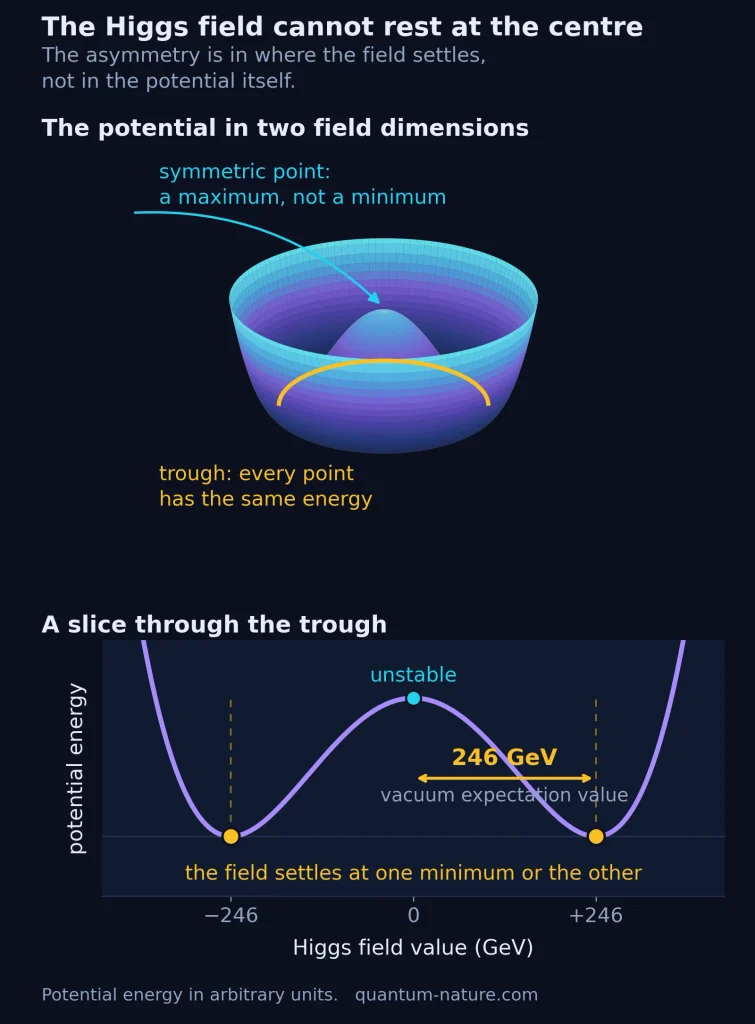
Spontaneous symmetry breaking resolves the contradiction by moving the asymmetry. The equations stay symmetric. The lowest-energy state does not.
A pencil balanced on its tip illustrates the structure. Nothing in the physics prefers one direction. The pencil still falls one way, and the final state has less symmetry than the law that produced it.
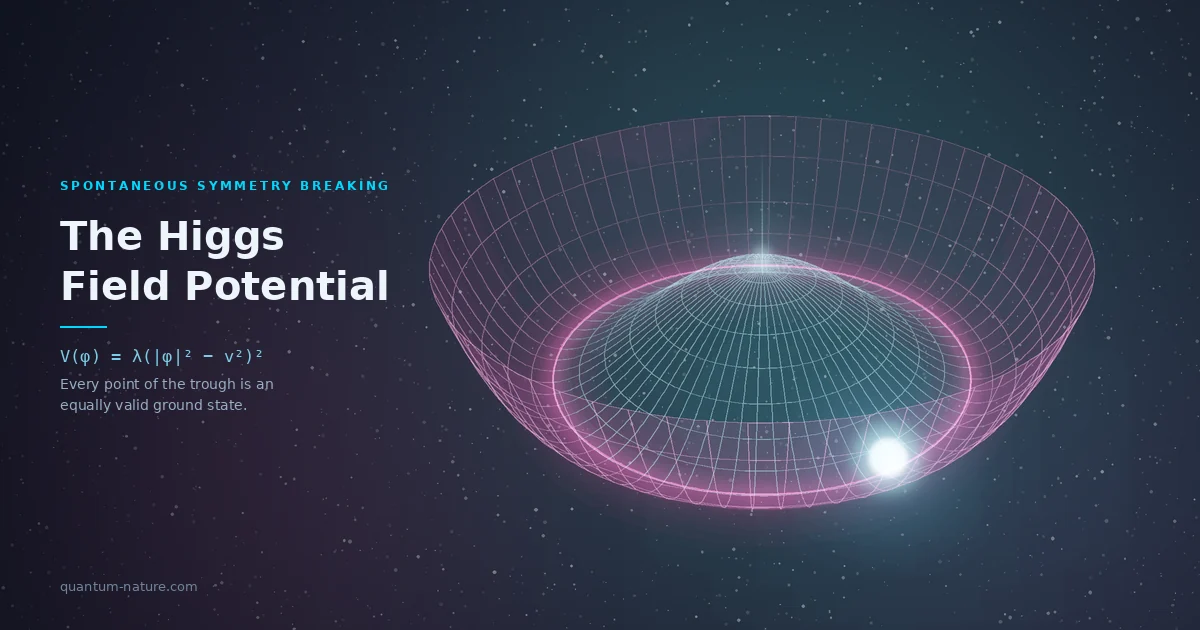
The Higgs field does the same thing in the quantum vacuum. Its potential energy has a maximum at the symmetric point and a circular trough of lower energy around it. The field settles somewhere in that trough and acquires a vacuum expectation value of 246 GeV. Particles that couple to the field acquire mass in proportion to that coupling. The photon stays massless because it corresponds to the one combination of generators that survives unbroken, not because its coupling happens to be weak.
Robert Brout and Francois Englert, Peter Higgs, and Gerald Guralnik with Carl Hagen and Tom Kibble published the mechanism independently in 1964. Steven Weinberg applied it to the electroweak sector in 1967. ATLAS and CMS reported the boson in 2012. Its mass is now 125.20 plus or minus 0.11 GeV.
It was a crossover, not a phase transition
Popular accounts describe electroweak symmetry breaking as a phase transition in the early universe. For the Standard Model, lattice calculations say otherwise.
Kajantie, Laine, Rummukainen and Shaposhnikov showed in 1996 that the transition is first order only when the Higgs boson is light. The critical value extrapolates to 72 plus or minus 2 GeV. The measured Higgs mass is 125 GeV, well above that line. At the observed mass the electroweak symmetry does not break sharply. It fades in as the universe cools, with no discontinuity and no boiling.
Later lattice work put the crossover temperature near 160 GeV, roughly 10 picoseconds after the Big Bang. Earlier estimates in the millisecond range are wrong by about eight orders of magnitude.
Why the distinction matters
A first-order transition would have driven the universe out of thermal equilibrium, which is one of the three conditions baryogenesis requires. A crossover does not. The Standard Model therefore cannot generate the matter surplus at the electroweak scale, and the failure is quantitative rather than a matter of taste.
The Higgs supplies about 1% of the mass of ordinary matter
The Higgs field gives mass to quarks and leptons. It does not give most of the mass to the objects those quarks build.
A proton contains two up quarks and one down quark. Current values put the up quark near 2.2 MeV and the down quark near 4.7 MeV. Those three quarks total roughly 9 MeV. A proton weighs 938 MeV. The Higgs coupling accounts for about 1% of the number.
The rest is quantum chromodynamics. Gluon field energy and the kinetic energy of confined quarks supply the remainder, and the mechanism is a separate symmetry breaking. Chiral symmetry breaks in the QCD vacuum and generates a mass scale that has nothing to do with the Higgs. Durr and colleagues confirmed the picture in 2008, computing light hadron masses from first principles on the lattice and matching experiment with controlled uncertainties.
Measurement versus interpretation
“The Higgs gives everything mass” is interpretation, and it is wrong by two orders of magnitude for ordinary matter. What the Higgs gives is the mass of the elementary constituents. What gives you your weight is binding energy in the strong force.
CP violation is broken symmetry measured directly
Not every broken symmetry is spontaneous. Some break in the laws themselves, and CP is the clearest case. C swaps particles for antiparticles. P inverts spatial coordinates. Combine them and the Standard Model predicts a small mismatch.
Christenson, Cronin, Fitch and Turlay found that mismatch in neutral kaon decays in 1964. BaBar and Belle observed it in B mesons in 2001. Both cases involve mesons, which pair a quark with an antiquark.
Baryons held out until 2025. LHCb reported CP violation in the decay of the beauty baryon lambda-b to a proton, a kaon and two pions. The measured asymmetry is 2.45% plus or minus 0.46% statistical and 0.10% systematic, at 5.2 standard deviations. Baryons are the three-quark structures that make up visible matter. The result extends CP violation to the class of particle we are made of, and it is consistent with the Cabibbo-Kobayashi-Maskawa mechanism.
The measured CP violation is far too small to explain the matter surplus
Andrei Sakharov set out three conditions for a universe to end up with more matter than antimatter. Baryon number must change. C and CP must both break. The process must run out of thermal equilibrium.
Planck data fix the surplus itself. The baryon-to-photon ratio sits near 6 in 10 billion. That is the residue left after almost everything annihilated.
CKM CP violation cannot produce it. Gavela and colleagues showed in 1994 that the Standard Model falls short by roughly ten orders of magnitude. The crossover result removes the third Sakharov condition as well. Two of three conditions fail inside the Standard Model, which is why baryogenesis is treated as evidence for new physics rather than an open calculation.
What is unresolved
No confirmed source of CP violation beyond the CKM matrix exists. Leptogenesis, extended Higgs sectors and first-order transitions driven by new scalars are all live proposals. None has experimental support.
Grand unification has no positive evidence
Grand unified theories propose that the strong and electroweak symmetries are fragments of one larger symmetry, broken near 10 to the 16 GeV. The idea is elegant and completely untested at that scale. No accelerator reaches within twelve orders of magnitude of it.
Proton decay is the accessible consequence. Unification lets quarks convert into leptons, so protons should eventually decay. Super-Kamiokande has looked and found nothing. The limit on the partial lifetime for decay to a positron and a neutral pion stands above 2.4 times 10 to the 34 years, at 90% confidence.
That limit has already excluded the minimal SU(5) model, which predicted a shorter lifetime. Larger schemes such as SO(10) survive because they predict slower decay. Hyper-Kamiokande should extend the reach by roughly an order of magnitude and will test a further slice of the parameter space.
Four open questions, stated plainly
The shape of the potential is unverified. Experiment infers the Mexican-hat form rather than measuring it. Confirming it requires the Higgs self-coupling, which needs Higgs pairs. The High-Luminosity LHC is the first machine with a plausible shot at it.
The vacuum may not be the final one. Extrapolating the measured Higgs and top masses places the Standard Model close to the boundary between a stable and a metastable vacuum, with current values favouring metastability. The predicted lifetime vastly exceeds the age of the universe. The result is sensitive to the top mass and to new physics at high scales.
Nothing explains 246 GeV. Quantum corrections should drive the electroweak scale up toward the Planck scale. It sits seventeen orders of magnitude below. Supersymmetry was the leading answer, and the LHC has found no sign of it.
Some symmetries look exact. Lorentz invariance and CPT have been tested to extraordinary precision, and no violation has been found. Whether they hold at the Planck scale is not something current experiments can answer.
What symmetry breaking does and does not explain
It explains why the W and Z are heavy and the photon is not. It explains the masses of quarks and leptons. It explains why electromagnetism and the weak force look like separate forces at low energy.
It does not explain most of the mass of ordinary matter, which comes from QCD. It does not explain the matter surplus, because the Standard Model fails two of Sakharov’s three conditions. It does not explain the size of the electroweak scale.
The mechanism is well tested where it has been tested. The territory it does not cover is where the next results will come from.
Note on sourcing
Every figure in this article traces to a peer-reviewed publication. No preprints or conference-preliminary results are used. Particle masses and lifetimes follow the Particle Data Group review, which is the standard aggregated source and is itself peer-reviewed. The crossover result and the 1% mass figure are lattice calculations rather than direct measurements, and both carry quantified systematic uncertainties in the cited papers. The vacuum metastability result is an extrapolation that assumes no new physics between the electroweak and Planck scales.
References
- E. Noether, Invariante Variationsprobleme, Nachr. Ges. Wiss. Gottingen, 235 (1918). English translation arXiv:physics/0503066
- F. Englert and R. Brout, Broken Symmetry and the Mass of Gauge Vector Mesons, Phys. Rev. Lett. 13, 321 (1964) doi:10.1103/PhysRevLett.13.321
- P. W. Higgs, Broken Symmetries and the Masses of Gauge Bosons, Phys. Rev. Lett. 13, 508 (1964) doi:10.1103/PhysRevLett.13.508
- G. S. Guralnik, C. R. Hagen and T. W. B. Kibble, Global Conservation Laws and Massless Particles, Phys. Rev. Lett. 13, 585 (1964) doi:10.1103/PhysRevLett.13.585
- S. Weinberg, A Model of Leptons, Phys. Rev. Lett. 19, 1264 (1967) doi:10.1103/PhysRevLett.19.1264
- ATLAS Collaboration, Observation of a new particle in the search for the Standard Model Higgs boson, Phys. Lett. B 716, 1 (2012) doi:10.1016/j.physletb.2012.08.020
- CMS Collaboration, Observation of a new boson at a mass of 125 GeV, Phys. Lett. B 716, 30 (2012) doi:10.1016/j.physletb.2012.08.021
- S. Navas et al. (Particle Data Group), Review of Particle Physics, Phys. Rev. D 110, 030001 (2024) and 2025 update. Source for the W, Z, Higgs, proton, quark masses and the photon mass limit doi:10.1103/PhysRevD.110.030001
- K. Kajantie, M. Laine, K. Rummukainen and M. Shaposhnikov, The Electroweak Phase Transition: A Non-Perturbative Analysis, Nucl. Phys. B 466, 189 (1996) doi:10.1016/0550-3213(96)00052-1
- M. D'Onofrio and K. Rummukainen, Standard Model cross-over on the lattice, Phys. Rev. D 93, 025003 (2016). Source for the crossover temperature doi:10.1103/PhysRevD.93.025003
- S. Durr et al., Ab Initio Determination of Light Hadron Masses, Science 322, 1224 (2008) doi:10.1126/science.1163233
- J. H. Christenson, J. W. Cronin, V. L. Fitch and R. Turlay, Evidence for the 2 pi Decay of the K-2-0 Meson, Phys. Rev. Lett. 13, 138 (1964) doi:10.1103/PhysRevLett.13.138
- LHCb Collaboration, Observation of charge-parity symmetry breaking in baryon decays, Nature 643, 1223 (2025) doi:10.1038/s41586-025-09119-3
- A. D. Sakharov, Violation of CP invariance, C asymmetry, and baryon asymmetry of the universe, JETP Lett. 5, 24 (1967)
- M. B. Gavela, P. Hernandez, J. Orloff and O. Pene, Standard Model CP violation and baryon asymmetry, Mod. Phys. Lett. A 9, 795 (1994) doi:10.1142/S0217732394000629
- Planck Collaboration, Planck 2018 results VI. Cosmological parameters, Astron. Astrophys. 641, A6 (2020). Source for the baryon-to-photon ratio doi:10.1051/0004-6361/201833910
- Super-Kamiokande Collaboration (A. Takenaka et al.), Search for proton decay via p to e+ pi0 and p to mu+ pi0 with an enlarged fiducial volume, Phys. Rev. D 102, 112011 (2020) doi:10.1103/PhysRevD.102.112011
- D. Buttazzo et al., Investigating the near-criticality of the Higgs boson, JHEP 12, 089 (2013). Source for vacuum metastability doi:10.1007/JHEP12(2013)089
Common questions
Does the Higgs give everything its mass?
No. The Higgs gives mass to elementary particles like quarks and leptons, but that is only about 1% of the mass of ordinary matter. The other 99% is binding energy from the strong force inside protons and neutrons.
What is the difference between broken symmetry and spontaneous symmetry breaking?
In spontaneous symmetry breaking the laws stay symmetric but the lowest-energy state does not, like a pencil balanced on its tip that must fall in some direction. CP violation is a different case, where the laws themselves are not symmetric.
Was electroweak symmetry breaking a phase transition?
At the measured Higgs mass of 125 GeV, lattice calculations show it was a smooth crossover as the universe cooled, near 160 GeV, roughly 10 picoseconds after the Big Bang, not a sharp first-order transition.
Why can't the Standard Model explain the matter-antimatter asymmetry?
It fails two of Sakharov's three conditions. Its CP violation is about ten orders of magnitude too small, and the electroweak crossover keeps the universe in thermal equilibrium instead of driving it out.
Has the Higgs potential's shape been measured?
Not yet. The Mexican-hat shape is inferred, not measured. Confirming it needs the Higgs self-coupling, which requires producing Higgs pairs, and the High-Luminosity LHC is the first machine with a plausible shot.
Responses