
High-Luminosity LHC Upgrade: Inside the Long Shutdown 3
The High-Luminosity LHC upgrade has begun. Here is what CERN is tearing out, what is going in, and the Higgs measurement the collider is being rebuilt to catch.
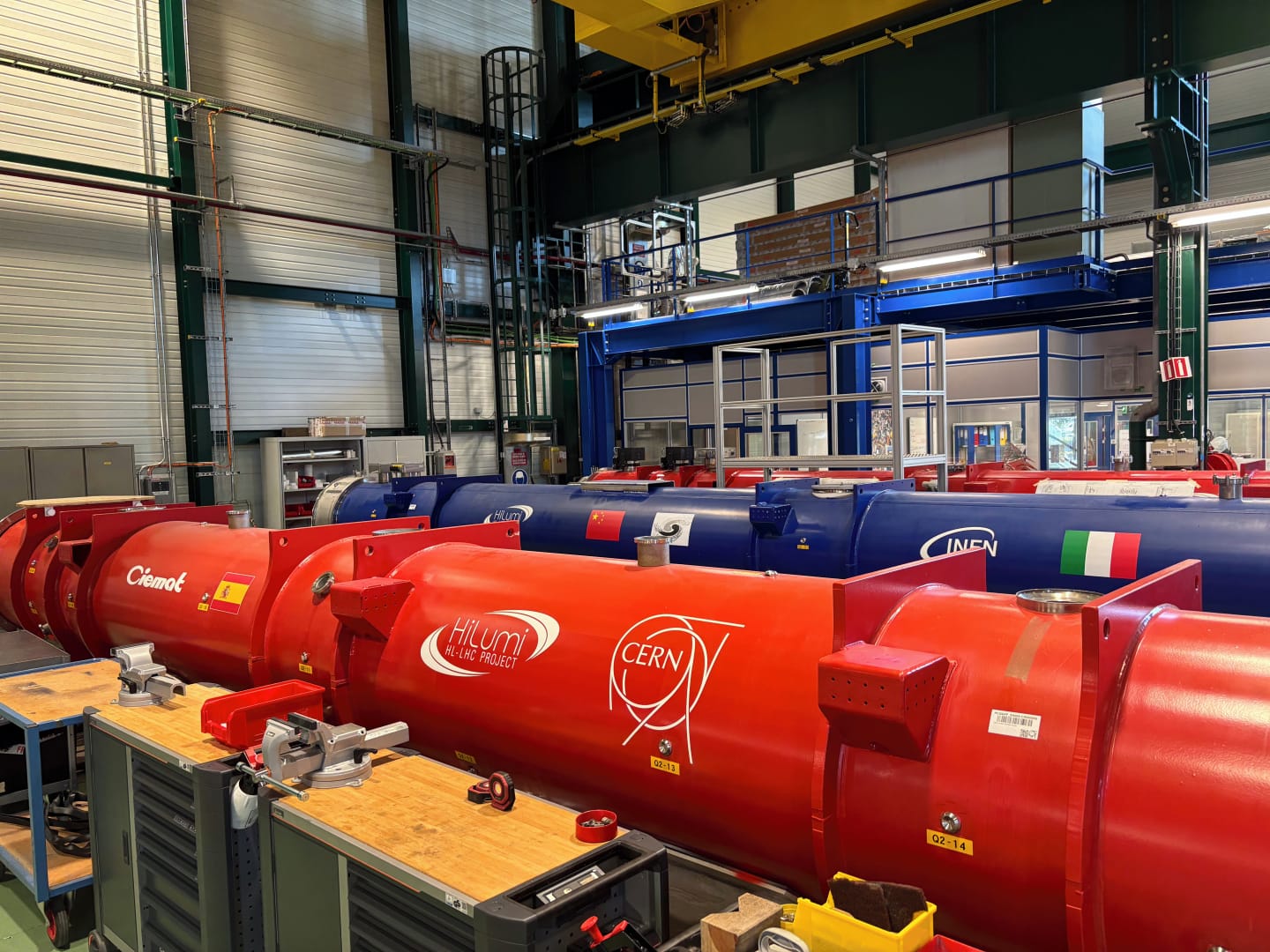
At 6 a.m. on 27 June 2026, the Large Hadron Collider dumped its last beams and stopped colliding. It was the first pause in nearly four years, and it is not a farewell. It marks the largest rebuild in the machine’s history. Over 1.2 kilometres of the 27-kilometre ring will be torn out and replaced to build the High-Luminosity LHC. Here is what comes out, what goes in, and the physics the collider is being rebuilt to catch.
The world’s most powerful collider went quiet
The LHC’s third run hit its official target of 500 inverse femtobarns of data before the end of 2025. It then kept running to squeeze out every last collision until late June. The injector chain that feeds it kept delivering beams until the end of August. Then the rest of CERN’s accelerator complex followed the LHC into shutdown. This is only the third long shutdown since the collider started up in 2008. By common agreement it is the most extensive intervention on the machine since it was built.
The shutdown, called Long Shutdown 3 (LS3), is scheduled to last 47 months. Beams are due back in the tunnel in June 2030, opening the High-Luminosity era, formally Run 4. CERN approved the upgrade in 2016. It carries a material budget of roughly 950 million Swiss francs, with dozens of institutes worldwide contributing.
Luminosity is the entire point
Luminosity measures how many collisions a machine delivers per unit area per unit time. It decides whether a rare process is ever seen. The rarest events at the LHC happen once in trillions of crossings, so collecting more collisions lifts the faint signals out of the noise.
The HL-LHC has two headline targets. It aims to raise the instantaneous luminosity, the collision rate at any moment, roughly fivefold beyond the original design. The integrated luminosity, the total gathered over the run, rises tenfold. In concrete terms the design dataset grows from 300 inverse femtobarns to 3,000, with an ultimate goal of 4,000. To date the LHC has delivered only a small fraction of the collisions the full programme envisages.
What it buys
Fed far more data, the same detectors can chase rare decays, faint new particles, and precision tests the first run only glimpsed. A tenfold dataset turns statistical rumours into measurable signals.
The Higgs measurement the first LHC could not finish
The 2012 discovery confirmed the Higgs boson exists and that the Higgs field gives particles their mass. That is the mechanism behind electroweak symmetry breaking. It did not reveal the shape of the Higgs potential: how strongly the Higgs talks to a copy of itself. That self-coupling sets whether our vacuum is stable, and it is the one major Higgs property still unmeasured.
The only direct probe is producing two Higgs bosons at once. That di-Higgs process is roughly a thousand times rarer than making a single one, and it sits just beyond the reach of the current dataset. Here sheer statistics decide the science. CERN projects the HL-LHC will produce on the order of 380 million Higgs bosons over its lifetime. That compares with roughly 55 million made since the LHC began. At full tilt the rate is about 15 million a year, against around 3 million in 2017.
What it promises
A first real handle on how the Higgs interacts with itself. Through that, a direct test of the shape of the Higgs potential and the stability of the vacuum. Alongside it come sharper searches for dark matter, heavy neutrinos, and the origin of the matter-antimatter imbalance.
New magnets squeeze the beam tighter
Higher luminosity starts with a smaller beam. The closer to a point the two beams focus where they meet, the more protons collide per crossing. Powerful quadrupole magnets flanking the ATLAS and CMS detectors do the focusing. The HL-LHC replaces them with a stronger technology.
The upgrade installs 24 large-aperture focusing quadrupoles wound from niobium-tin, the first use of that superconductor in a particle-physics accelerator. Niobium-tin reaches operating fields around 11 to 12 tesla, against roughly 8 tesla for the niobium-titanium magnets it replaces. That extra strength lets the magnets grip the beam harder and open a wider aperture. The cost is length: the focusing triplet grows from about 23 metres to 32. The material is brittle and unforgiving to make, which is why the magnets took years of prototyping to qualify.
What it enables
Beams squeezed to roughly half their former size at the collision point, the single largest lever on collision rate. It is also a proof of niobium-tin at accelerator scale that future colliders already count on.
Crab cavities and a superconducting spine
Squeezing the beams creates a new problem. To avoid stray collisions along the way, the two beams cross at a small angle rather than head-on. That angle shrinks the region where the bunches actually overlap. The fix is a set of superconducting radiofrequency devices called crab cavities. Each one sits just outside the collision region. It tilts its passing bunch so the two meet face-on at the crossing point, then untilts them afterward. The name comes from the sideways-shuffling motion the kick imparts.
Powering the new magnets takes its own innovation. They draw far more current than the originals. Superconducting links built from magnesium diboride carry it, housed in flexible cryostats with high-temperature-superconducting leads. The links move the power converters out of the tunnel and into new surface galleries, clear of the radiation. Each one delivers on the order of a hundred kiloamperes to the magnets below.
What it enables
The crab cavities recover the collision overlap that the tighter crossing angle would otherwise cost. The superconducting links keep the sensitive electronics clear of radiation. Together they turn the raw focusing gain into usable luminosity.
The detectors are being rebuilt too
More collisions mean more collisions stacked on top of each other. Today ATLAS and CMS see roughly 60 proton-proton collisions in a single bunch crossing. Under the HL-LHC that pile-up climbs to between 140 and 200. That is a wall of overlapping debris the current detectors were never built to untangle.
Both experiments are being substantially rebuilt in response. Each gets an entirely new silicon tracker with far finer granularity. Each gets fully replaced trigger and readout electronics to pick, in real time, which events to keep. And each gets new precision timing detectors that tag a collision to within tens of picoseconds. That timing is the key trick. If two collisions land trillionths of a second apart, separating them in time pulls apart what would otherwise blur together in space. The heavy-ion programme continues too, extending the quark-gluon plasma studies that run alongside the proton physics.
What it enables
Detectors that can still reconstruct individual collisions when 200 pile up at once. Without this rebuild, the extra luminosity would arrive as noise the experiments could not read.
The road to 2030
LS3 runs in stages. Through the end of 2026 the teams are de-installing the present machine, stripping out magnets, cryogenics, and beamline sections. The first major transport operation of the shutdown, a 77-tonne load, moved in late July 2026. By early September, crews were running electrical-integrity checks on the exposed circuits. The next two years or so go to civil work and new infrastructure. New beamline components go in from late 2028, and re-commissioning starts in mid-2029.
Beam is scheduled to return in June 2030. The High-Luminosity LHC should then run into the early 2040s, collecting the bulk of the data the LHC will ever produce. The collider gathered most of what it is remembered for with a fraction of its planned collisions. The rebuild is a bet that the most important measurements are still ahead.
The honest caveat
The schedule has already slipped once, pushing the restart from 2029 to 2030. On a machine this complex, 47 months of work leaves room for more. The luminosity and Higgs figures are design targets and projections, not results. The physics reach is real, but it will be measured on the far side of the shutdown, not before it.
Note on sourcing
Timeline, budget, and hardware descriptions trace to CERN’s own communications, the HL-LHC Technical Design Report, and a 2026 machine review in a peer-reviewed journal. Luminosity multipliers, the 380-million Higgs figure, and pile-up ranges are design targets and projections rather than measured results. Nothing in the High-Luminosity physics programme has been collected yet. The machine that would collect it is still being built.
References
- CERN, Long Shutdown 3: the road to HiLumi
- CERN, High-Luminosity LHC media kit
- CERN Courier, HL-LHC counts down to LS3 (2025)
- Bruning et al., News from the HL-LHC machine, Eur. Phys. J. Plus (2026) doi:10.1140/epjp/s13360-026-08142-1
- CERN, Updated schedule for CERN's accelerators
- Apollinari et al. (eds.), High-Luminosity LHC Technical Design Report, CERN-2020-010 doi:10.23731/CYRM-2020-0010
Common questions
Is CERN shutting down the LHC for good?
No. The LHC entered a planned upgrade called Long Shutdown 3 in mid-2026. Beams are due back in June 2030 as the High-Luminosity LHC, or Run 4.
What does high luminosity actually mean?
Luminosity is the rate of collisions. The upgrade aims to raise the total collisions collected by a factor of about 10, so experiments can catch processes too rare to see now.
Why replace the magnets?
Tighter focusing needs stronger magnets. The upgrade installs 24 niobium-tin quadrupoles reaching around 11 to 12 tesla, the first use of that superconductor in a particle-physics accelerator.
What is the main physics goal?
Measuring the Higgs self-coupling, the strength with which the Higgs interacts with itself. It requires producing two Higgs bosons at once, which only the far larger High-Luminosity dataset makes possible.
When will results arrive?
Not before the shutdown ends. Beam returns in June 2030, and the High-Luminosity LHC is expected to run into the early 2040s.
Responses