
Oxygen and Neon Collisions Reveal New Evidence of Quark-Gluon Plasma at the LHC
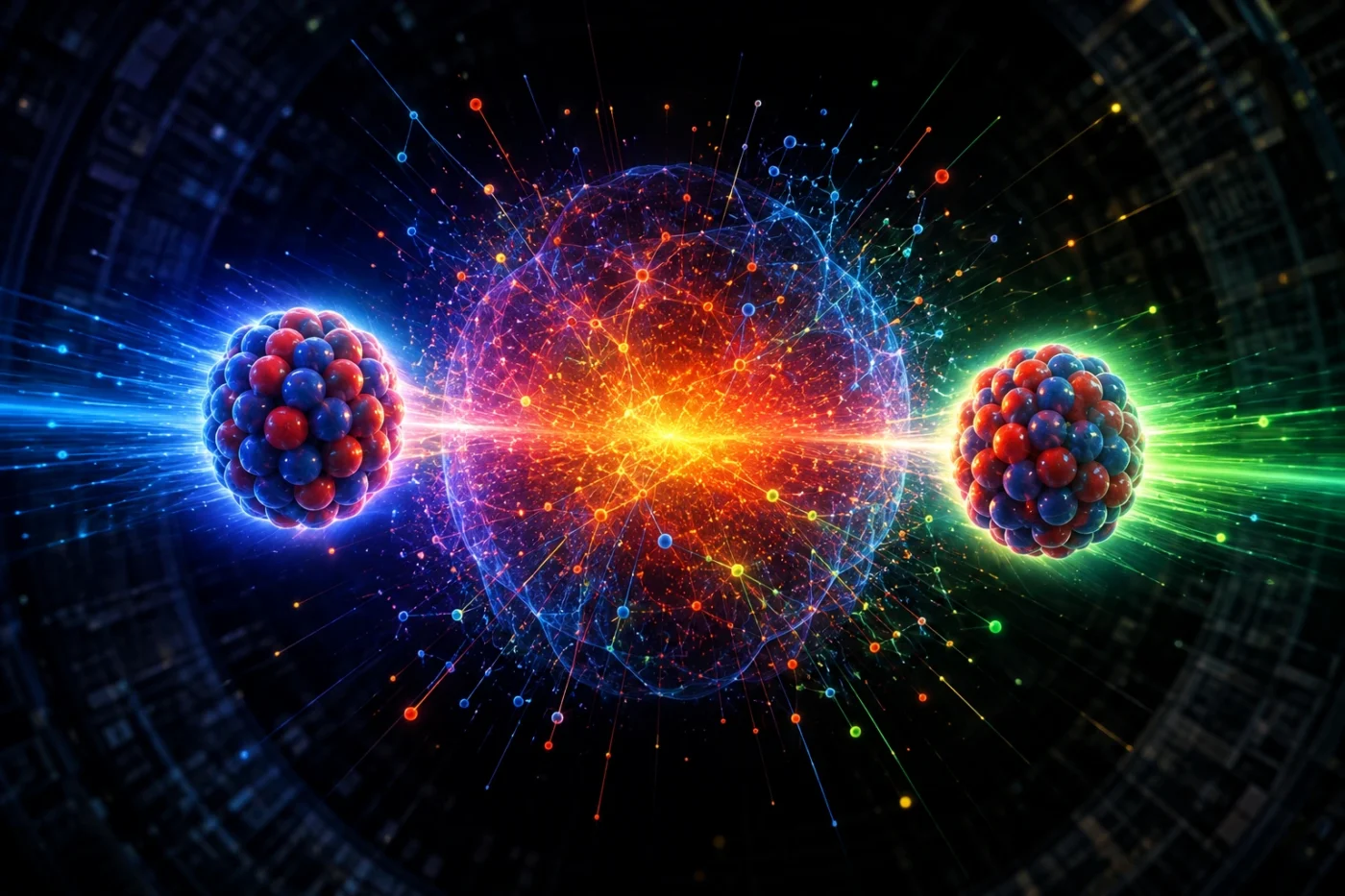
Two oxygen nuclei carry sixteen protons and neutrons apiece. Smash them together and the jets that come out lose energy on the way, which means something hot and dense sat in their path. ATLAS reports that effect above five sigma, the smallest system in which anyone has seen it. Four detectors have now reported plasma signatures from the same eleven-day run. Three of those results remain preliminary.
Quarks that cannot be separated
Nobody has ever found a quark on its own. Pull two apart and the force between them refuses to weaken with distance, the way gravity or electromagnetism does. It stays roughly constant instead.
So the energy you invest keeps climbing. Eventually the vacuum finds it cheaper to manufacture a fresh quark-antiquark pair than to stretch the bond any further. You end up with two bound particles rather than two free quarks. Physicists call this confinement, and it explains why every quark you will ever meet sits packaged inside a proton, a neutron, or some other composite.
One known exception exists. Heat matter far enough, compress it hard enough, and the packaging fails. Quarks and the gluons that bind them stop belonging to individual protons and start roaming a shared medium.
That medium is the quark-gluon plasma. Reaching it takes a temperature more than a hundred thousand times that at the centre of the Sun. The universe sat in this state for roughly its first millionth of a second. Everything since has been the cooled remains.
The small-system puzzle
Recreating the plasma means colliding heavy nuclei. Lead, with 208 nucleons, has done most of the work. For years physicists assumed only something that heavy could produce a droplet large enough to matter.
That assumption started cracking about a decade ago. Collisions between protons, and between protons and lead nuclei, began showing collective flow. Flow had always signalled a fluid medium. But those same collisions stubbornly refused to show the other classic signature, energy loss by particles crossing that medium.
Half the fingerprint turned up and half did not. Nobody produced an explanation that covered both facts comfortably.
Oxygen and neon sit precisely in the gap. Heavier than a proton, far lighter than lead. If you want to find the size at which a droplet of plasma starts behaving like a plasma, this is where you look.
The two fingerprints
Hydrodynamic flow. The plasma behaves as a fluid of remarkably low viscosity. The shape of the initial overlap between the two nuclei therefore imprints itself on the directions particles fly out. An almond-shaped overlap produces an anisotropic spray.
Parton energy loss. A high-energy quark or gluon born in the collision must cross the medium to escape, and it loses energy doing so. When the affected object is a jet, a collimated spray of particles, physicists call this jet quenching.
Eleven days of a different beam
Between 29 June and 9 July 2025, the LHC switched away from protons. In that window it delivered the first collisions between pairs of oxygen nuclei, the first between pairs of neon nuclei, and collisions between oxygen and protons. The centre-of-mass energy reached 5.36 TeV per nucleon pair.
Neon earned its place for a specific reason. The neon-20 nucleus is not spherical. It stretches out, a shape physicists have taken to calling a bowling pin, and that deformation hands you a geometric handle no round nucleus can offer.
In head-on collisions, ALICE, ATLAS and CMS all saw a neon-oxygen-lead hierarchy in elliptic flow. That is what you would expect if neon collisions produce the most pronounced almond shape.
First results surfaced at the Initial Stages conference in Taipei in September 2025. The fuller set arrived a year later, and CERN summarised them on 24 July 2026.
How you weigh a jet against its partner
ATLAS looked at dijets. When a hard scattering happens inside a collision, it typically throws out two jets back to back. Momentum conservation means they should carry nearly equal transverse momentum.
The measured quantity is the ratio of the smaller jet’s momentum to the larger one’s, written xJ. In proton-proton collisions, where no medium exists, that ratio clusters near one.
Put a plasma in the way and the symmetry breaks. The two jets start at the same point but travel different distances through the medium before escaping, so they shed different amounts of energy. Fluctuations in the energy-loss process add further spread. The distribution of xJ drifts away from one.
The result that clears five sigma
The shift is there, in both oxygen-oxygen and neon-neon collisions. In central collisions it exceeds five standard deviations. That is the conventional observation threshold in particle physics, and jet quenching has never crossed it in a system this small.
The centrality dependence makes it convincing. Physicists sort collisions by how squarely the two nuclei hit each other. Glancing collisions produce small droplets and should show little quenching. ATLAS finds their xJ distributions closely resemble proton-proton.
Head-on collisions produce the largest droplets. There the distributions resemble those from lead-lead collisions that happen to produce a droplet of comparable size. The effect scales with the thing it ought to scale with.
Why this closes a puzzle rather than opening one
For a decade, small collision systems showed flow without energy loss. Oxygen and neon now show both signatures in the same system. That does not explain what was happening in proton-proton collisions, but it does mean the two fingerprints have stopped pointing in different directions. The open question shifts from whether small systems make plasma to where exactly the threshold sits.
Fewer particles than there should be
If partons lose energy crossing a medium, fewer high-momentum particles should emerge than a proton-proton collision predicts once you scale up for the extra nucleons. CMS measured exactly that in oxygen-oxygen collisions: a minimum suppression to 0.69 ± 0.04 of the expected yield, around 6 GeV. A follow-up analysis then lined up oxygen-oxygen alongside neon-neon, xenon-xenon and lead-lead on a single scale, and found the suppression grows steadily with the size of the colliding nucleus.
ALICE came at the same question from an angle designed to close a loophole. Suppression can also arise from effects that live in the nucleus before any collision happens, with no hot medium involved at all.
So ALICE compared neutral pion production in oxygen-oxygen collisions against proton-oxygen collisions, rather than against protons alone. Proton-oxygen came back consistent with no suppression at all, which rules out cold-nucleus effects as the explanation. Once those are subtracted out, the remaining suppression in oxygen-oxygen departs from a no-energy-loss baseline at a 4.9-sigma level.
LHCb contributed a third variant, comparing hadrons built from a charm quark and a light quark. The suppression grows stronger in the heavier neon system, which is what a larger plasma droplet should do.
Bound states that come undone
A heavy quark and its antiquark can orbit one another in a bound state. Upsilon mesons, made of a bottom quark and its antiquark, come in several such states. Crucially, those states bind with different strengths.
A surrounding plasma should pull the loosely bound states apart more easily than the tightly bound ones. That graded suppression makes a distinctive fingerprint, because ordinary nuclear effects do not naturally sort themselves by binding energy. CMS found exactly that grading: the two more loosely bound upsilon states came out suppressed relative to the tightest one, at better than five standard deviations.
CMS found evidence of it by comparing oxygen-oxygen with neon-neon collisions. LHCb found preliminary evidence of the same pattern using proton-oxygen and oxygen-oxygen data.
Three quarks flow harder than two
The last signature is the subtlest. ALICE reports that baryons, which contain three quarks, leave oxygen-oxygen collisions with a stronger directional preference than mesons, which contain two.
The reasoning runs like this. Particles at intermediate momentum may form by gathering up quarks that were already flowing collectively in a medium. Each quark then contributes its share of that flow to the final particle. A three-quark object inherits more than a two-quark object.
Seeing baryons flow harder than mesons therefore argues that the quarks were moving collectively before they combined. Which is to say that a medium existed for them to move in.
What is solid and what is not
The four-detector framing is accurate but it flattens real differences in how firm each result is. Sorted by status:
Figure 1
Nine results, one announcement, three levels of evidence
Quark-gluon plasma signatures from the LHC light-ion run, June to July 2025.
Publication status of the nine light-ion results announced together: two peer-reviewed or in press, four submitted preprints, three preliminary conference results. The colour marks the signature type, not the tier. Source: CERN, 24 July 2026, and the collaboration preprints detailed below.
- Peer-reviewed or in press. CMS oxygen-oxygen charged-particle suppression, published in Physical Review Letters. The follow-up CMS paper placing oxygen-oxygen, neon-neon, xenon-xenon and lead-lead suppression on one scale, accepted by Physics Letters B.
- Submitted preprints, peer review pending. The ATLAS jet-quenching observation. CMS upsilon suppression. LHCb charm-hadron suppression. ALICE neutral pions.
- Preliminary, conference only. ATLAS charged particles recoiling against photons. LHCb quarkonium suppression. ALICE baryon and meson flow.
The top two tiers carry the headline. The baryon-versus-meson flow result, the most intuitively appealing of the set and the one most likely to get quoted, sits in the third.
What is unresolved
Where the threshold actually falls. Oxygen and neon quench jets; protons apparently do not, or not measurably. Nobody has pinned down the system size at which the transition happens, or established that “transition” is even the right word for something that may switch on gradually. The proton-proton flow signals still lack an explanation on their own terms. And the LHC has now closed Run 3, so the next light-ion data waits for the High-Luminosity machine.
Note on sourcing
This article gives publication status per result rather than for the set as a whole, because it varies: two results peer-reviewed or accepted, four submitted preprints, three preliminary conference results. Significance figures appear only where a collaboration has stated them. The ATLAS observation claim of five standard deviations applies to central collisions specifically, not to all centralities. The specific ATLAS conference-note number for the photon-recoil study could not be confirmed at time of writing and has been left unattributed rather than guessed. No collaboration claims to have identified the system size at which plasma formation begins.
References
- ATLAS Collaboration, Observation of centrality-dependent dijet transverse momentum imbalance in O+O and Ne+Ne collisions at 5.36 TeV. The five-sigma jet-quenching observation
- CMS Collaboration, Charged-particle suppression in oxygen-oxygen collisions, Physical Review Letters. The only peer-reviewed result in this set doi:10.1103/89sf-9t1x
- CMS Collaboration, System-size dependence of charged-particle suppression. First neon-neon measurement, set alongside O-O, Xe-Xe and Pb-Pb; accepted, Phys. Lett. B
- CMS Collaboration, Upsilon suppression in light-ion collisions
- LHCb Collaboration, Charm-hadron suppression in oxygen-oxygen and neon-neon collisions
- ALICE Collaboration, Neutral pion production in oxygen-oxygen and proton-oxygen collisions
- ATLAS Collaboration, Preliminary photon-recoil study in O-O and Ne-Ne, reported in CERN's 24 July 2026 summary. Conference note number unconfirmed
- G. Giacalone et al., The unexpected uses of a bowling pin: exploiting neon-20 isotopes for precision characterizations of collectivity in small systems. The deformed-neon argument
- CERN, Oxygen collisions at the LHC show new indications of extreme state of matter, 24 July 2026; and First oxygen and neon collisions at the LHC, CERN Courier, November 2025. Run dates and the elliptic-flow hierarchy
Common questions
What is quark-gluon plasma?
A state in which quarks and gluons stop belonging to individual protons and neutrons and roam a shared hot, dense medium. It needs a temperature more than a hundred thousand times that at the centre of the Sun, and the universe was in this state for roughly its first millionth of a second.
Why collide oxygen and neon instead of lead?
They sit between light protons and heavy lead in size. Lead reliably makes plasma while protons show only half the signatures, so oxygen and neon probe the size range where a droplet of plasma starts, or stops, behaving like one.
What did ATLAS actually observe?
Jet quenching: back-to-back jets emerging with unequal momentum because they cross the medium and lose different amounts of energy. In central oxygen-oxygen and neon-neon collisions the effect exceeds five sigma, the smallest system in which quenching has been seen.
What puzzle does this resolve?
For a decade small collision systems showed fluid-like flow but no energy loss, so the two plasma fingerprints disagreed. Oxygen and neon now show both in the same system, shifting the open question from whether small systems make plasma to where the size threshold lies.
Are all nine results equally solid?
No. One CMS result is peer-reviewed and a second is accepted; four are submitted preprints; three are preliminary conference results. The baryon-versus-meson flow result, the most quotable of the set, is in the preliminary tier.
Why is neon-20 special?
It is not spherical; it stretches into a bowling-pin shape. That deformation gives a geometric handle on the shape of the initial collision that a round nucleus cannot provide, which sharpens the flow comparison.
What is still unresolved?
The system size at which plasma formation switches on, and whether it switches on sharply or gradually. Proton-proton flow still lacks its own explanation, and with Run 3 closed the next light-ion data waits for the High-Luminosity LHC.
1 response