
The Nuclear Reaction That Wasn’t Breaking the Stardust Models
The first ever measurement of neutron capture on niobium-94 came back close to the theoretical estimate it replaced. That is the key finding. For two decades, stellar models struggled to reproduce the molybdenum-94 found in grains of ancient stardust, and the unmeasured niobium-94 capture rate was one possible explanation. CERN's n_TOF collaboration has now measured it, ruling out a significantly slower capture rate as the explanation. The remaining discrepancy points toward the stellar modelling and the treatment of niobium-94 beta decay under stellar conditions.
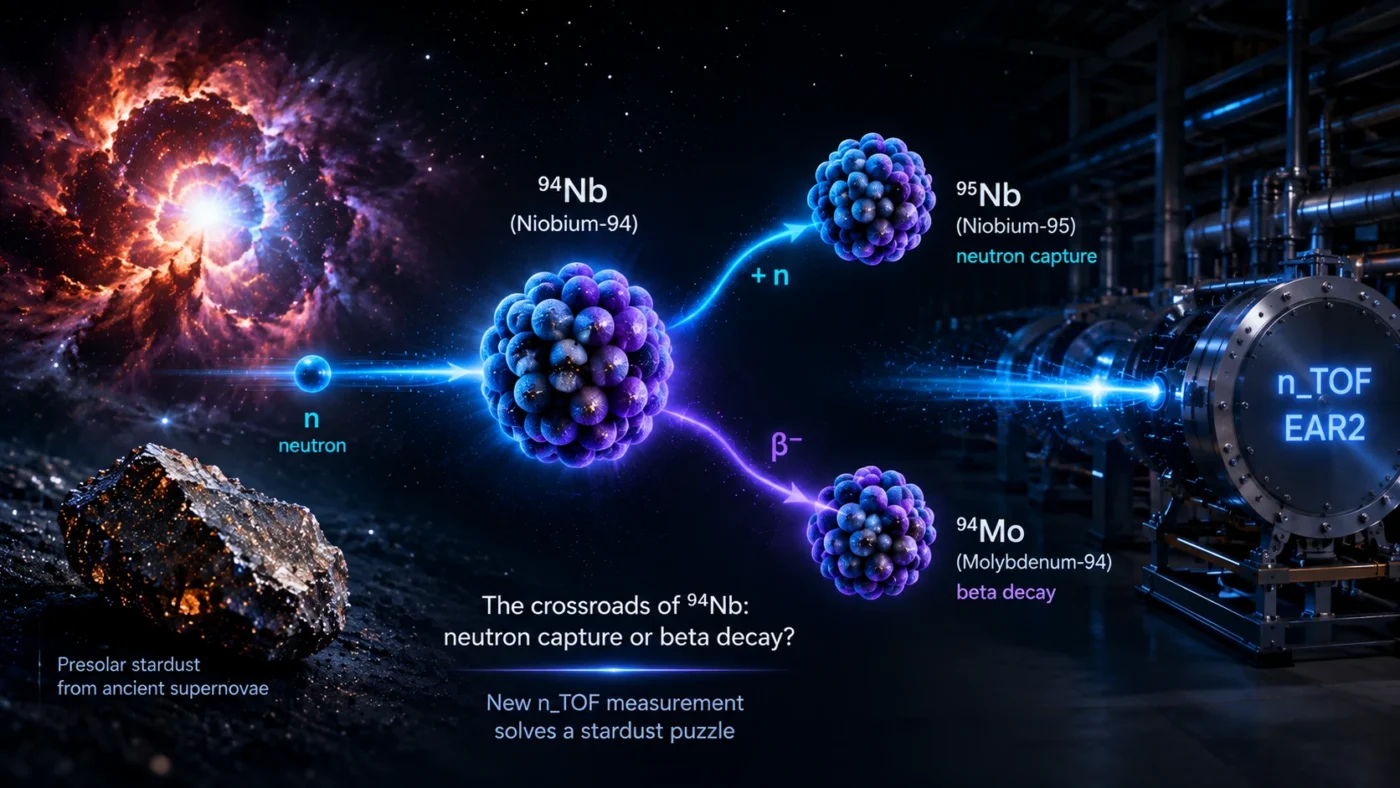
Presolar grains are direct samples of other stars
Primitive meteorites carry microscopic mineral grains that predate the Sun. These presolar grains condensed in the outflows of dying stars, survived the Solar System’s formation, and now sit in laboratory collections on Earth. Silicon carbide grains are particularly valuable because their isotopic compositions preserve detailed records of stellar nucleosynthesis. Their heavy-element isotope ratios carry the fingerprint of the slow neutron-capture process, or s-process, which builds roughly half the elements beyond iron.
The n_TOF paper works with grains traced to low-mass asymptotic giant branch stars of roughly 1.5 to 3 solar masses. Three populations matter here. Mainstream grains make up about 90% of the AGB-origin total, with the Y and Z groups at roughly 1% to 5% each. All three show indistinguishable molybdenum isotope ratios.
Here is the problem. Isotopic analyses over two decades consistently show these grains carrying more molybdenum-94, relative to molybdenum-92, than the models produce.
Niobium-94 sits at a fork in the s-process path
Niobium-94 is radioactive. Inside a star it faces a choice. It can capture a neutron and become niobium-95, which routes the material past molybdenum-94 entirely. Or it can beta decay straight into molybdenum-94. Temperature and neutron density decide which path wins, so the isotope acts as a branching point: a switch in the reaction network that stellar conditions flip.
Under terrestrial conditions, niobium-94 has a half-life of roughly 2 × 10⁴ years. At s-process temperatures near 3 × 10⁸ K, calculations predict a dramatic reduction in the effective beta-decay half-life, to less than a year. Beta decay then becomes genuinely competitive with capture. The capture side had never been measured.
Timing matters too. During the long interpulse phases inside an AGB star, neutron density sits near 107 to 108 per cubic centimetre and the branching point stays shut. During a thermal pulse it spikes to 109 to 1011 per cubic centimetre for a brief episode, and the fork opens.
Figure 1
One fork measured, one still theoretical
The s-process path through the zirconium, niobium and molybdenum region. Niobium-94 decides whether material reaches molybdenum-94 or bypasses it entirely.
Neutron capture to niobium-95
Measured: 460 ± 37 mb at kT = 30 keV.
Beta decay to molybdenum-94
Half-life falls from about 20,000 yr to under 1 yr. Calculated, not measured.
Surrounding s-process flow
Routes material past molybdenum-94 entirely.
When the fork opens. Only during a thermal pulse, when the neutron density spikes to 109 to 1011 per cubic centimetre. Through the long interpulse phases the branching point stays shut.
Source: Balibrea-Correa et al., Phys. Rev. Lett. 137, 082701 (2026).
Niobium-94 sits at a fork. The cyan arm is the one n_TOF measured. The amber arm still rests on calculated stellar rates. Grey arrows trace the surrounding s-process flow, which routes material past molybdenum-94 altogether. Source: Balibrea-Correa et al., Phys. Rev. Lett. 137, 082701 (2026) · arXiv:2603.17646
Four facilities to make one sample
The hard part was the sample, not the beam. IFW Dresden synthesised 304 mg of ultrahigh-purity niobium-93 carrying less than 1 ppm tantalum, drawn into two short wires. The Institut Laue-Langevin in Grenoble then irradiated those wires for 51 days in its high-flux reactor. The thermal neutron fluence reached roughly 4.3 × 10²¹ per square centimetre. The Paul Scherrer Institut characterised the activated sample by gamma spectroscopy.
That yielded 10.1 MBq of niobium-94 with no detectable radioactive contaminants. In atom terms: 9.24(18) × 1018 niobium-94 atoms, roughly 1% of the bulk sample.
At CERN, the team irradiated that sample at the EAR2 station and detected the prompt gamma rays from capture. Two features made it viable. EAR2 delivers an exceptionally high instantaneous neutron flux, and the segmented sTED array, a set of small deuterated-benzene cells, handles the resulting count rates. Nine sTED units sat in a compact ring to maximise signal against background. The experiment used segmented total-energy detectors for the first time in this type of measurement.
The numbers
The team resolved and analysed ten niobium-94 capture resonances up to about 800 eV. For the first resonance they extracted a radiation width of 145(40) meV, then held that value fixed where needed while fitting the others.
From that resonance set they derived an s-wave level spacing of 32(7) eV and a neutron strength function of 0.19(8) × 10-4. Those average parameters feed the Maxwellian-averaged cross section, or MACS, which is the quantity stellar models actually consume.
Two headline values: 1167(93) mb at a thermal energy of 5 keV, and 460(37) mb at 30 keV. The systematic uncertainty is 8%, dominated by the normalisation chain that ties the yield to a gold reference resonance.
The result landed close to the old estimates
Compare that with the KADoNiS v0.3 recommended values. The new MACS runs 26% higher at 5 keV and sits within 5% at 30 keV. At higher thermal energies it falls up to 13% lower. The KADoNiS values were theoretical estimates; the comparison does not carry the same experimental uncertainty as the new measurement.
This is the load-bearing result, and it is a negative one. A significantly slower capture rate would have pushed more niobium-94 down the beta-decay arm, boosting molybdenum-94 production. That is exactly what the grain data seemed to demand. The measurement rules out a significantly slower capture rate as the mechanism for enhancing molybdenum-94 production.
What the measurement settles
The niobium-94 capture rate is no longer an unmeasured parameter. The new value sits close to the theoretical estimates the models were already using, which rules out a significantly slower capture rate as the explanation for the enhanced molybdenum-94 in the grains. That is a real gain: one degree of freedom constrained in a network that had several.
The modelling framework carries much of the weight
The paper feeds the new rate into FRUITY models of 2 solar-mass AGB stars, using magnetic buoyancy-driven mixing and a full nuclear network reaching up to bismuth, coupled to the star’s evolving structure. The magnetic FRUITY models can reproduce the molybdenum-94 patterns seen in the mainstream, Y and Z grains, but the new capture rate itself changes the predicted ratio only modestly.
Swapping the measured rate in for the old theoretical one, however, shifts the predicted molybdenum-94 to molybdenum-96 ratios only modestly. The authors read that limited response the obvious way. The earlier theoretical rates were already close to what the experiment found.
Their own diagnosis is explicit. The long-standing mismatch likely arose from limitations in earlier postprocessing calculations, and particularly from how those calculations approximated the temperature- and density-dependent beta-decay rate of niobium-94.
The authors themselves credit a combination: modern coupled models that handle thermally sensitive branchings properly, plus an experimentally constrained rate. The measurement’s contribution to that pairing is to eliminate a candidate explanation and nail down one input.
Reading the abstract against the discussion
Worth flagging, because it shapes every downstream summary of this result.
The abstract states that incorporating the new MACS into the models brings them into agreement with the grain data. Read alone, that is a causal claim: new number, therefore agreement. The discussion section says the same substitution produces only modest changes, and attributes the earlier mismatch to the postprocessing treatments rather than to the nuclear input.
Both statements are accurate. The abstract describes a package that works. The discussion identifies where within that package the change actually came from. Coverage based only on the abstract can therefore give a misleading impression of how much the new nuclear measurement itself changed the stellar models.
Reading the claim carefully
The CERN release itself gets this right. It quotes the principal investigator saying the measurement landed close to prior theoretical estimates. That points the blame at older stellar models. The compression happens at the headline layer, where “measurement solves puzzle” replaces the narrower claim the paper actually supports.
What the measurement does not constrain
Three limits are worth carrying forward.
The MACS is derived, not measured across the stellar range. Ten resonances below 800 eV anchor it. Everything above that comes from average resonance parameters plus statistical-model assumptions.
The p-wave contribution is significant and partly assumed. The team set the average radiative width for p-wave neutrons equal to the s-wave value. They adopted a p-wave strength function from neighbouring isotopes. They estimated the p-wave level spacing by assuming parity-independent level densities.
The full resonance analysis is not in this paper. Detailed results for the niobium-94 and niobium-93 samples are promised in a separate forthcoming publication. The resonance parameter table lives in the Supplemental Material.
The other fork is still theoretical
A branching point has two arms. This work measured one of them.
The temperature- and density-dependent beta-decay rate of niobium-94 under stellar conditions still rests entirely on calculation, tracing back to a 1987 tabulation by Takahashi and Yokoi. With the capture side now constrained, that beta-decay rate becomes an important remaining uncertainty.
The PANDORA project exists to close it. The plan is to measure beta-decay rates of radioactive isotopes inside laboratory plasmas that reproduce stellar temperature and density conditions. Niobium-94 is one of its primary targets.
This concerns grains, not the Solar System’s molybdenum
Easy to conflate, so state it plainly. Two different quantities are in play. One is the molybdenum-94 in the bulk Solar System inventory. The other is the molybdenum-94 excess recorded inside individual presolar grains.
In the classical nucleosynthesis picture, molybdenum-94 is a p-only isotope, shielded from the s-process flow. The paper sets out the route by which that flow bypasses it. Most material sitting at zirconium-93 captures another neutron and becomes zirconium-94 rather than decaying to niobium-93. Zirconium-94 captures again to zirconium-95, which decays through niobium-95 to molybdenum-95, skipping molybdenum-94 altogether.
The excess this paper addresses is local. It is an s-process signature internal to the grains’ parent stars, recorded as molybdenum isotope ratios in the grains themselves. It is not a revision of the Solar System’s overall molybdenum-94 inventory.
The authors are explicit that the wider question stays open. They frame the result as a firmer foundation for future work on disentangling the stellar and galactic processes behind the Solar System’s molybdenum-94, not as an answer to it.
What to watch
A stellar beta-decay measurement. From PANDORA or a comparable plasma experiment. Until one lands, the branching point stays half-constrained.
The remaining molybdenum cross sections. n_TOF has measured stable molybdenum isotopes to tighten the surrounding network. A preprint on improved molybdenum-94 resonance parameters appeared in August 2026, and analysis of molybdenum-96 capture data is ongoing.
The detailed n_TOF resonance paper. It will carry the full parameter set behind the MACS values quoted here, which is where any revision to this result would first appear.
Note on sourcing
The central result traces to a peer-reviewed, open-access Physical Review Letters paper published in August 2026. The linked arXiv preprint predates peer review and may differ in detail from the published version. The companion molybdenum resonance work is a preprint and is not peer-reviewed. All stellar beta-decay rates quoted here, and every stellar yield attributed to FRUITY, are model outputs rather than measurements.
References
- J. Balibrea-Correa et al. (n_TOF Collaboration), First niobium-94 neutron-capture measurement: constraining the nucleosynthetic origin of molybdenum-94 in presolar grains, Phys. Rev. Lett. 137, 082701 (2026). Open access; arXiv:2603.17646 predates the accepted version doi:10.1103/538w-rhqb
- n_TOF Collaboration, Improved molybdenum-94 neutron resonance parameters from neutron capture and transmission measurements at n_TOF and GELINA (2026). Preprint, not peer-reviewed
- CERN, n_TOF experiment sheds light on ancient stardust, 19 August 2026. Institutional press release
- Grain isotope data: N. Liu et al., Astrophys. J. 881, 28 (2019); T. Stephan et al., Astrophys. J. 877, 101 (2019) and Astrophys. J. 981, 201 (2025)
- Magnetic FRUITY models: D. Vescovi, S. Cristallo, M. Busso, N. Liu, Astrophys. J. Lett. 897, L25 (2020)
- Prior theoretical rates: I. Dillmann et al. (KADoNiS), Nucl. Data Sheets 120, 171 (2014). Stellar beta-decay rates: K. Takahashi and K. Yokoi, At. Data Nucl. Data Tables 36, 375 (1987)
Common questions
What did the n_TOF experiment actually measure?
The rate at which niobium-94 captures a neutron, expressed as a Maxwellian-averaged cross section. They reported 1167 millibarns at a thermal energy of 5 keV and 460 millibarns at 30 keV, with an 8 percent systematic uncertainty. It was the first time this reaction had ever been measured.
Why does niobium-94 matter for stardust?
It sits at a branching point in the slow neutron-capture process. Depending on temperature and neutron density it either captures a neutron and bypasses molybdenum-94, or beta decays directly into it, so its rates control how much molybdenum-94 a dying star makes.
Did the measurement solve the molybdenum-94 puzzle?
Not by itself. The new rate came out close to the theoretical estimate the models already used, so it rules out a slower capture rate as the cause but changes the model predictions only modestly. The better agreement comes mainly from improved stellar modelling.
Why does the abstract sound more decisive than that?
The abstract describes the whole package, new rate plus modern models, reaching agreement with the grains. The discussion shows the rate substitution alone changes little and pins the earlier mismatch on how older calculations approximated niobium-94 beta decay. Both are accurate; headlines tend to compress it into measurement-solves-puzzle.
What is still unmeasured?
The other arm of the branching point: the temperature- and density-dependent beta-decay rate of niobium-94 inside a star, which still rests on a 1987 calculation. The PANDORA project aims to measure it in laboratory plasmas that reproduce stellar conditions.
Is this about the Solar System's molybdenum?
No. It concerns the molybdenum-94 excess recorded inside individual presolar grains, an s-process signature local to the grains' parent stars, not the bulk Solar System molybdenum inventory, which the authors say stays an open question.
How hard was the experiment?
The sample was the hard part. Four facilities made it: ultrapure niobium-93 synthesised at IFW Dresden, irradiated for 51 days at the Institut Laue-Langevin, characterised at the Paul Scherrer Institut, then measured at CERN with a new segmented detector array.
Responses