
What Does a Dark Matter Detector Actually Measure?
On 26 August 2026, two kilometres under Ontario, SuperCDMS began collecting its first scientific data. No detector can see dark matter. What it measures is heat and charge, two numbers per event, and the ratio between them is the entire experiment.
Cite this article
Quantum Nature (2026). What Does a Dark Matter Detector Actually Measure?. Quantum Nature. https://quantum-nature.com/dark-matter-detector-measures/
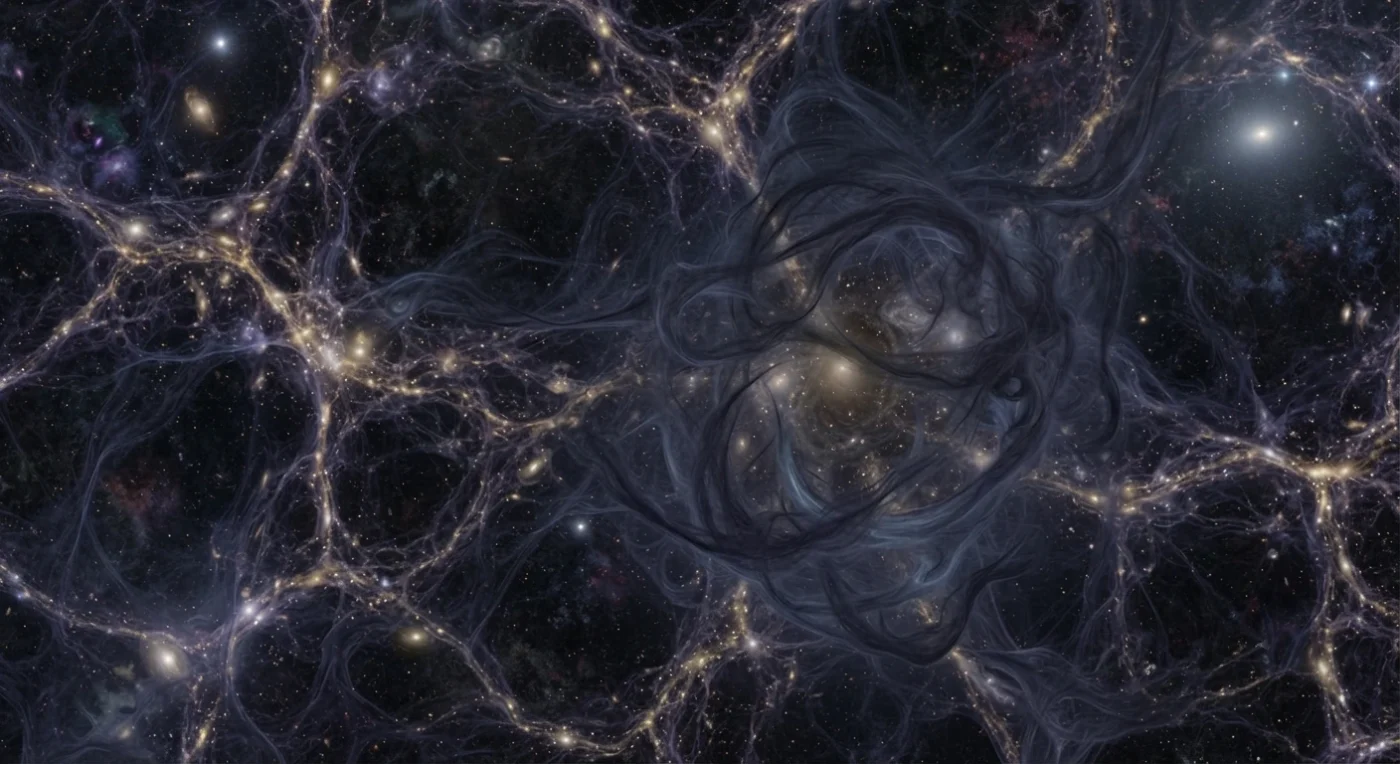
What the detector is actually waiting for
The evidence for dark matter is gravitational and it is overwhelming. Galaxies rotate too fast for their visible mass. Clusters bend light more than they should. The cosmic microwave background carries an imprint that only fits if roughly 85 percent of matter is something we cannot see. None of it tells you what the stuff consists of.
Direct detection makes one assumption. If dark matter is a particle, and if the Earth ploughs through a halo of it, then occasionally one should strike an atomic nucleus and knock it sideways. That recoiling nucleus deposits a tiny amount of energy in the crystal. Everything about the experiment serves one goal: catching that deposit.
The energies involved are the problem. A dark matter particle a few times heavier than a proton would leave less than a keV in a germanium nucleus. For comparison, a single photon of visible light carries about 2 eV, and a typical chemical bond is a few eV. The signal is a few hundred bond-breakings, deposited once, in a kilogram of crystal, perhaps a handful of times a year.
Two signals from one crystal
When anything deposits energy in a semiconductor crystal, it does two things at once. It shakes the lattice, producing phonons, which is to say heat. It also lifts electrons into the conduction band, producing free charge carriers, which is to say ionisation.
SuperCDMS reads both. Superconducting sensors on the crystal faces collect the phonons. Electrodes drift the charge carriers to the surfaces and count them. One interaction, two independent measurements.
This is why the detectors have to be cold. At 15 millikelvin the crystal’s own thermal vibrations are quiet enough that a few hundred eV of deposited heat is a measurable disturbance rather than lost in the noise. The temperature is not a detail of the engineering. It is the reason the measurement is possible at all.
The ratio is the whole measurement
Here is the physics the experiment turns on. A recoiling electron spends its energy efficiently on making more ionisation. A recoiling nucleus is heavy and slow, and it loses most of its energy to shoving neighbouring atoms around instead. For the same deposited energy, a nuclear recoil produces far less charge.
Physicists call this ratio the ionisation yield. Define it as 1 for electron recoils. In germanium, nuclear recoils come out near 0.2 to 0.3, following a prediction made by Jens Lindhard in the 1960s. Almost every background, gamma rays and beta particles and cosmic-ray secondaries, is an electron recoil. Dark matter would be a nuclear recoil.
So the discriminator is a ratio, and above a few keV it removes essentially all electron-recoil background in the bulk of the crystal. That single trick is what makes a kilogram-scale detector competitive with tonnes of liquid xenon.
Figure 1
The whole measurement is one ratio
A germanium crystal reports two numbers per event. Their ratio separates the dark matter signal from almost every background, right up until it does not.
This is the trade the experiment is built around. Light dark matter deposits less than 1 keV, which is exactly where the ratio stops separating signal from background. SuperCDMS runs two detector types for that reason: one that keeps the discrimination, and one that abandons it to reach a lower threshold.
The nuclear-recoil curve is computed from Lindhard theory for germanium, with k = 0.157. Band widths model a fixed ionisation resolution of about 100 eV divided by recoil energy, plus a floor, shown at two standard deviations. Real detector bands are measured from neutron and gamma calibration rather than assumed.
Ionisation yield against recoil energy in germanium. Electron recoils from gamma and beta backgrounds sit at yield one. Nuclear recoils, which is what dark matter would produce, sit near 0.2, following Lindhard theory. The separation is clean above a few keV and vanishes below about 1 keV, which is precisely the energy range where light dark matter would deposit its energy. Sources: SuperCDMS SNOLAB projected sensitivity · arXiv:1405.4215
The trade: threshold or discrimination
The ratio fails at low energy, and it fails for a mundane reason. The charge readout has a roughly fixed noise level in absolute terms, so its effect on a ratio grows as the denominator shrinks. Below about 1 keV the two bands widen into each other and event-by-event discrimination stops working. That is exactly where light dark matter lives.
SuperCDMS runs two detector types to attack both sides. The iZIP detectors read phonons and ionisation separately at a bias of a few volts, keeping the yield discrimination. Their sensors interleave on both faces. An event near a surface deposits charge on one face only, which flags it for removal, while a bulk event deposits on both.
The HV detectors give the discrimination away on purpose. Run the crystal at around 100 volts and every drifting charge carrier sheds additional phonons as it crosses the field, an effect named for Neganov, Trofimov and Luke. That amplifies the ionisation signal into the phonon channel and drops the threshold to the eV scale. The cost is that you can no longer separate the two channels, so you lose the ability to tell a nuclear recoil from an electron recoil one event at a time.
The design in one line
One detector type sees fewer events but knows what each one is. The other sees far more and has to argue statistically. The experiment fields both because nobody knows which mass range the answer is hiding in.
Why it has to be underground
At the surface, cosmic ray muons pass through your hand at roughly one per second per square centimetre. Any of them would swamp a detector looking for a few events per year.
SNOLAB sits about two kilometres down in an active nickel mine near Sudbury, under rock equivalent to some 6,000 metres of water. That removes the muon flux by roughly six orders of magnitude. It does not remove everything.
Neutrons are the hard background. A neutron scattering off a nucleus produces exactly the signal dark matter would produce, with exactly the same ionisation yield. No ratio distinguishes them. Three defences apply: layered shielding, radioactively clean materials, and one statistical argument. Dark matter would scatter once in the whole apparatus. A neutron usually scatters more than once, so multiple-scatter events get discarded.
Where SuperCDMS fits
Liquid xenon experiments dominate the heavy end. LZ has excluded spin-independent cross sections down to 2.2 × 10-48 cm2 at 40 GeV, from 4.2 tonne-years of exposure. XENONnT reaches 1.7 × 10-47 cm2 at 30 GeV. Neither experiment has found anything.
Below about 10 GeV the physics changes. A light particle striking a heavy xenon nucleus transfers very little energy, because the kinematics match badly. Germanium and silicon are lighter targets, and cryogenic detectors have thresholds three orders of magnitude below a xenon TPC. SuperCDMS targets roughly half a proton mass up to about ten proton masses. In that window it expects to be the most sensitive experiment in the world.
Two things are closing on that window. In December 2025 LZ pushed its own search down into 3 to 9 GeV for the first time, using 417 live days, and found nothing. From below, solar neutrinos are rising into the same region. SuperCDMS is not walking into empty territory.
The floor that cannot be shielded
Neutrinos from the Sun also scatter coherently off nuclei, a process called CEνNS, first observed in 2017. The recoils they produce are indistinguishable from a dark matter signal. The same neutrinos are the subject of a separate measurement problem. No amount of rock or lead removes them, because neutrinos pass through everything. This is the neutrino fog.
The fog is no longer theoretical. In 2024, PandaX-4T and XENONnT reported the first indications of solar boron-8 neutrinos scattering in a dark matter detector, at 2.64 and 2.73 sigma. LZ saw the same signal in 2025. The largest experiments in the field are now limited by an irreducible background rather than by their own cleanliness.
The boron-8 component peaks in the few-GeV region, the same window SuperCDMS targets. Reaching the fog does not end the search, but it changes it. Beyond that point progress requires either enormous exposure to separate two overlapping distributions statistically, or a different observable, such as the annual modulation of the signal as the Earth’s orbital velocity adds to and subtracts from its motion through the halo.
What a null result would mean
Forty years of direct detection have found nothing, across improvements spanning many orders of magnitude in sensitivity. It is worth being precise about what that has and has not established.
What it rules out. Large regions of parameter space for weakly interacting massive particles, including much of the range motivated by supersymmetry at the electroweak scale. That was the field’s leading hypothesis for decades, and the null results are a real result about it.
What it does not rule out. Dark matter that interacts only gravitationally, in which case no detector of this kind will ever see it. Axions, which need entirely different experiments. Primordial black holes. Dark sectors that couple through mediators these searches are not tuned for. None of it touches the gravitational evidence.
The honest framing
A null result does not mean dark matter is not there. It means dark matter does not interact with ordinary matter in the specific way this class of experiment assumes. Those are different statements, and press coverage routinely merges them.
Where it stands
Running now. SuperCDMS SNOLAB is taking early-science data with 24 detectors, 18 germanium and 6 silicon, in four towers at 15 millikelvin. The collaboration spans 28 institutions, with SLAC leading.
The schedule. Early science runs through autumn 2026. The experiment then warms up for cryogenic and noise optimisation into late 2026, followed by a year of data at full sensitivity from 2027. The collaboration says even the early phase could produce a result.
Unresolved. Everything that matters. Whether dark matter is a particle, whether it scatters off nuclei at all, and whether the low-mass window closes before the neutrino fog fills it.
What is genuinely new here is not a discovery. It is that a detector sensitive to a few hundred eV of deposited energy, held two kilometres underground within a hundredth of a degree of absolute zero, is now running and collecting data. Whether that turns out to be the instrument that finds the answer or the one that closes another region of the map, the measurement itself is remarkable.
Note on sourcing
Exclusion limits and the CEνNS indications are from peer-reviewed papers. The SuperCDMS operational status and schedule come from the collaboration’s own announcement of 26 August 2026 and are subject to change. The figure’s nuclear-recoil curve is calculated from Lindhard theory rather than reproduced from a published plot, and the band widths are a simple model of the ionisation resolution rather than measured detector performance; the figure caption states this.
References
- SLAC National Accelerator Laboratory, SuperCDMS SNOLAB begins preliminary phase of dark matter hunt, 26 August 2026
- SuperCDMS Collaboration, Projected sensitivity of the SuperCDMS SNOLAB experiment, Phys. Rev. D 95, 082002 (2017) doi:10.1103/PhysRevD.95.082002
- LZ Collaboration, Dark matter search results from 4.2 tonne-years of exposure of the LUX-ZEPLIN experiment, Phys. Rev. Lett. 135, 011802 (2025) doi:10.1103/PhysRevLett.135.011802
- XENON Collaboration, WIMP dark matter search using a 3.1 tonne-year exposure of the XENONnT experiment, Phys. Rev. Lett. 135, 221003 (2025)
- PandaX Collaboration, First indication of solar boron-8 neutrinos through coherent elastic neutrino-nucleus scattering in PandaX-4T, Phys. Rev. Lett. 133, 191001 (2024)
- XENON Collaboration, First indication of solar boron-8 neutrinos via coherent elastic neutrino-nucleus scattering with XENONnT, Phys. Rev. Lett. 133, 191002 (2024)
- SuperCDMS Collaboration, Search for low-mass dark matter with CDMSlite using Neganov-Trofimov-Luke amplification
- SuperCDMS Collaboration, Phonon-based position determination in SuperCDMS iZIP detectors
- J. Lindhard, V. Nielsen, M. Scharff and P. V. Thomsen, Integral equations governing radiation effects, Mat. Fys. Medd. Dan. Vid. Selsk. 33, 10 (1963). Origin of the ionisation yield model used in the figure
Common questions
How can a detector tell dark matter from ordinary radioactivity?
By the ratio of charge to heat. An electron recoil produces ionisation efficiently, a nuclear recoil does not. Set the electron-recoil yield to 1 and nuclear recoils come out near 0.2 in germanium.
Why must the detectors be so cold?
At 15 millikelvin the crystal's own thermal vibrations are quiet enough that a few hundred electron volts of deposited heat is a measurable disturbance rather than noise. The temperature is the reason the measurement works at all.
Why does SuperCDMS use two different detector types?
The yield ratio fails below about 1 keV, which is where light dark matter deposits energy. The iZIP detectors keep the discrimination, the high-voltage detectors trade it away for a far lower threshold.
Why go two kilometres underground?
At the surface, cosmic ray muons arrive at roughly one per square centimetre per second. SNOLAB's rock, equivalent to about 6,000 metres of water, cuts that flux by about a million.
What is the neutrino fog?
Solar neutrinos scatter off nuclei and produce recoils indistinguishable from a dark matter signal. No shielding removes them. Two experiments reported the first indications of this background in 2024.
Does finding nothing mean dark matter does not exist?
No. It means dark matter does not interact with ordinary matter in the specific way this class of experiment assumes. The gravitational evidence is untouched.

Responses