
What Is the Hubble Tension?
Measure how fast the universe is expanding using the afterglow of the Big Bang, and you get one number. Measure it using nearby stars and exploding suns, and you get another, about nine percent higher. Both are now precise to roughly one percent, so the gap between them is far too large to be luck. The James Webb Space Telescope was supposed to find the mistake. Instead it confirmed the awkward number and deepened the problem. This piece explains what the two measurements are, why they disagree, and why a decade of sharper instruments has made the Hubble tension harder to dismiss rather than easier.
Cite this article
Quantum Nature (2026). What Is the Hubble Tension?. Quantum Nature. https://quantum-nature.com/hubble-tension/
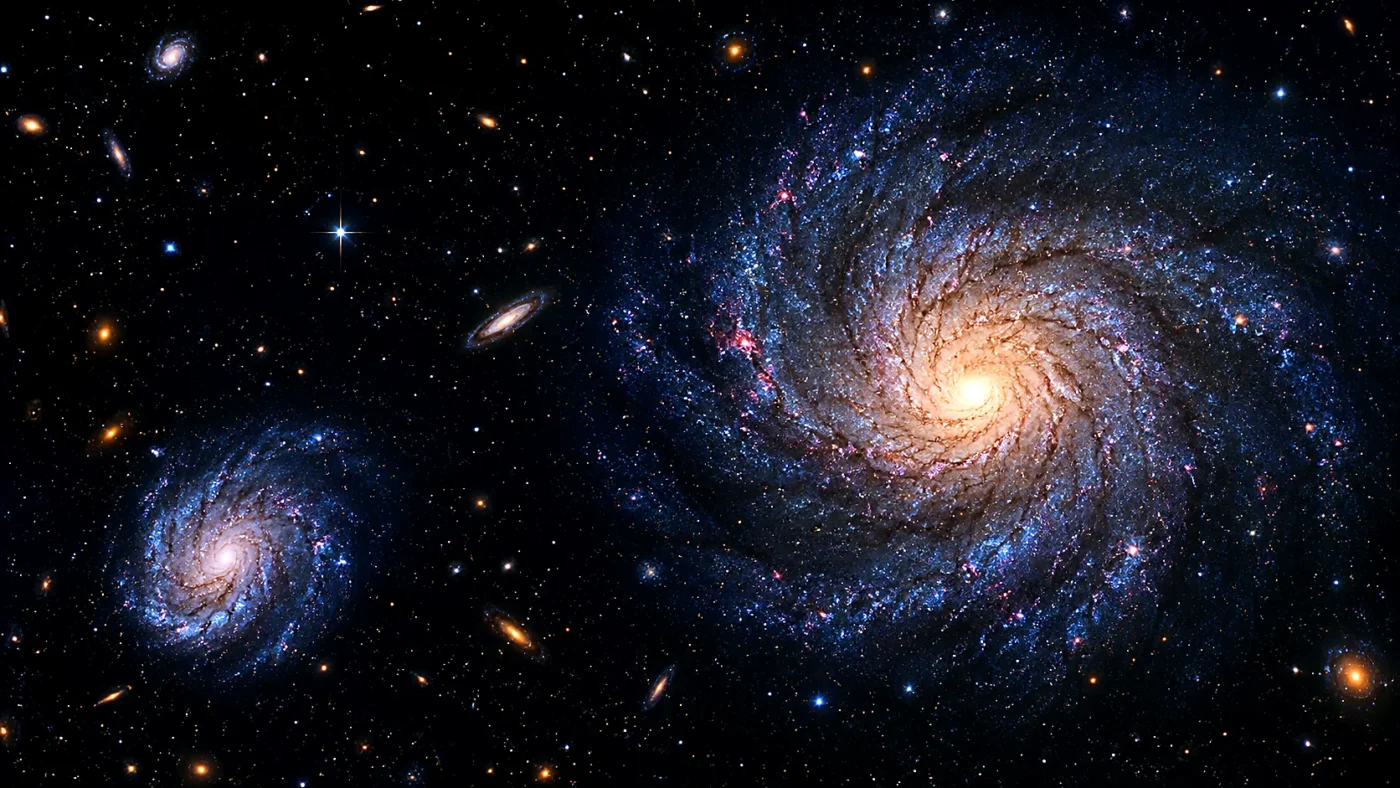
Take the most carefully measured number describing how fast the universe is expanding. Now measure it a second way. The two answers do not match. They miss by about nine percent. That does not sound like much. But both measurements are now precise to about one percent, so the gap between them is far too large to be an accident. Physicists have spent a decade hunting for the mistake that would make it go away. They have built sharper instruments, rechecked every step, and ruled out the obvious culprits one by one. The gap has not closed. If anything, it is getting harder to explain.
One constant, two independent roads to it
The Hubble constant, written H₀, sets the present-day expansion rate of the universe. It is measured in kilometres per second of recession velocity, for every megaparsec of distance. H₀ is one of cosmology’s most fundamental numbers, and there are two structurally different ways to measure it.
The early-universe route starts from the cosmic microwave background. This is the relic radiation released when the universe first became transparent, 380,000 years after the Big Bang. Its faint pattern of temperature ripples encodes a precise sound horizon, a standard ruler baked in at that moment. Combine that ruler with the standard cosmological model, and H₀ falls out as a derived quantity.
The late-universe route measures H₀ directly, with no cosmological model required. It builds a distance ladder. Parallax fixes distances to nearby stars. Cepheid variable stars, calibrated against those distances, extend the ladder to galaxies hosting Type Ia supernovae. The supernovae extend it further still, out to where their redshift and known brightness give H₀ directly from Hubble’s law.
The two numbers, and the gap between them
Planck’s cosmic microwave background analysis gives H₀ near 67.4 kilometres per second per megaparsec. The SH0ES collaboration’s distance-ladder measurement gives roughly 73.0 to 73.5. Each side quotes uncertainties near one percent. A gap this size is not something either method can shrug off as noise. As of the 2025 assessments the tension has passed 6 standard deviations, well beyond the 5-sigma threshold physicists use to declare a discovery.
A third, largely independent route uses baryon acoustic oscillations. This is the same sound-horizon physics as the cosmic microwave background, but read off the clustering of galaxies rather than the microwave sky. The Dark Energy Spectroscopic Instrument gives H₀ = 68.53 ± 0.80, close to Planck and in tension with SH0ES, despite using none of Planck’s data.
Why this counts as a real tension
Two early-universe methods, the cosmic microwave background and baryon acoustic oscillations, agree with each other. They rely on almost entirely different data. One late-universe method, the distance ladder, disagrees with both. That pattern points at something specific to the local, late-time measurement, or at physics that changes between the early and late universe.
The obvious suspect: crowded starfields
For years, the leading systematic explanation was Cepheid crowding. Cepheids sit in busy, star-forming regions of distant galaxies. The Hubble Space Telescope’s resolution could not always separate a Cepheid from its unresolved neighbours. Unrecognised crowding makes a star look brighter than it is, which makes it appear closer than it is, which biases H₀ upward.
NASA built the James Webb Space Telescope partly to settle this. Its near-infrared vision resolves roughly three times finer than Hubble at comparable wavelengths. That is sharp enough to pick apart individual Cepheids that Hubble could only see as a single smear of light.
JWST checked the crowding hypothesis and it failed
Adam Riess and collaborators compared more than a thousand Cepheids across five supernova host galaxies, observed with both telescopes. The mean difference between Hubble and JWST distances came out to −0.01 ± 0.03 magnitudes, consistent with zero. The team ruled out distance-dependent crowding bias as the explanation, at 8.2 standard deviations, a higher confidence than the tension itself.
A 2025 follow-up added a particularly clean low-background host galaxy, NGC 3447A, and again found no hidden bias. Combining 24 Type Ia supernovae across 19 JWST-observed Cepheid hosts gave H₀ = 73.49 ± 0.93, matching the original Hubble-based SH0ES result almost exactly. The telescope built to catch the error instead confirmed the number.
Ruling out one bad measurement, systematically
A further line of work tested whether any single method, distance indicator, or calibration step could be dropped to make the tension disappear. It could not. Excluding any one ingredient from the distance-ladder calculation leaves the local H₀ value essentially unchanged. The tension is spread across the entire measurement, not concentrated in one identifiable weak link.
That matters, because it forecloses the easiest kind of explanation. A single flawed calibration, or an overlooked systematic in one step, would have been the tidiest resolution available. The data no longer support that story.
Where the search for a fix stands
With the leading systematic explanations weakening, attention has shifted toward new physics that changes the expansion history itself. Early dark energy models add a brief burst of energy in the young universe. That burst shrinks the sound horizon and raises the cosmic microwave background’s inferred H₀, meeting the local value partway. One such model, combining cosmic microwave background, baryon acoustic oscillation and JWST data, raises H₀ to 71.58 ± 1.05. That eases the tension to roughly 1 standard deviation in that particular fit. The same DESI data drives a parallel standoff over the summed mass of the neutrinos.
Easing a tension inside one model is not the same as showing that model is correct. Early dark energy has to thread a needle. It must shift H₀ without disturbing the rest of the cosmic microwave background’s tightly constrained fit. It must also match how galaxies clustered as the same physics played out. No proposed extension of the standard model has yet done all of that cleanly and won broad acceptance.
Current status, stated plainly
As of 2026 the tension is unresolved, and by several assessments it is hardening rather than easing. JWST removed the most widely discussed systematic explanation rather than confirming it. No new-physics model has settled the disagreement in a way the field broadly accepts. Claims of resolution circulated in 2025, several resting on evolving dark energy. They were method-specific and have not held up across the broader body of evidence.
What would actually settle it
A fully independent local measurement would carry the most weight, one that bypasses Cepheids entirely. Gravitational-wave standard sirens are the most promising candidate. The wave itself supplies the distance, with no stellar calibration step needed. But the sample of well-localised events is still too small to compete with the precision of the distance ladder or the cosmic microwave background.
Until that arrives, the field is left with two robust, independently checked numbers for the same quantity. They disagree by more than either measurement’s stated uncertainty allows. That is what makes this a tension rather than an error, and why it now sits among the sharpest open problems in cosmology.
Note on sourcing
The Planck, SH0ES, DESI and JWST results cited here are peer-reviewed and published in Astronomy & Astrophysics or the Astrophysical Journal and its Letters series. Early dark energy and other extensions of the standard model remain active research proposals rather than settled explanations, and this article presents them as such. Assessments of whether the tension is easing or hardening vary across the literature, depending on which measurements a given group emphasises. This article reflects the balance of peer-reviewed evidence as of 2026 rather than any single position.
References
- Planck Collaboration, Planck 2018 results. VI. Cosmological parameters, Astronomy and Astrophysics 641, A6 (2020). Preprint arXiv:1807.06209 doi:10.1051/0004-6361/201833910
- A. G. Riess et al., A Comprehensive Measurement of the Local Value of the Hubble Constant, Astrophysical Journal Letters 934, L7 (2022). H0 = 73.04 plus or minus 1.04 doi:10.3847/2041-8213/ac5c5b
- A. G. Riess et al., JWST Observations Reject Unrecognized Crowding of Cepheid Photometry as an Explanation for the Hubble Tension at 8 sigma Confidence, Astrophysical Journal Letters 962, L17 (2024) doi:10.3847/2041-8213/ad1ddd
- DESI Collaboration, DESI DR2 baryon acoustic oscillation measurements of the Hubble constant, giving H0 = 68.53 plus or minus 0.80, independent of Planck (2025)
- G.-H. Du, T.-N. Li et al., Resolving the Hubble Tension in the Early Dark Energy Framework with JWST and DESI Data, giving H0 = 71.58 plus or minus 1.05 in an axion early-dark-energy model (2026). Preprint arXiv:2606.19090
- Tensions in Cosmology 2025 conference summary, reporting the Hubble constant discrepancy has exceeded 6 sigma across combined DESI, JWST and ACT data (2025). Preprint arXiv:2509.25288
Common questions
What is the Hubble tension?
A persistent disagreement between two ways of measuring how fast the universe is expanding. Early-universe methods give about 67.4, late-universe methods give about 73, and the gap is too large to be a statistical fluke.
Why do the two measurements disagree?
Nobody knows for certain. The early-universe value depends on the standard cosmological model, while the late-universe value is measured directly, so the mismatch points either to a flaw in the local measurement or to physics missing from the model.
Did the James Webb Space Telescope resolve the Hubble tension?
No. It was built partly to test whether crowded starfields were biasing the distance-ladder measurement, and it ruled that out at high confidence, confirming the higher value and deepening the problem rather than solving it.
How significant is the Hubble tension now?
It has grown past five standard deviations, and by several 2025 assessments past six. That is well beyond the threshold physicists use to declare a discovery, and it has been called a crisis for the standard model of cosmology.
Could new physics explain the tension?
Possibly. Early dark energy, a brief energy burst in the young universe, can ease it within some fits, but no proposed extension of the standard cosmological model has resolved it cleanly while matching all the other data.
What would it take to settle the question?
An independent local measurement that does not rely on Cepheid stars, such as gravitational-wave standard sirens, which supply distances directly. The current sample of such events is still too small to compete with existing methods.

Responses