
Why Nobody Has Ever Seen a Free Quark
Take a proton and try to pull one of its quarks out. The force resisting you does not weaken with distance the way gravity or electricity does. It stays roughly constant at about 15 tonnes of pull, no matter how far you go. Long before anything comes free, the energy you have poured in converts into fresh particles, and you finish holding two ordinary hadrons instead of one loose quark. That is confinement. It explains why every particle ever detected is colour-neutral, and after fifty years nobody has proved it from first principles.
Colour is a charge that comes in three
Electric charge has one kind and two signs, positive and negative. The strong force needs more structure than that, because three quarks bind into a proton and no arrangement of a single charge type explains why three is the magic number.
Quantum chromodynamics gives quarks a charge with three values, labelled red, green and blue. The names are arbitrary and have nothing to do with light. What matters is the rule: only combinations that cancel to colourless can exist as free particles. Three quarks with one of each colour cancel. So does a quark paired with an antiquark carrying the matching anticolour. Those two recipes give you baryons and mesons, which is very nearly the entire particle zoo.
The mathematical structure behind this is the group SU(3). It is the reason the theory is called chromodynamics, and every consequence below follows from it.
Gluons carry the charge they transmit
Here is the difference that produces everything else. A photon transmits the electromagnetic force but carries no electric charge itself, so two photons ignore each other completely. A gluon transmits the strong force and carries colour charge, in the form of a colour and an anticolour. Gluons therefore pull on other gluons.
The count. SU(3) has eight independent generators, so QCD has eight gluons, not one. Experimental evidence for the gluon arrived in 1979, when four collaborations at the PETRA collider in Hamburg saw events producing three sprays of particles rather than two. The third spray was a radiated gluon.
The whole argument in one line
Electromagnetic field lines spread out into space, so the force falls away. Colour field lines attract each other and collapse into a narrow tube, so the force does not.
Up close, the force almost vanishes
Gluon self-interaction has a second consequence, and it runs opposite to intuition. In electromagnetism, virtual particle pairs cluster around a charge and screen it, so the effective charge grows as you approach. In QCD the gluon loops do the reverse. They spread colour charge outward and antiscreen it. Get close enough and the interaction becomes weak.
This is asymptotic freedom. David Gross, David Politzer and Frank Wilczek worked it out in 1973 and shared the 2004 Nobel Prize for it. The strong coupling measured at the Z boson mass, around 91 GeV, sits close to 0.118. Drop to around 1 GeV and it approaches 1, where the usual method of calculating by expanding in a small number stops working entirely.
So QCD has two regimes with opposite character. At high energy the quarks inside a proton behave almost like free particles, which is why deep inelastic scattering worked and why the quark model was believable before anyone could calculate a hadron mass. At low energy the theory becomes something else.
Far apart, it refuses to fade
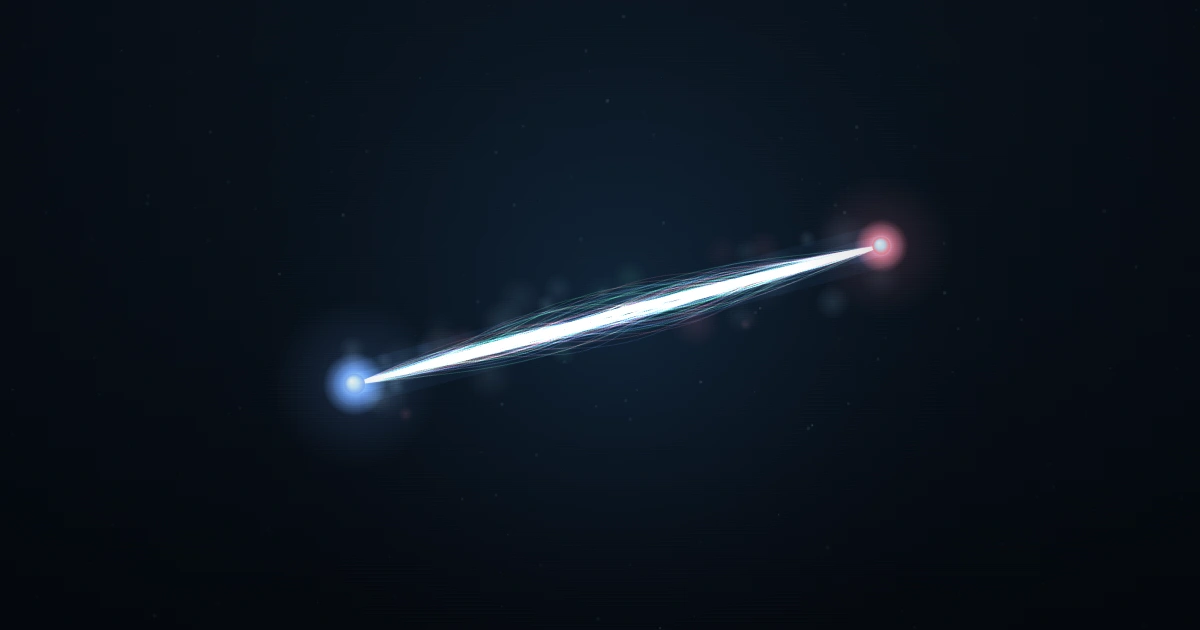
Separate two static colour charges and the field between them does not spread out. Gluon self-attraction squeezes the field lines into a narrow cylinder roughly a fermi across, called a flux tube or string. The energy stored in a tube is proportional to its length, exactly like stretching a rubber band.
The number that defines confinement. Lattice calculations give a string tension whose square root is about 440 to 460 MeV. In more familiar units that is roughly 1 GeV of energy for every fermi of separation, or about 15 tonnes of force. Crucially, it is constant. Doubling the distance doubles the stored energy and leaves the force unchanged.
A constant force means infinite energy to achieve infinite separation. That single fact is the whole of confinement, expressed in the potential between a quark and an antiquark: a Coulomb-like attraction at short range from single-gluon exchange, plus a term that rises linearly and never stops.
Pull hard enough and you make new particles
The rubber band analogy has one flaw, and it is the interesting part. Real rubber bands snap and leave two loose ends. A flux tube snaps and leaves no loose ends at all.
What happens instead. Once the tube holds more energy than it costs to create a quark and antiquark from the vacuum, the vacuum supplies exactly that. The new pair appears inside the tube and caps both broken ends. You started with one quark and one antiquark joined by a string. You end with two colour-neutral mesons. The quark you were pulling on is still bound, just to a different partner.
Where it breaks. Lattice QCD can now watch this happen. A 2019 calculation with dynamical up, down and strange quarks put the breaking distance near 1.23 fm for light quarks and 1.35 fm for strange. A 2026 study of the chromo-electric field at physical quark masses places it between 0.96 and 1.16 fm. The measurements do not yet agree, which tells you how hard the calculation remains.
Figure 1
The potential that never lets go
Energy stored between a static quark and antiquark as you pull them apart. The straight middle section is confinement. The flat end is the string breaking.
The flat section is why confinement is not observable directly. Adding energy past the break does not increase the separation of the original pair. It produces more particles instead.
Shape and scale from lattice QCD. String tension √σ ≈ 440–460 MeV. Breaking distance: 1.23 fm (Bulava et al. 2019, light quarks) and 0.96–1.16 fm (Cea et al. 2026, physical masses). Curve is schematic, drawn to the measured parameters.
The static potential between a quark and an antiquark. At short range it resembles the Coulomb potential of electromagnetism, then it rises in a straight line at roughly one GeV per fermi, and it flattens abruptly once the flux tube has enough energy to create a new quark pair. The force in the linear region is constant at about 15 tonnes, which is why separating a quark would take infinite energy. Sources: arXiv:1902.04006 · arXiv:2607.07143
What experiments see instead
Collide an electron and a positron at high energy and you can produce a quark and an antiquark flying apart at nearly light speed. String breaking happens along the way, repeatedly, and the detector records two narrow sprays of hadrons travelling in the original quark directions. These are jets. A jet is the visible fossil of a quark that was never visible.
The direct searches came up empty. A free quark would carry a charge of one third or two thirds of an electron’s, and such a thing would be unmistakable in a Millikan-style measurement. Experimenters have looked in bulk matter for decades. The most sensitive search examined 70 mg of silicone oil and set an upper limit of 1.17 × 10⁻²² fractionally charged particles per nucleon at 95 percent confidence. A 1981 claim of fractional charges in niobium did not survive a larger follow-up study.
Every particle ever catalogued is colour-neutral. That is an experimental fact, not a theoretical preference.
Why the calculation is so hard
Physics has one general-purpose tool for interacting quantum fields: expand in powers of the coupling and keep the first few terms. It works when the coupling is small. Around 1 GeV, where hadrons live, the QCD coupling is close to 1, so every term in the series matters as much as the last. The tool simply fails.
Lattice QCD is the alternative. Replace continuous spacetime with a four-dimensional grid, put quarks on the sites and gluons on the links, and evaluate the resulting integral numerically. It is a first-principles method and it works. It also has hard limits. Two of them matter here: the sign problem, which makes calculations at high baryon density intractable, and the difficulty of real-time dynamics, since the lattice formulation runs in imaginary time.
Those two gaps are precisely why quantum simulation of gauge theories has become an active research programme. A quantum computer evolves in real time by construction, which is the thing the lattice cannot easily do.
Confinement has never been proven
Everything above is well supported. None of it is a proof.
The mechanism has strong candidate explanations. The leading picture treats the QCD vacuum as a dual superconductor: an ordinary superconductor expels magnetic field into thin flux tubes, and the vacuum does the same to colour-electric field by condensing magnetic monopoles. The picture is compelling and reproduces the phenomenology. It is not derived from the QCD Lagrangian.
The formal statement of the gap. Proving that Yang-Mills theory in four dimensions exists as a rigorous quantum field theory and has a mass gap is one of the seven Clay Millennium Prize Problems. It carries a million-dollar prize and remains unclaimed. Confinement in real QCD is a harder question still.
Established, contested, unproven
Established: the linear potential, the string tension, string breaking, asymptotic freedom, and the total absence of free quarks in every search performed. Contested: which mechanism drives confinement, with the dual superconductor picture leading but not settled. Unproven: that QCD confines at all, as a mathematical statement.
What this underwrites
Confinement is not one topic among many. It is the assumption underneath most of modern hadron physics.
Where mass comes from. The up and down quarks in a proton weigh about 9 MeV in total. The proton weighs 938 MeV. Roughly 99 percent of it is the energy of the confined gluon field, not the Higgs mechanism. Confinement is why you have mass.
Why glueballs should exist. If gluons bind to each other, they should be able to bind into a particle with no quarks at all. Glueball searches are a direct test of the same self-interaction that causes confinement.
Why the quark-gluon plasma matters. Heat matter past roughly 155 MeV and lattice calculations say confinement gives way. Quarks and gluons stop being locked into hadrons. Studying that transition is the only way to observe the confining vacuum by removing it.
Each of those subjects rests on a mechanism that works everywhere it has been tested and has never been derived. That combination is unusual in physics, and worth stating plainly rather than glossing over.
Note on sourcing
String tension and string-breaking distances come from lattice calculations, which carry both statistical and systematic uncertainties and currently disagree at the 20 percent level on where the string breaks. The 2026 result is a preprint and the list says so. The force in tonnes is a unit conversion from the lattice string tension, offered for scale rather than as a measurement. Quark masses are scheme-dependent quantities; the 99 percent figure for the proton is standard but not a precise number.
References
- D. J. Gross & F. Wilczek, Ultraviolet behavior of non-Abelian gauge theories, Phys. Rev. Lett. 30, 1343 (1973). Asymptotic freedom doi:10.1103/PhysRevLett.30.1343
- H. D. Politzer, Reliable perturbative results for strong interactions?, Phys. Rev. Lett. 30, 1346 (1973) doi:10.1103/PhysRevLett.30.1346
- J. Bulava et al., String breaking by light and strange quarks in QCD, Phys. Lett. B 793, 493 (2019). Preprint arXiv:1902.04006 doi:10.1016/j.physletb.2019.05.018
- P. Cea et al., Hints for string breaking in QCD (July 2026). Preprint, not peer-reviewed
- I. T. Lee et al., Large bulk matter search for fractional charge particles, Phys. Rev. D 66, 012002 (2002). Preprint arXiv:hep-ex/0209060 doi:10.1103/PhysRevD.66.012002
- V. Halyo et al., Search for free fractional electric charge elementary particles, Phys. Rev. Lett. 84, 2576 (2000) doi:10.1103/PhysRevLett.84.2576
- R. Sommer, A new way to set the energy scale in lattice gauge theories, Phys. Rept. 275, 1 (1996). Background on the static quark potential and string breaking
- Clay Mathematics Institute, Yang-Mills and the Mass Gap. Millennium Prize Problem, unclaimed
- Particle Data Group, Review of Particle Physics. Source for the strong coupling, quark masses and the proton mass
Common questions
What is confinement?
The fact that quarks are never found alone: the force between colour charges stays roughly constant with distance instead of fading, so separating them costs ever more energy until a new quark-antiquark pair forms and you are left with colour-neutral hadrons.
Why doesn't the strong force weaken with distance?
Because gluons carry colour charge and attract one another, unlike photons, which are neutral. The colour field lines collapse into a narrow flux tube whose energy rises linearly with length, giving a constant force of roughly 15 tonnes.
What is asymptotic freedom?
The opposite behaviour at short range: gluon self-interaction antiscreens colour charge, so the strong coupling becomes weak at high energy. Quarks inside a proton then behave almost freely, which is why deep inelastic scattering revealed them.
Why does string breaking leave no free quark?
When the flux tube stores more energy than it costs to make a quark-antiquark pair, the vacuum supplies one that caps both broken ends. You started with a quark and antiquark joined by a string and end with two colour-neutral mesons.
Where does most of the proton's mass come from?
Not the Higgs. The up and down quarks total about 9 MeV, while the proton is 938 MeV; roughly 99 percent is the energy of the confined gluon field. Confinement is essentially why matter has mass.
Has confinement been proven?
No. It is supported by the linear potential, string breaking, asymptotic freedom and the total absence of free quarks, but it has never been derived from QCD. Proving that four-dimensional Yang-Mills has a mass gap is an unclaimed Clay Millennium Prize Problem.
How does this connect to quantum simulation?
Lattice QCD, the first-principles tool, struggles with real-time dynamics and finite density because of the sign problem. A quantum computer evolves in real time by construction, which is why quantum simulation of gauge theories has become an active programme.
1 response