
The Latest in Quantum Computing: The Advances Reshaping the Field
Error correction crossed the threshold, a quantum advantage became verifiable, and the cost of breaking RSA fell — on maths, not hardware. What actually changed, and what each result promises.

Eighteen months ago, quantum error correction was a promise on a whiteboard. It is now working hardware — and that single shift reorganises everything else happening in the field. Here is what actually changed between December 2024 and mid-2026, what the physics behind each result is, and what each one promises.
Error correction dropped below the surface-code threshold
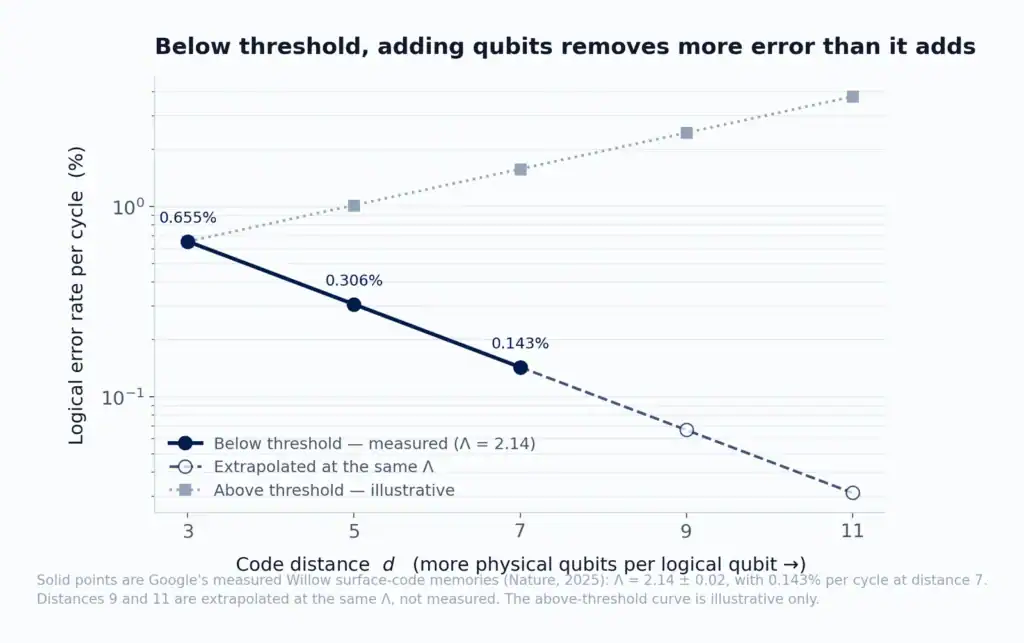
A single physical qubit is fragile: a stray photon, a trace of heat, or a wandering magnetic field can flip its state and ruin a calculation. The accepted fix is a logical qubit — spread one unit of quantum information across many physical qubits and run constant parity checks that catch errors by inspecting a qubit’s neighbours, never the encoded data itself, since measuring the data directly would collapse the superposition. The most-studied scheme, the surface code, lays qubits out in a two-dimensional grid and reconstructs where an error occurred from those neighbour measurements. There is a catch, called the threshold: this machinery only helps if the raw hardware is already good enough. Above that critical error rate, adding qubits adds more noise than it removes.
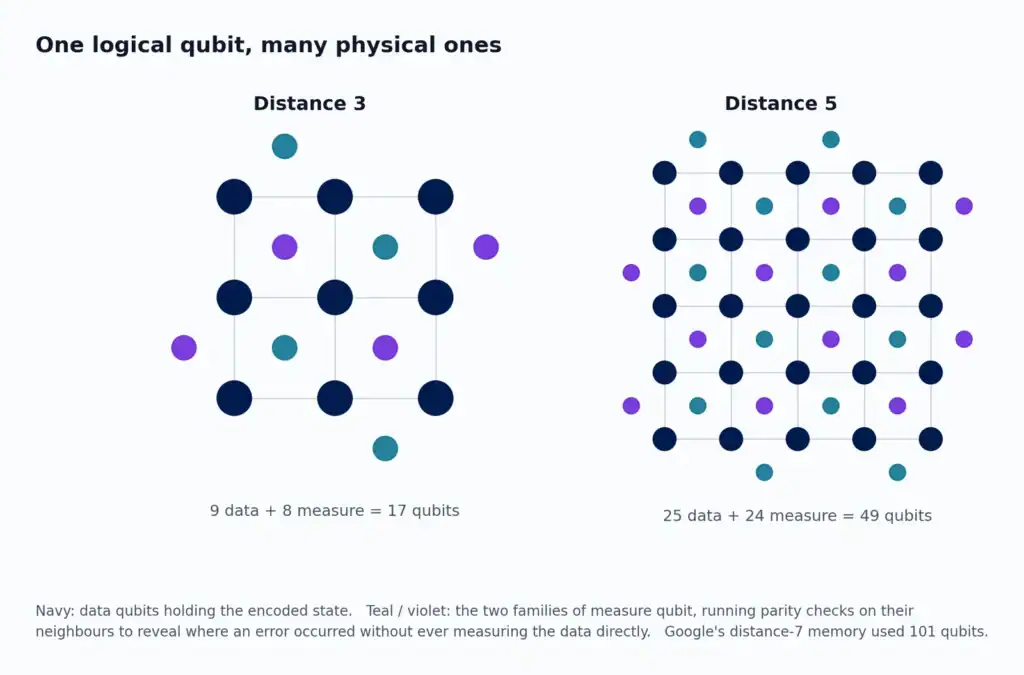
Google’s Willow processor — 105 physical qubits — is the first hardware to cross that line cleanly. Reporting in Nature in February 2025, the team ran a distance-7 surface-code memory and a distance-5 memory with a real-time decoder. The logical error rate fell by a factor of Λ = 2.14 ± 0.02 for every two-step increase in code distance, reaching 0.143% ± 0.003% error per correction cycle on a 101-qubit distance-7 code. The memory also passed “break-even,” outliving its best individual physical qubit by a factor of 2.4 ± 0.3.
What it promises
The first hardware-scale confirmation that the surface code obeys the scaling curve theorists predicted for decades. More qubits now means fewer errors — the precondition for every fault-tolerant machine, and the foundation everything below stands on.
The first verifiable — and physically useful — quantum advantage
Proving a quantum computer has beaten a classical one is harder than it sounds, because for most “supremacy” tasks there is no way to independently confirm the answer is right. An out-of-time-order correlator, or OTOC, offers a way through. It measures how a disturbance to a single qubit ripples outward and scrambles through an entangled system — the same information-scrambling that makes quantum chaos, and even black-hole physics, so hard to reverse. The technique works like a precise echo: perturb one qubit, run the system’s evolution backward in time, and listen for the signal that constructive interference amplifies on the return trip.
In October 2025 Google ran exactly this on Willow — an algorithm it calls Quantum Echoes, published in Nature — and reports it ran roughly 13,000 times faster than the best classical algorithm on one of the fastest classical supercomputers. The decisive word is verifiable: the result can be reproduced on another quantum machine of the same calibre. Google reports it spent on the order of ten person-years stress-testing the claim against nine separate classical simulation algorithms before publishing.
What it promises
Unlike 2019’s abstract sampling task, this points at real applications — learning the structure of molecules and materials, and quantum-enhanced NMR for drug discovery. It is the clearest step so far from benchmark to usable tool.
Neutral atoms solved continuous operation
This platform throws out etched circuits entirely. It traps individual rubidium atoms in “optical tweezers” — tightly focused laser beams that hold one atom each — and stores quantum information in the energy states of the atom’s outer electron, which stay coherent for seconds. To entangle two atoms, you drive them into bloated, high-energy Rydberg states so they can feel each other’s presence. The platform’s long-standing weakness was mundane but fatal: atoms slowly drift out of their traps, capping how long a computation could run.
The Harvard–MIT–QuEra collaboration cleared that barrier. In Nature in September 2025, Mikhail Lukin’s group ran an array of more than 3,000 atoms continuously for over two hours, replenishing atoms mid-computation. A second Nature paper that November demonstrated a neutral-atom system detecting and removing errors below the performance threshold. QuEra raised over $230 million in 2025 — backers include Google Quantum AI, SoftBank and NVIDIA — and is targeting roughly 100 logical qubits on about 10,000 physical atoms.
What it promises
A path to many high-quality logical qubits that run indefinitely. It is the reason a growing number of researchers now see neutral atoms as a front-runner for large-scale fault tolerance.
The physical-to-logical overhead collapsed
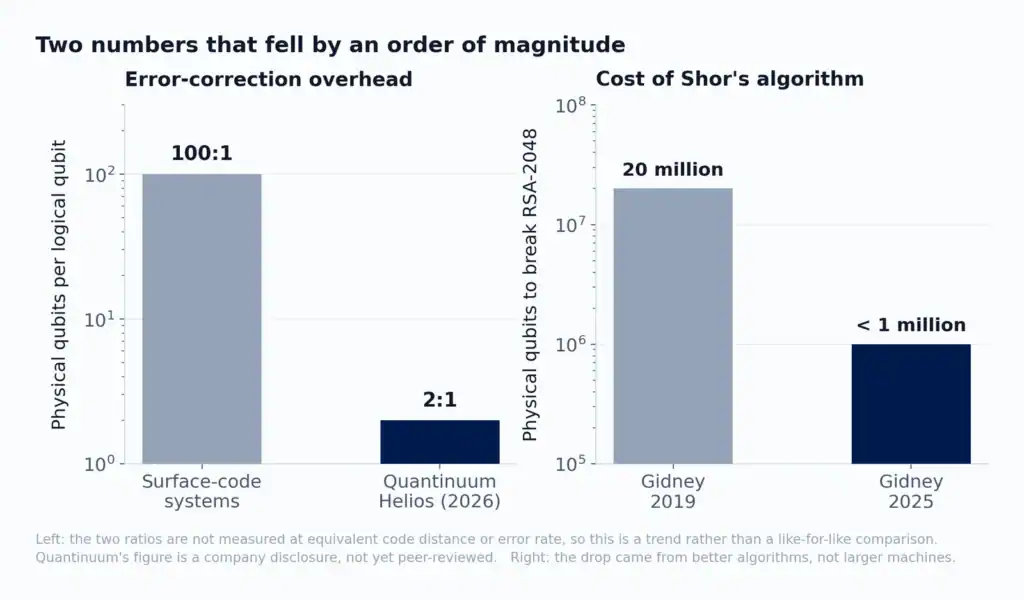
The number that quietly decides when useful machines arrive is not raw qubit count but overhead — how many physical qubits it takes to build one reliable logical qubit. Because error correction is expensive, that ratio has, until recently, run anywhere from dozens to well over a thousand physical qubits each. Drive it down and a useful machine needs far fewer parts.
That ratio just fell by more than an order of magnitude. Quantinuum reported that its trapped-ion Helios system produced 48 logical qubits from only 98 physical qubits — a 2:1 overhead — against a prior best-in-class figure of up to 100:1. QuEra reported the same 2:1 ratio on neutral atoms using high-rate qLDPC codes in April 2026. Quantinuum’s roadmap continues to Sol in 2027, around 100 logical qubits approaching “five nines” fidelity, and Apollo in 2029, hundreds of logical qubits at “ten nines” — roughly 10 billion operations before an error.
What it promises
The strongest near-term signal that genuinely useful machines could arrive this decade rather than next — though the roadmap targets remain unproven, and the overhead figures come from company disclosures rather than peer review.
Cat qubits: error protection built into the hardware
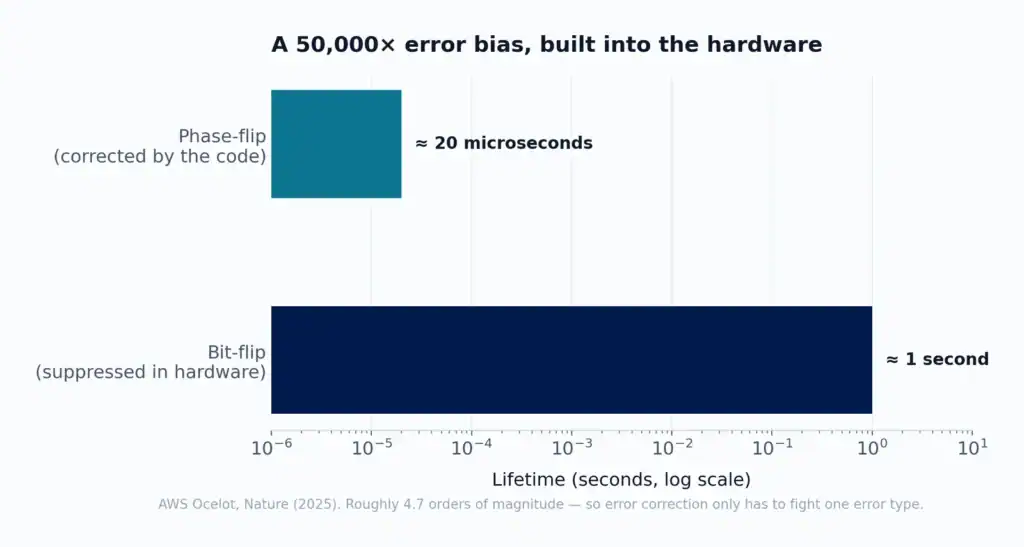
A cat qubit takes Schrödinger’s famous thought experiment literally. Rather than storing a 0 or 1 in the state of a single particle, it encodes information in two opposite-phase waves of microwave light coexisting inside a superconducting cavity — the “alive and dead” cat, made real as two coherent states of the same field. The payoff is structural. Flipping the bit would mean reversing that entire macroscopic wave at once, which the physics makes exponentially unlikely as you make the “cat” larger. One whole class of error — bit-flips — is suppressed in hardware, before any error-correcting code runs. That leaves engineers fighting mostly a single, well-understood error, phase-flips, which is a far easier problem than correcting both at once.
AWS built the idea into silicon with its Ocelot chip, published in Nature in February 2025, using coherent states in superconducting tantalum resonators. The measured asymmetry is striking: bit-flip lifetimes approaching one second against phase-flip times near 20 microseconds. AWS projects this can cut error-correction overhead by up to roughly 90% versus conventional transmon approaches. The French startup Alice & Bob, pursuing the same architecture, reported bit-flip stability exceeding an hour on its Helium 2 chip.
What it promises
Fault tolerance with dramatically fewer physical qubits. The open question is whether the two-qubit gates that preserve this built-in bias can reach the fidelity fault tolerance demands — if they can, it is arguably the most qubit-efficient superconducting route on the board.
Topological qubits: bold new claims, unresolved evidence
This is the most theoretically beautiful idea in the field, and the most disputed. A topological qubit would be built from Majorana zero modes — exotic quasiparticles predicted to appear at the ends of specially engineered nanowires. A Majorana mode is its own antiparticle, and, crucially, a pair of them stores a bit of information non-locally, smeared across two distant points at once. Local noise can only touch one location at a time, so it cannot easily corrupt data spread across both. The protection is baked into the topology itself, which in principle would slash the number of error-correcting qubits needed. The difficulty is equally fundamental: proving these modes genuinely exist inside a real device is very hard.
Microsoft’s Majorana 1 chip was published in Nature in 2025 with an unusual editors’ note stating that the results do not represent evidence for Majorana zero modes in the reported devices. In 2026 the company unveiled Majorana 2, swapping aluminium for lead to strengthen the electron pairing and reporting that the key quantum state now persists for reporting parity lifetimes of around 20 seconds, some reaching minute-scale — orders of magnitude longer than the microsecond timescale of qubit operations — a change Microsoft says lets it move its useful-machine target from 2033 to 2029. Independent skepticism has if anything intensified: a peer-reviewed Nature critique by Henry Legg challenges the Topological Gap Protocol that underpins the claims, and the field remembers that Microsoft retracted an earlier Majorana claim in 2018. Majorana fermions, first proposed by Ettore Majorana in 1937, have still never been unambiguously observed.
What it promises — conditionally
If the physics holds, intrinsically robust qubits that could largely sidestep the overhead problem. But the central evidence is not yet settled, and much of the independent community remains unconvinced.
The roadmaps became shipping hardware
Most of these efforts share a design philosophy: rather than build one enormous chip, build one reliable module and scale by wiring many together, the way classical supercomputers scale. The major roadmaps stopped being slideware in this window. IBM delivered its Nighthawk processor — 120 qubits, capable of circuits around 5,000 gates — to users by the end of 2025, and unveiled Loon, an experimental chip carrying the components needed for fault tolerance, including long-range “c-couplers” that link non-adjacent qubits and the architecture for high-rate qLDPC codes. IBM is targeting verified quantum advantage in 2026 and a large-scale fault-tolerant machine, Starling — 200 logical qubits capable of 100 million operations — by 2029. Separately, Google announced a neutral-atom programme based in Boulder alongside its superconducting effort.
What it promises
A dated, public path from today’s noisy chips to a fault-tolerant machine — and, in Google’s second bet, a sign that even the leaders are hedging on which hardware ultimately wins.
The cryptographic timeline moved — on maths, not hardware
Shor’s algorithm, published in 1994, is the reason quantum computing keeps cryptographers awake. RSA encryption is secure because factoring the product of two enormous primes is effectively impossible for a classical computer; Shor reframes that factoring as a period-finding problem a quantum computer can solve efficiently. The looming concern is “harvest now, decrypt later” — adversaries storing encrypted data today to crack once a large enough machine exists.
The estimated cost of that attack fell sharply, and the driver was algorithmic rather than a bigger machine. Google’s Craig Gidney published the canonical 2019 estimate: roughly 20 million physical qubits running about 8 hours. In May 2025 he revised it to fewer than one million physical qubits — a roughly 20-fold reduction, though at the cost of a longer runtime, under a week rather than eight hours. The saving comes from approximate residue arithmetic, yoked surface codes for idle qubits, and cheaper magic-state distillation. Further theoretical work pushes logical-qubit counts lower still — one scheme reaches roughly 1,730 logical qubits for RSA-2048, at the cost of trillions of gate operations.
What it promises — or threatens
Less a capability than a countdown. The essential caveat is that these are resource estimates on machines that do not yet exist, and no current processor is remotely near the million-qubit mark. The defence is already standardised: NIST finalised its first post-quantum cryptography standards — ML-KEM, ML-DSA and SLH-DSA — in August 2024, with quantum-vulnerable algorithms slated for deprecation after 2030. That is why migration is already underway.
References
- Google Quantum AI, Quantum error correction below the surface code threshold, Nature 638, 920 (2025); preprint arXiv:2408.13687; DOI 10.1038/s41586-024-08449-y
- Google Quantum AI, Quantum Echoes — verifiable quantum advantage via OTOC, Nature (2025)
- Harvard–MIT–QuEra (Lukin group), continuous operation of a 3,000+ atom array, Nature (September 2025)
- Harvard, neutral-atom below-threshold error correction, Nature (November 2025)
- Putterman et al., Hardware-efficient quantum error correction via concatenated bosonic qubits, Nature 638, 927–934 (2025)
- Aghaee et al., 20 Second Parity Lifetime in an InAs–Pb Tetron Device, arXiv:2606.03884 (2026)
- Quantinuum, Helios logical-qubit results — company disclosures (2026)
- C. Gidney & M. Ekerå, RSA-2048 factoring resource estimates (2019; revised May 2025); NIST FIPS 203 / 204 / 205 (August 2024)
Note on sourcing
Hardware and error-correction figures trace to peer-reviewed Nature papers or preprints. The Quantinuum overhead figures come from company disclosures and are not yet independently peer-reviewed. The Majorana results are actively contested in the literature. The cryptographic figures are theoretical resource estimates on machines that have not been built.
3 responses