
What Is the Measurement Problem in Quantum Mechanics?
Quantum theory has two rules for how states change and no agreed account of when the second one applies. A century on, experiments are finally narrowing the options.
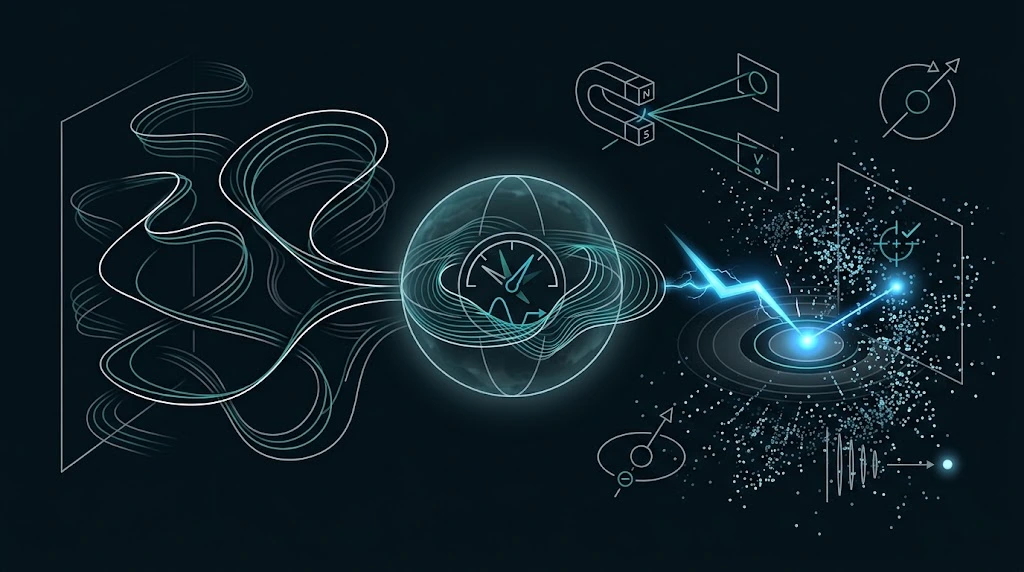
The measurement problem is a contradiction at the heart of quantum mechanics. One rule says a quantum state changes smoothly and predictably, following the Schrödinger equation. A second rule says a measurement gives one definite result, picked at random. The theory never says when the second rule takes over, what counts as a measurement, or whether “collapse” is a real physical event.
Our guide to quantum mechanics lists measurement as the third of its three rules and flags that it sits uneasily with the second. This article explains why. It covers the clash itself, what decoherence explains and what it leaves open, the three main ways out, and the experiments now closing some of those exits.
A century after the theory took shape, experts still split down the middle. In a 2025 Nature survey of more than 1,100 researchers, 45% said a boundary between the quantum and classical worlds exists. Another 45% said it does not.
The two rules that clash
Rule one is the Schrödinger equation. Given a quantum state now, it fixes the state at every later time. It is deterministic and reversible. It is also linear: if two states are allowed, so is any superposition of them. Nothing in the equation ever picks one branch over another.
Rule two is the measurement postulate. When you measure a quantity, the state jumps to one of that quantity’s definite values. The Born rule gives the probability of each result: the squared size of that part of the state. The jump is random, irreversible and non-linear.
No amount of rule one produces rule two. A linear, deterministic equation cannot output a random choice between branches. So quantum mechanics runs on two laws of motion that contradict each other. It needs a third ingredient to say which one applies, and textbooks supply it with a single word: “measurement”. They never define that word in physical terms.
John Bell made this complaint famous in his 1990 essay “Against ‘measurement'”. His point was simple. A fundamental theory should not depend on a word that has no exact physical meaning.
A concrete example: one spin and one detector
Take an electron whose spin points sideways. Measured along the vertical axis, it has equal chances of reading up or down. In quantum terms, its state is an equal superposition of up and down.
Now send it through a Stern–Gerlach magnet with a detector that displays “UP” or “DOWN”. The detector is made of atoms, so treat it as a quantum system too. Run the Schrödinger equation on electron and detector together. The answer is not “the detector shows UP” or “the detector shows DOWN”. It is an entangled state:
|↑⟩|UP⟩ + |↓⟩|DOWN⟩
Here |UP⟩ means the detector displays UP, and the normalising factor 1/√2 is left out for clarity. The superposition has spread from the electron to the machine.
Yet every real laboratory records a single reading: UP about half the time, DOWN about half the time. The gap between that entangled state and the single reading is the measurement problem in miniature. The same logic applies to a double-slit experiment with a which-path detector, or to any pair of entangled systems.
The von Neumann chain and the Heisenberg cut
John von Neumann made the problem precise in his 1932 textbook. A camera reads the detector’s display. A person reads the camera’s file. Every link is made of atoms. Apply the Schrödinger equation to each one and the entanglement simply spreads down the chain. No link ever produces a single outcome.
So at some point you must stop using rule one and switch to rule two. Physicists call that switching point the Heisenberg cut. Von Neumann showed something awkward about it. The predictions come out identical wherever you put the cut: after the detector, after the camera or after the retina. The theory works perfectly, and it gives no reason to prefer any position.
Where does the quantum description stop?
Every link in a measurement chain is made of atoms, so each can be treated quantum mechanically. Somewhere you must switch to the Born rule.
Fritz London and Edmond Bauer in 1939, and later Eugene Wigner in 1961, suggested the chain ends in the observer’s consciousness. Wigner later moved away from the idea. Few physicists hold it today.
Schrödinger’s cat is the same chain, scaled up
Erwin Schrödinger made the point vivid in 1935. His thought experiment links one radioactive atom to a Geiger counter, a hammer, a vial of poison and a cat. Run the Schrödinger equation on the whole box and you get a superposition of a live cat and a dead cat.
Schrödinger meant this as a reductio ad absurdum. He was signalling that something in the standard account is missing, not claiming that cats are half alive. It is the von Neumann chain with a cat in place of the pointer. Our explainer on Schrödinger’s cat tells the full story.
What decoherence explains
Decoherence is the best-established part of the answer. It is standard quantum mechanics, not an interpretation. A detector, a cat or a dust grain constantly interacts with air molecules, stray photons and heat. Each interaction carries away information about which branch the object is in. Within a tiny fraction of a second, the branches can no longer interfere in any measurable way.
The environment also picks out which states survive. Wojciech Zurek calls this einselection. The environment constantly monitors the positions of large objects, and position states survive that monitoring. That is why the world looks like objects in definite places, not odd blends of places.
Experiments have watched decoherence happen. In 1996, Serge Haroche’s group in Paris tracked a microwave field in a cavity as it lost its quantum coherence step by step. In 2003, a Vienna team sent C70 molecules through an interferometer while adding background gas. The interference faded exactly as decoherence theory predicted. Our article on decoherence covers the mechanism in detail.
What decoherence leaves open
Decoherence does not pick an outcome. After decoherence, the combined state of object plus environment is still a superposition of every branch. Each branch is now hidden from the others, but nothing in the equations has removed any of them.
The mathematics makes this sharp. Ignore the environment, and the object’s state looks exactly like a classical coin toss: UP with probability one half, DOWN with probability one half. Physicists call this an improper mixture. It gives the right statistics, but it is not a single result. Maximilian Schlosshauer’s 2004 review in Reviews of Modern Physics sets out the distinction carefully.
So decoherence explains why we never see interference between a live cat and a dead cat. It does not explain why we see one cat. That leftover question is often called the problem of outcomes. It is the hard core of the measurement problem.
Three ways out, and what each gives up
In 1995, the philosopher Tim Maudlin showed that three claims cannot all hold together. One: the wave function is a complete description of a system. Two: it always evolves by the linear Schrödinger equation. Three: measurements have single, definite outcomes. Every realist solution keeps two and gives up one.
Give up completeness: hidden variables. Bohmian mechanics, developed by David Bohm in 1952, adds real particle positions guided by the wave function. Outcomes are definite because particles are always somewhere. The price is explicit nonlocality.
Give up linearity: objective collapse. The GRW model of 1986 and its successor, continuous spontaneous localisation (CSL), add a small random term to the Schrödinger equation. Collapse becomes a real physical process: rare for one particle, fast for a large object. The price is new constants of nature. The payoff is that these models are testable.
Give up single outcomes: many worlds. Hugh Everett’s 1957 proposal keeps the linear equation for everything. Every outcome occurs, each in its own decohered branch. The price is a vast unseen reality, plus a hard question: what does probability mean when every outcome happens?
Contested: views that reject the premise
A fourth family denies that the wave function is a physical object at all. Copenhagen-style views treat it as a tool for predicting results. QBism treats it as an agent’s personal degrees of belief. Relational quantum mechanics treats every state as relative to another system. On these views, collapse is an update of information, not a physical event, so the problem dissolves. Critics reply that this moves the question rather than answering it: information held by whom, and about what? No experiment currently decides between these readings and the three realist options.
No-go theorems that fence in the answers
Several theorems rule out whole classes of explanation. Each is a mathematical result built on stated assumptions. Experiments then check whether nature breaks those assumptions.
Bell (1964). No theory with local hidden variables can reproduce quantum correlations. Loophole-free tests since 2015 confirm the violation. See our explainer on Bell’s theorem.
Kochen–Specker (1967). Measurement results cannot all be fixed in advance, independently of which other compatible measurements you make alongside them. Physicists call this property contextuality.
Pusey–Barrett–Rudolph (2012). Add one assumption about independent preparations, and the wave function cannot be mere information about some deeper physical state. It must correspond to something real. This squeezes some information-based readings.
Extended Wigner’s friend (2018). Daniela Frauchiger and Renato Renner, and separately Časlav Brukner, analysed set-ups in which observers are themselves quantum systems. Their results show that several innocent-looking assumptions about observers and their reasoning cannot all hold together.
Wigner’s friend in the laboratory
Eugene Wigner imagined a friend who measures a quantum system inside a sealed lab. From inside, the friend sees one result. From outside, Wigner describes friend and system together as an entangled superposition. Both descriptions follow the rules. Which one is right?
In 2020, Kok-Wei Bong and colleagues turned the puzzle into a testable inequality, the Local Friendliness no-go theorem. It rests on two assumptions. First, an observed event is a fact for everyone. Second, a free choice of measurement can only affect events in its own future. Quantum theory predicts a violation, and the team measured one with entangled photons.
A year earlier, Massimiliano Proietti and colleagues at Heriot-Watt University in Edinburgh tested a related inequality with six photons. They found a violation of about five standard deviations. (For what that threshold means, see what 5 sigma means.)
The catch is that the “friends” in these experiments are photons. Few people would call a photon an observer. Current work runs the friend as a circuit on a quantum computer. The long-term aim, set out by Howard Wiseman and colleagues in 2023, is a friend that is an artificial intelligence running on a large quantum computer.
Measurement as a process you can watch
Textbook collapse is instantaneous. Real measurements are not. In 2019, Zlatko Minev and colleagues at Yale watched a superconducting artificial atom continuously. They showed that a quantum jump, once under way, follows a smooth and predictable path. They could even catch a jump mid-flight and reverse it.
This supports the quantum-trajectory picture, in which a measurement is a continuous physical interaction with a definite strength. Weak measurements, and the mid-circuit measurements used in quantum computers, work the same way.
It does not settle the measurement problem. Whether a jump starts at all is still random, and the trajectory picture still assumes a measurement record. What the experiment removes is the cartoon of collapse as a sudden, unexplained snap.
Collapse models are being pushed into a corner
Collapse models make a prediction that other interpretations do not. The random collapse process jiggles charged particles. Jiggling charges radiate, so ordinary matter should glow very faintly in X-rays.
In 2020, a team working deep under the Gran Sasso mountain in Italy looked for that glow with a germanium detector. They found nothing beyond known backgrounds. The null result ruled out the simplest, parameter-free version of the Diósi–Penrose model, in which gravity triggers collapse.
In 2026, the XENONnT collaboration repeated the search with its dark-matter detector, the kind of instrument described in our piece on what a dark matter detector actually measures. CSL has two parameters: a collapse rate λ and a length scale rC. Using data from 1 to 140 keV, XENONnT set λ/rC2 < 3.0 × 10⁻³ s−1 m−2 at 90% confidence. That beats the previous best limit by a factor of about 135. For the first time, it excludes the parameter values originally proposed for CSL.
One caveat matters. These X-ray limits apply to the simplest versions of the models, in which the collapse noise is “white” and contains all frequencies. Versions with a frequency cutoff radiate far less and survive. Slow mechanical tests, such as vibrating cantilevers and the LISA Pathfinder spacecraft, constrain those versions instead.
Superpositions keep getting bigger
If collapse is real, large objects should lose their quantum behaviour even in perfect isolation. So the other strategy is to build ever-bigger superpositions and see whether they fail.
They have not failed yet. In 2019, Markus Arndt’s group in Vienna made molecules of about 2,000 atoms and more than 25,000 atomic mass units interfere. In January 2026, the same group reported interference of sodium nanoclusters with more than 7,000 atoms each and masses above 170,000 atomic mass units. On the macroscopicity scale, which rates how strongly an experiment constrains collapse, the result reached μ = 15.5. That is an order of magnitude beyond earlier experiments.
A different route uses vibration instead of flight. In 2023, a team at ETH Zurich put a 16-microgram crystal into a Schrödinger cat state of motion. The two branches differed by far less than the width of an atom, but the object contained roughly 1017 atoms.
Every one of these experiments agrees with standard quantum mechanics. Each result pushes the allowed collapse parameters further down.
Gravity may hold the next clue
Roger Penrose and Lajos Diósi argued that gravity itself might trigger collapse. A superposed mass curves spacetime in two different ways at once, and Penrose suggested nature cannot sustain that for long. The underground radiation searches have already ruled out the simplest version of this idea.
A second line asks whether gravity can entangle two masses at all. In 2017, two groups proposed a test: Sougato Bose and colleagues, and Chiara Marletto with Vlatko Vedral. Put two tiny masses into superpositions and let only gravity act between them. If they end up entangled, gravity must have a quantum character.
No experiment is close yet. The smallest mass whose gravity anyone has measured is a gold sphere of about 90 milligrams, studied in Vienna in 2021. The proposals need masses around 10−14 kilograms held in spatial superpositions far larger than any achieved so far. Theorists also dispute what a positive result would prove. Treat this line as proposals, not results.
What physicists actually think
There is no consensus, and the numbers show it. For the quantum centenary in 2025, Nature emailed more than 15,000 researchers who publish on quantum mechanics and received more than 1,100 responses. The Copenhagen interpretation came first with 36%. Information-based views took 17%, many-worlds 15%, Bohmian mechanics 7% and spontaneous collapse about 4%.
Confidence was low. Only 24% thought their favoured interpretation was actually correct. The rest called it adequate or a useful tool. Asked whether the wave function is real, 36% said yes, 47% called it a useful tool and 8% called it a subjective belief.
A survey is not evidence about nature. What it shows is that the measurement problem is not a solved question that the public has failed to hear about. The experts themselves disagree.
What the measurement problem does not mean
It is not about consciousness. The idea that a mind causes collapse is a minority speculation. No experiment supports it.
It is not about human observers. A photodiode, a Geiger counter or a stray air molecule plays the same role as a person in the von Neumann chain.
It is not about clumsy instruments. A probe can disturb what it measures, and the uncertainty principle limits what any state can have. Both effects are real, but neither is the measurement problem.
It is not solved by decoherence alone. Decoherence explains why interference vanishes, not why one outcome occurs.
It does not threaten the predictions. Every mainstream interpretation gives the same numbers for standard experiments. Only collapse models predict different physics, which is exactly why they are the ones under test.
Where the measurement problem stands now
A century after quantum mechanics took shape, the measurement problem is still open. It has changed character, though. It used to be a debate between interpretations that made identical predictions. Collapse models turned part of it into physics that detectors can test, and those detectors keep returning null results. Bigger superpositions keep working. Wigner’s-friend inequalities have moved into the laboratory.
The honest summary is short. Every experiment so far agrees with standard quantum mechanics. None has told us which of the remaining stories is true. The next clues will come from heavier interferometers, quieter mechanical sensors, cleaner underground detectors and, perhaps one day, an artificial observer running on a quantum computer.
Note on sourcing
Every experimental result here comes from a peer-reviewed paper listed in the references. That includes Donadi et al. (2021), XENONnT (2026), Pedalino et al. (2026), Bild et al. (2023), Proietti et al. (2019), Bong et al. (2020) and Minev et al. (2019). The survey figures come from Nature’s 2025 news feature, which reports a poll, not a measurement. Gravity-induced entanglement and AI-observer Wigner’s-friend tests are proposals, not results. The interpretations appear as competing positions. The figure is a schematic.
References
- J. von Neumann, Mathematische Grundlagen der Quantenmechanik (Springer, Berlin, 1932)
- E. Schrödinger, Die gegenwärtige Situation in der Quantenmechanik, Die Naturwissenschaften 23, 807 (1935) doi:10.1007/BF01491891
- F. London and E. Bauer, La théorie de l'observation en mécanique quantique (Hermann, Paris, 1939)
- E. P. Wigner, Remarks on the mind-body question, in The Scientist Speculates, ed. I. J. Good (Heinemann, London, 1961)
- J. S. Bell, Against 'measurement', Physics World 3(8), 33 (1990) doi:10.1088/2058-7058/3/8/26
- J. S. Bell, On the Einstein Podolsky Rosen paradox, Physics 1, 195 (1964) doi:10.1103/PhysicsPhysiqueFizika.1.195
- B. Hensen et al., Loophole-free Bell inequality violation using electron spins separated by 1.3 kilometres, Nature 526, 682 (2015) doi:10.1038/nature15759
- S. Kochen and E. P. Specker, The problem of hidden variables in quantum mechanics, Journal of Mathematics and Mechanics 17, 59 (1967)
- T. Maudlin, Three measurement problems, Topoi 14, 7 (1995) doi:10.1007/BF00763473
- D. Bohm, A suggested interpretation of the quantum theory in terms of hidden variables I, Physical Review 85, 166 (1952) doi:10.1103/PhysRev.85.166
- H. Everett, Relative state formulation of quantum mechanics, Reviews of Modern Physics 29, 454 (1957) doi:10.1103/RevModPhys.29.454
- G. C. Ghirardi, A. Rimini and T. Weber, Unified dynamics for microscopic and macroscopic systems, Physical Review D 34, 470 (1986) doi:10.1103/PhysRevD.34.470
- G. C. Ghirardi, P. Pearle and A. Rimini, Markov processes in Hilbert space and continuous spontaneous localization of systems of identical particles, Physical Review A 42, 78 (1990) doi:10.1103/PhysRevA.42.78
- L. Diósi, Models for universal reduction of macroscopic quantum fluctuations, Physical Review A 40, 1165 (1989) doi:10.1103/PhysRevA.40.1165
- R. Penrose, On gravity's role in quantum state reduction, General Relativity and Gravitation 28, 581 (1996) doi:10.1007/BF02105068
Common questions
What is the measurement problem in simple terms?
Quantum states evolve smoothly into superpositions, but every measurement gives one definite result. Quantum mechanics does not explain when or how that switch happens, or what counts as a measurement.
What is wave function collapse?
It is the textbook rule that a quantum state jumps to one definite value when measured. Whether collapse is a real physical process or just an update of information is exactly what the measurement problem disputes.
Does observing a particle change it?
Measuring a particle means letting it interact with a device, which entangles the two and usually disturbs the particle. No human observer is needed. A detector or even a stray air molecule has the same effect.
Does consciousness cause wave function collapse?
That is a minority speculation, proposed by London and Bauer and later by Wigner, who moved away from it. No experiment supports it, and standard physics treats any recording interaction as a measurement.
Has decoherence solved the measurement problem?
Not fully. Decoherence explains why we never see interference between outcomes and why objects look classical. It does not explain why only one outcome occurs.
What is the Heisenberg cut?
It is the line between the part of an experiment described quantum mechanically and the part treated as classical. Predictions do not depend on where you draw it, and the theory does not say where it belongs.
How is Schrödinger's cat related to the measurement problem?
The cat is Schrödinger's 1935 illustration of the von Neumann chain. Following the Schrödinger equation, a superposition spreads from one atom to a whole cat, yet nobody ever sees a half-alive cat.
What is Wigner's friend?
It is a thought experiment in which a friend measures a system inside a sealed lab while Wigner, outside, describes friend and system as one entangled superposition. Extended versions now give inequalities that experiments can test.
Can the measurement problem be tested experimentally?
Partly. Collapse models predict faint X-ray emission and a loss of interference for large objects. Underground detectors, including XENONnT in 2026, have excluded their simplest versions, and ever-larger superpositions keep behaving normally.
Which interpretation of quantum mechanics do most physicists accept?
None has a majority. In a 2025 Nature survey of more than 1,100 researchers, Copenhagen led with 36%, followed by information-based views at 17% and many-worlds at 15%.
Responses