

Universal Quantum Gates from Anyons: How S3 Topological Computing Works
A 54-qubit trapped-ion experiment demonstrates universal quantum gates using the braiding and fusion of non-Abelian anyons in an S3 quantum double, without relying on magic-state distillation.
In this article
A quantum processor has run a universal gate set built entirely out of moving exotic quasiparticles around one another and fusing them together. Fifty-four qubits, one phase of matter, three operations. Theorists proposed the scheme more than twenty years ago and nobody had built it. It also corrects no errors, throws away roughly a quarter of its shots, and yields its headline state one time in four.
Computing by tying knots in time
Every particle you have met belongs to one of two families. Swap two identical bosons and the quantum state does not change. Swap two identical fermions and the state picks up a minus sign. Three-dimensional space allows nothing else.
Confine matter to two dimensions and a third family opens up. Swap two of these and the state changes by something other than nothing or a minus sign. Physicists call them anyons. They are not fundamental particles but collective excitations of a two-dimensional system, quasiparticles, real things you can track without their being made of anything.
The interesting ones are non-Abelian. For those, the order of the swaps matters. Swap A then B and you land somewhere different than if you had swapped B then A. That non-commutativity makes them useful, because it means a sequence of swaps does arithmetic.
Topology supplies the protection. Draw each anyon’s path through time and you get a set of strands. Move the anyons around one another and the strands braid, the way rope does. The quantum operation depends only on the topology of that braid: which strand crossed over which, and how often.
It does not depend on how fast you moved, how precisely you traced the path, or what local noise the anyon met along the way. A wobble in the trajectory leaves the knot alone. In a conventional quantum computer, every stray photon degrades the state, which is why error correction exists. In a topological one, whole classes of error simply do not matter.
Two ways to use a topological phase
The surface code, which underpins most fault-tolerance roadmaps, hides information in the ground-state subspace of a topological phase and fixes errors by measuring stabilisers over and over. Topological quantum computation does something different. It puts the information in the internal states of the anyons themselves and computes by moving them. This experiment is the second kind. The distinction matters when you read the numbers, because the two approaches use different benchmarks and fail in different ways.
Why braiding alone was not enough
The obstacle has always been which anyons to use. Fibonacci anyons can perform any quantum computation by braiding alone. They are also extremely hard to realise. Conjectured no-go results block scalable preparation, and nobody has found gate sets that keep information from leaking out of the computational space.
The easier phases fail in the opposite direction. Topological orders built from finite groups are the minimal non-Abelian generalisations of the toric code, and hardware can prepare them efficiently. But their braiding operations provably cannot reach every quantum operation. A machine could hold the phase and still not compute with it.
Lo and colleagues take a third route. The team spans Harvard, Quantinuum, Stony Brook and Chicago, and their starting point is that braiding is not the only thing anyons do. They also fuse.
Bring two anyons together and they merge into a single object. Which object you get is itself a measurement outcome, and it reveals something about the state they encoded. Treat that fusion as a computational operation rather than a read-out step and a minimally non-Abelian phase becomes universal. Mochon proved this on paper in 2004. Nobody had built it.
Why S3, the smallest non-Abelian group
The phase here is the quantum double of S3. S3 is the symmetry group of an equilateral triangle: three rotations and three reflections, six elements, the smallest group whose operations refuse to commute.
A quantum double is a recipe that turns a group into a two-dimensional topological phase. The group’s structure decides which anyons appear. S3 yields eight anyon types.
What makes S3 the right choice is a property called cyclic fusion rules. That is the technical condition under which adding fusion to braiding produces universality. An earlier trapped-ion experiment realised a related phase built from the group D4. D4 lacks cyclic fusion rules, so no amount of fusion makes it universal.
Fifty-four qubits, eighteen sites
Building the phase costs more qubits than the headline number suggests. Each edge of the lattice carries a six-state object, one state per group element. That object splits into a qubit paired with a three-state qutrit, and the qutrit itself takes two ions. Three physical qubits per site.
The lattice is three by three, wrapped onto a torus, giving eighteen sites. That comes to 54 of the 56 qubits on Quantinuum’s H2-1, each qubit living in the hyperfine states of a trapped ytterbium-171 ion. Two spare. The team scavenged its ancillas by measuring and resetting qubits that later stages no longer touch.
The torus is not decoration. Wrapping the lattice so it has no edges permits the loops that define the phase’s global structure, and it makes the single-anyon demonstration below possible.
The ground state arrives in two stages. The team first prepares a simpler Abelian phase, a toric code made from qutrits. It then applies a procedure called gauging, which promotes a global symmetry of that phase into a local one and enriches the topological order into non-Abelian S3 order. The certifying stabiliser measurements come out at 0.987(2) and 0.962(4) for the two families of projector. The runs took place on H2-1 between December 2024 and December 2025.
One anyon, alone on a torus
Anyons normally appear in pairs, emerging from the vacuum at the two ends of a string-like operator, and they annihilate back to nothing when they meet. Isolating a single one is a hallmark of genuinely non-Abelian order.
The team gets one by exploiting the fact that two different flux types braid non-trivially with each other. They start from a ground state already threaded with one flux type around one cycle of the torus. They then create a pair of the other type and braid one member of that pair around the other cycle.
That braiding switches the pair out of the vacuum channel. Fusing them back together therefore yields something rather than nothing. A single anyon remains, showing up as one excited plaquette in an otherwise clean lattice.
The paper calls this the first experimental realisation of a single non-Abelian flux anyon in a lattice model with topological order. Its purpose deserves a precise statement. The lone anyon holds no information and performs no computation. It is a diagnostic. It shows the fusion rules are cyclic, and therefore that the phase has the structure universality demands.
Where the information lives
A pair of fluxes whose combined flux is zero holds the logical information. Despite that neutrality, the pair keeps a shared charge degree of freedom that belongs to neither member on its own. The resulting protected space has three dimensions, so the encoded object is a qutrit rather than a qubit. Three logical states instead of two.
Its code distance is simply how far apart the two fluxes sit. No local operation that fails to enclose both of them can read the state or disturb it. That is the topological protection, made concrete.
Three primitives, one gate set
The entangling operation is a pull-through. One flux from the control pair travels all the way around the target pair and returns to where it started. Braiding conjugates the fluxes by their total flux, which at the logical level entangles the two qutrits.
Applied to the right input it yields a qutrit Bell state. The nonlocal correlator that certifies it climbs from 0.32(3) at the start of the protocol to 0.86(3) when the fluxes come home, against a theoretical target of 1.
The other two primitives measure. Both work by braiding an ancillary pair of anyons around the data and reading what the ancillas fuse into.
The first separates the charge-free logical state from the charged subspace, and it does so cleanly. The relevant projector reads 0.84(4) when the input carries no charge and 0.06(3) when it does. The second compares rather than reads absolutely. It tells you whether the data qutrit matches a reference qutrit, not what either one is. Where the two states differ the projector lands at 0.32(4) against a predicted 1/4. Where they match, the fusion is deterministic and reads 0.92(2).
That second measurement is relative, so the scheme needs agreed reference states to compare against. Preskill named this a bureau of standards, and the analogy is exact. A kilogram only means anything against a reference kilogram. The team builds one from three flux pairs compared pairwise, then shifts from an encoding anchored to a fixed origin to a fully relative one. The fixed-origin version has what the authors call an Achilles’ heel: information can leak out through a local charge measurement at that origin.
Magic without distillation
A quantum computer restricted to one well-behaved set of operations, the Clifford gates, gains nothing over a classical machine. A classical computer can simulate it efficiently. Genuine quantum advantage demands at least one operation outside that set.
Most fault-tolerant architectures supply that ingredient as a magic state: a specially prepared resource that, consumed alongside Clifford operations, produces the missing gate. Magic states resist clean preparation, so machines distil them, burning many noisy copies to yield one good one. Distillation is expected to dominate the runtime and qubit budget of any large fault-tolerant computer.
Here topological operations alone make the magic state. Starting from an equal superposition of all three logical values, a comparison measurement against one reference collapses the state into a two-level superposition carrying a complex relative phase. The protocol needs two successive braidings rather than one, so that no net charge escapes and the projection stays coherent.
Charge violations at the lattice origin certify the result. They separate the intended state both from a phase-free superposition and from a fully decohered mixture. The measured weights are 0.11(2), 0.21(3) and 0.68(4) against theoretical values of 1/12, 1/4 and 2/3.
The acceptance rate is 26.52%. Roughly three attempts in four go in the bin.
What the fidelity numbers actually say
Two numbers describe the quality of the prepared ground state, and they sit very far apart. The per-qudit fidelity falls between 0.970(5) and 0.988(3). The fidelity of the whole 54-qubit state falls between 0.58(6) and 0.81(4). Both appear in the paper. The first is the one that will travel.
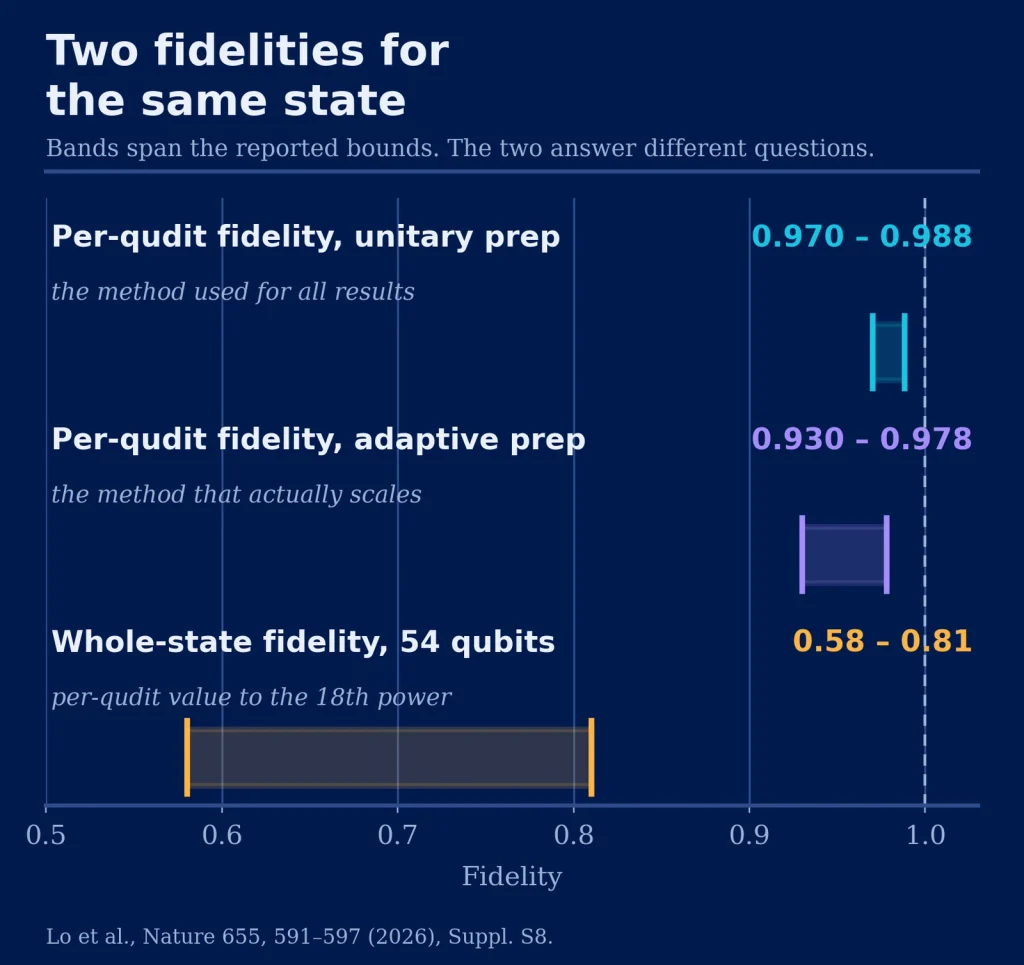
Neither figure lies, and the gap between them is arithmetic rather than sleight of hand. A per-site number raised to the eighteenth power falls fast. But the two answer different questions. The per-qudit fidelity says the local physics is clean. The whole-state fidelity says that on any given shot, the odds of holding the intended eighteen-site wavefunction sit somewhere between just over half and about four fifths.
The scalable method is the lower-fidelity one
A second gap deserves naming. S3 is a solvable group, so the phase also admits a constant-depth preparation that uses mid-circuit measurement and feedforward. That adaptive method, not the one used here, is what guarantees the protocol scales to larger systems.
It performed worse, landing between 0.930(8) and 0.978(2). The team chose a purely unitary circuit instead, for its slightly better fidelity at this system size. They state plainly that future experiments will need the measurement-based route.
Measurement versus interpretation
What the experiment measures: a universal gate set, running on a 54-qubit non-Abelian topological phase, with a magic state made topologically. What it does not measure: that this scales, that it is fault tolerant, or that the approach beats the surface code. The scalable preparation method exists and the team tested it, then set it aside in favour of one that does not scale. Read the result as proof that the primitives work, which is what the paper claims. Do not read it as a working topological computer.
What was not done
The experiment corrects no errors. Hold on to this above everything else. The phrase “fault-tolerant quantum computation” runs through the coverage and through the paper’s own outlook, and in both places it names a destination rather than a result. The paper defers logical error mechanisms and decoding strategies to future work, contingent on scaling beyond three by three.
Post-selection runs through everything. Heralding throws away about 24% of shots on the three-by-three lattice. It checks stabilisers that tend to break when preparation fails, and separately catches qutrits that have leaked outside their computational subspace.
The bureau of standards also post-selects on a particular fusion outcome. There the authors note the post-selection is a convenience rather than a necessity, since the protocol can simply repeat until it succeeds. The magic state acceptance rate of 26.52% is the sharpest version of the same point.
How this differs from the Majorana route
What survives those subtractions is still substantial, and it stands in useful contrast to the other topological approach. Microsoft’s Majorana programme has spent years trying to establish that the quasiparticles it needs exist at all, and its central evidence remains contested in the peer-reviewed literature.
This experiment sidesteps that argument. It does not hunt for non-Abelian anyons in a material. It builds them, deliberately, out of qubits the team already controls, and then computes with them.
The trade is that no genuine energy gap in a physical phase protects anything here. The topological order is a state prepared on hardware, and it decays like any other state on hardware.
What is unresolved
Whether the fidelities survive at larger system sizes, where the adaptive preparation becomes mandatory and the whole-state number has further to fall. Whether decoders for non-Abelian topological order can work in practice, a problem with a substantial theoretical literature but no hardware demonstration. And whether encoding in the fusion space of anyons ends up cheaper than the ground-state approach the surface code already uses. The paper proposes that comparison as future work rather than claiming it.
Why it matters anyway
For two decades the choice in topological quantum computing looked like a dilemma. Phases rich enough to compute universally by braiding were too hard to build. Phases simple enough to build could not compute universally.
The finding here is that the dilemma came from asking braiding to do all the work. Add fusion to the gate set and the smallest non-Abelian group in existence turns out to be enough. The authors describe S3 as a sweet spot, structured enough to prepare efficiently and rich enough to support universal computation. On the evidence of one 54-qubit experiment, with the caveats above intact, that description holds.
References
- C. F. B. Lo, A. Lyons, D. Gresh, M. Mills, P. E. Siegfried, M. D. Urmey, N. Tantivasadakarn, H. Dreyer, A. Vishwanath, R. Verresen and M. Iqbal, Universal gates from braiding and fusing anyons on quantum hardware, Nature 655, 591–597 (2026); DOI 10.1038/s41586-026-10709-y; preprint arXiv:2601.20956 — all experimental figures in this article.
- C. F. B. Lo, A. Lyons, R. Verresen, A. Vishwanath and N. Tantivasadakarn, Universal Quantum Computation with the S3 Quantum Double: A Pedagogical Exposition (2025); arXiv:2502.14974 — the three-primitive universality argument.
- C. Mochon, Anyon computers with smaller groups, Phys. Rev. A 69, 032306 (2004) — the original result that fusion measurement makes finite-group anyons universal.
- M. Iqbal et al., Non-Abelian topological order and anyons on a trapped-ion processor, Nature 626, 505 (2024) — the earlier D4 realisation, which lacks cyclic fusion rules.
- M. Iqbal et al., Qutrit toric code and parafermions in trapped ions, Nature Communications 16, 6301 (2025) — the qutrit toric code the preparation builds on.
- A. Kitaev, Fault-tolerant quantum computation by anyons, Annals of Physics 303, 2 (2003) — quantum double models and the toric code.
- Supporting data, Zenodo, 10.5281/zenodo.18054264.
Note on sourcing
Every number in this article comes from the peer-reviewed Nature paper and its supplementary material rather than from press coverage. That includes the fidelity bounds, the post-selection acceptance rate and the shot discard rate. A team including Quantinuum employees carried out the experiment on Quantinuum hardware, and one author declares shareholding in the company. The experiment performed no error correction, and the authors make no fault-tolerance claim.
Keep reading
One issue a week. No hype, no collapse jokes.
New writing on quantum science and the engineering it is becoming, sent once a week.
Subscribe freeContinue reading
More from the archive
The fourth neutrino was excluded at 99.99%. The anomalies are still there.
A fourth neutrino that feels no weak force explained thirty years of anomalies. MicroBooNE excluded it at 95% confidence and KATRIN found no kink…
Six antineutrinos a day, measured from a reactor that had been switched off for weeks
A pressurised water reactor that has been offline for three weeks still sends about six antineutrino events a day into a detector 400 metres…
A particle made of nothing but force
Gluons pull on each other, so they should be able to bind into a particle with no quarks at all. BESIII says X(2370) is…