
There is a paradox at the foundation of reality, one that physicists have spent decades learning to live with: the universe exists because of imperfection.
Imagine a cosmos of perfect symmetry. Every particle perfectly balanced. Every force in exact equilibrium. Every interaction mirrored in reverse. In such a world—mathematically pristine, fundamentally symmetric—nothing would happen. No asymmetry means no preferred direction. No preferred direction means no evolution, no structure, no complexity. A perfectly symmetric universe would be empty and dead, a void of unrealized potential, a blank slate that remains forever blank.
And yet we are here.
The universe we inhabit is demonstrably asymmetric. Matter outnumbers antimatter by a staggering margin. Stars ignite and die. Galaxies spiral. Life emerges from non-living matter and reaches toward awareness. Time itself appears to flow in one direction. None of this should be possible in a symmetric cosmos. None of it would be.
This is the central miracle of physics: the universe exists because, at key moments in its history, fundamental symmetries broke.
Symmetry as the Foundation of Physical Law
To understand why broken symmetry matters, we must first understand what symmetry means in the physicist’s vocabulary. It is not mere aesthetic balance. It is something far more profound—a statement about what remains unchanged under transformation.
In physics, a symmetry is an operation that leaves a system invariant. Consider a circle: it remains a circle after rotation by any angle. Rotation is a symmetry of the circle. A sphere possesses the same symmetry in three dimensions. These are geometric symmetries, intuitive to visualize.
But the symmetries that govern reality operate at deeper levels.
A fundamental symmetry in classical physics is translation: the laws of physics are the same regardless of where you are in space. If you perform an experiment in your laboratory and then perform the identical experiment in another location, the outcome is identical. This symmetry— spatial homogeneity—is profound. It tells us that space has no preferred location, no center, no special point. Physics is the same everywhere.
Similarly, the laws of physics appear unchanged by translation in time. An experiment performed today yields the same result as the same experiment performed a century ago (all else being equal). Time is homogeneous.
These symmetries have an intimate relationship with conservation laws—a connection formalized by Emmy Noether’s theorem. Each continuous symmetry of a system corresponds to a conserved quantity. Translation in space gives rise to conservation of momentum. Translation in time gives rise to conservation of energy. Rotational symmetry yields conservation of angular momentum.
Symmetry, in this sense, is not decoration. It is the skeleton upon which the laws of physics are constructed.
The Standard Model’s Symmetry Framework
Enter the twentieth century, and physicists discovered something startling: the symmetries underlying particle physics are far more abstract than spatial rotations or temporal translations. These are gauge symmetries—internal symmetries that don’t correspond to transformations in spacetime itself, but rather to transformations in the internal quantum states of particles.
The weak nuclear force, for example, is understood through a gauge symmetry called SU(2). The strong nuclear force is governed by SU(3). Electromagnetism arises from U(1). These abstract symmetry groups are not merely mathematical conveniences; they are the deepest description of how particles interact.
Here lies the puzzle: if these gauge symmetries are fundamental, unbroken symmetries of nature, then the weak and electromagnetic forces should be indistinguishable. The particles that mediate them should be massless, like photons. But they are not. The W and Z bosons that carry the weak force are massive—about 80 and 91 times heavier than a proton, respectively.
In a perfectly symmetric theory, they would have no mass at all.
For decades, this contradiction gnawed at physicists. The symmetry was mathematically beautiful. The predictions were experimentally accurate for high-energy collisions. Yet the theory predicted massless mediators for a force that manifestly relies on massive particles. The mathematics and reality seemed incompatible.
The resolution came not from abandoning symmetry, but from recognizing something even more subtle: the symmetry could be broken.
Spontaneous Symmetry Breaking
The key insight, developed primarily by Yoichiro Nambu, Goldstone, and later by Weinberg and Salam, was this: a symmetry can be present in the fundamental laws of nature yet absent in the state of the system itself. This is spontaneous symmetry breaking.
Consider a simple analogy: imagine a pencil standing perfectly balanced on its tip. The situation possesses a rotational symmetry—there is no preferred direction in which the pencil should fall. The physical laws that govern the pencil are rotationally symmetric. And yet, if you nudge the pencil ever so slightly, it will fall—and when it does, it will fall in some particular direction. Rotational symmetry is broken in the final state, even though it was present in the initial laws.
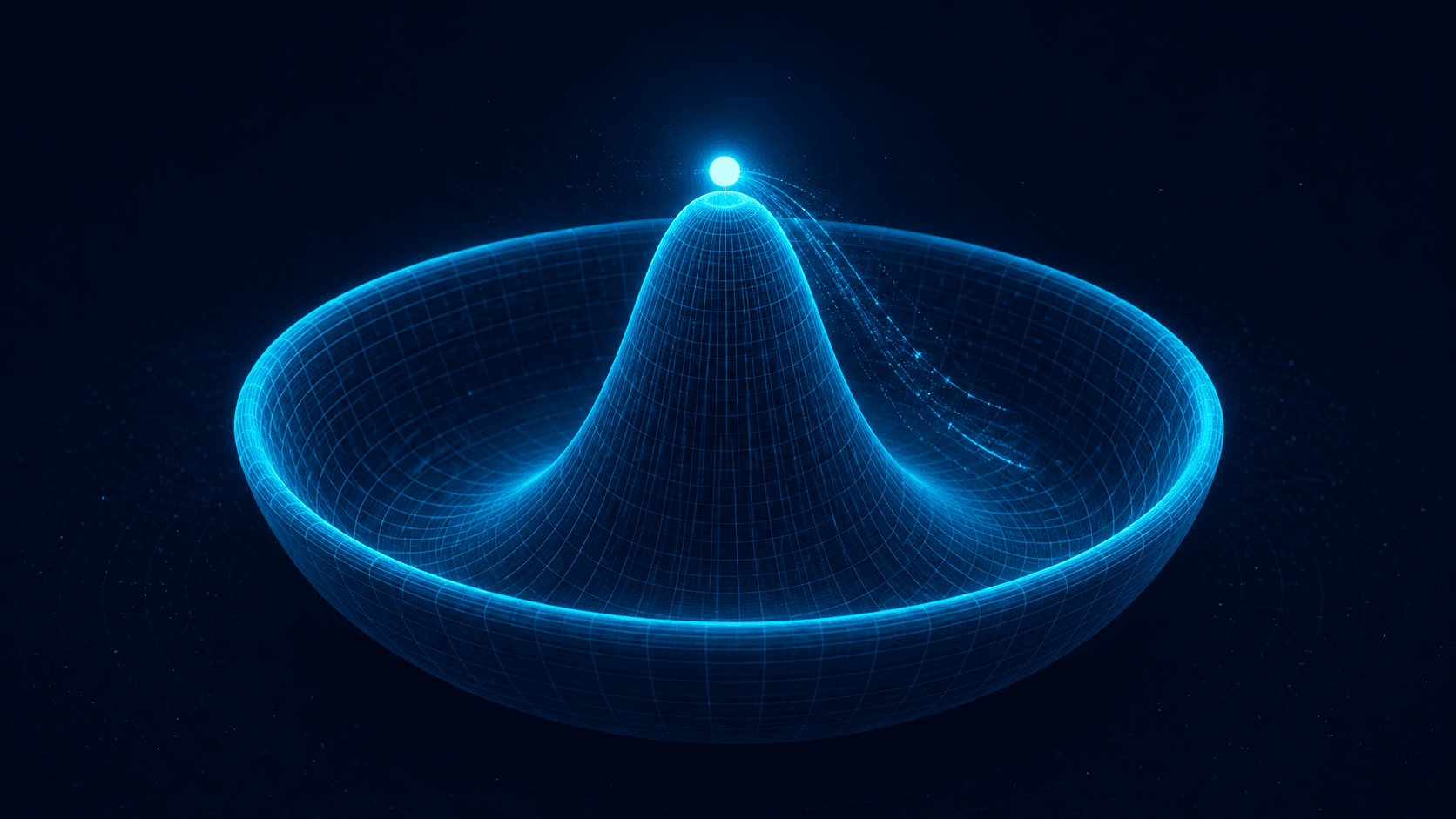
In particle physics, spontaneous symmetry breaking occurs in the quantum vacuum. The vacuum—the ground state of quantum fields—can possess less symmetry than the equations that describe it. The Higgs field, for instance, has a potential energy landscape shaped like an inverted Mexican hat: a central maximum surrounded by a trough of equal depth. At high temperatures (such as in the early universe), the field sits at the symmetric point, the central maximum. No asymmetry exists.
But as the universe cools, the field becomes unstable at the center. It “rolls down” into the trough—but it must roll down in some direction in the complex field space. There is no preferred direction, so it randomly selects one. The field acquires a nonzero vacuum expectation value. The symmetric state is abandoned for a lower-energy asymmetric state.
This is spontaneous symmetry breaking. The laws remain symmetric. The ground state does not. And from this breaking emerges mass.
The Electroweak Unification and the Origin of Mass
In the high-energy, high-temperature conditions of the early universe—milliseconds after the Big Bang—the Higgs field rested at its symmetric point. In this regime, the weak and electromagnetic forces were truly unified into a single electroweak force. The W and Z bosons were massless, like photons. Four apparently distinct particles (the photon and the three weak bosons) were really four faces of the same object, the electroweak boson.
But the universe expanded and cooled. When temperatures dropped below roughly 100 GeV—a threshold measured in the precision of particle accelerators decades later—the Higgs field underwent a phase transition. It spontaneously acquired a vacuum expectation value around 246 GeV.
In that instant, the electroweak symmetry broke.
The consequences were profound. The photon, coupled only weakly to the Higgs field, remained massless. It retained the properties we associate with light. But the W and Z bosons, coupled strongly to the Higgs field, acquired mass through their interaction with it. The unified electroweak force splintered into two distinct forces: electromagnetism, mediated by massless photons, and the weak nuclear force, mediated by massive bosons.
Crucially, quarks and leptons also interact with the Higgs field. Before symmetry breaking, these fermions were massless. After the Higgs field acquired its vacuum expectation value, they too acquired mass—mass proportional to their coupling strength to the Higgs field. A quark that couples strongly to the Higgs becomes heavy; one that couples weakly remains light. This is the origin of mass for all fundamental particles.
Without spontaneous symmetry breaking of the electroweak symmetry, there would be no distinction between forces. There would be no massive W and Z bosons, no weak interactions as we know them, and therefore no beta decay, no stellar nucleosynthesis producing the elements, no chemistry, no life. The universe would be a radically different place.
Beyond the Electroweak: Symmetries at the Frontier
Electroweak symmetry breaking is not the only broken symmetry in nature. The strong nuclear force exhibits its own mysteries of symmetry.
At extremely high energies—in the first microseconds of the Big Bang—the strong and electroweak forces are believed to have been unified into a single grand unified force, governed by a larger symmetry group such as SU(5) or SO(10). This grand unified symmetry would be broken at extraordinarily high energies, around 10^16 GeV, far beyond what any terrestrial accelerator could achieve. At lower energies, what we observe is three distinct forces, each with its own symmetry structure.
Even within the strong force, there are subtleties. At extremely high densities, such as in the cores of neutron stars or in the moments following the Big Bang, the strong force might undergo a phase transition into a color superconductor phase, where quarks pair up in exotic condensates. This would represent another breaking of the strong force’s SU(3) gauge symmetry.
And then there is the puzzle of CP symmetry—the symmetry between particles and their antimatter counterparts, combined with mirror reflection. For decades, it was believed that CP symmetry was exact. Then, in 1964, it was discovered to be violated, though only slightly, in the decays of certain kaons. Later, CP violation was observed in B meson decays. This violation is real, measurable, and profound—it may be the key to understanding why the universe contains matter rather than being annihilated into pure radiation in a matter-antimatter cataclysm.
The Cosmological Implications
The universe itself is a record of symmetry breaking. We can read its history in the breaking of symmetries.
In the first instants after the Big Bang—at energies beyond our current experimental reach—all forces may have been unified under a single symmetry. As the universe expanded and cooled, this primordial symmetry fractured, again and again. First came the breaking of grand unified symmetry, fragmenting the strong force from the electroweak force. Then came electroweak symmetry breaking, separating electromagnetism from the weak force. Each breaking left imprints on the universe: different coupling constants, different particle masses, different interaction rates.
The timeline of these symmetry breakings determined the trajectory of cosmic evolution. Had electroweak symmetry breaking occurred at a different energy scale, the W and Z bosons would have had different masses. The cross-section for weak interactions would have been different. The rate of nucleosynthesis in the early universe would have been altered. The abundances of hydrogen, helium, and lithium—the seeds from which galaxies would eventually form—would be different. Life as we know it might be impossible.
This is one entry point into the question of cosmic fine-tuning: the parameters of the Standard Model appear suspiciously well-adjusted to allow for complexity, for stars, for life. Some of this fine-tuning can be understood through the dynamics of symmetry breaking—but not all of it.
The Unbroken Mysteries
Yet symmetry breaking, profound as it is, leaves questions unanswered.
Why does symmetry break when it does? What determines the vacuum expectation value of the Higgs field? Is there a deeper principle that selects which symmetries break and which remain? These questions point toward physics beyond the Standard Model.
Some physicists propose that additional symmetries exist at higher energies—
supersymmetry, for instance, which would relate fermions and bosons. These symmetries, like those we already know, would eventually break. The proliferation of symmetries and their sequential breaking as energy decreases might be a pattern extending far deeper than we currently grasp.
Others wonder whether we are asking the question backwards. Perhaps symmetry is not fundamental. Perhaps symmetry breaking is the rule, and unbroken symmetries are rare exceptions. Perhaps the universe’s fundamental description involves principles we have not yet identified—principles that would explain not just how symmetries break, but why they existed in the first place.
There is also the question of which symmetries are exact and which are approximate. Is Lorentz symmetry—the symmetry under which the speed of light is constant in all reference frames—truly exact, or could it be violated at the highest energies, with quantum gravity effects breaking it? Is energy conservation truly perfect, or could it be violated in some exotic regime?
These are frontier questions, the ones that drive theoretical physics forward.
The Philosophical Residue
There is something philosophically unsettling about symmetry breaking, something that resists easy resolution. A perfectly symmetric state is, in a sense, “nothing”—no distinction, no complexity, no information. Asymmetry creates differentiation. Differentiation creates structure. Structure creates possibility.
In this view, broken symmetry is not a flaw or imperfection in nature. It is the prerequisite for existence. A universe that was truly symmetric would be barren—it might as well not exist. The universe as we find it, with its broken symmetries, its arrow of time, its distinction between past and future, between particles and antiparticles, between up and down, between here and there— this asymmetric universe is the only kind that can be anything other than empty.
This suggests a deep principle: perhaps the universe must be asymmetric. Perhaps the apparent fine-tuning of symmetry-breaking parameters reflects not luck but necessity. If the symmetries had not broken precisely as they did, we would not be here to notice it. There would be no observers, no questions, no sense of wonder.
This is not an answer to the question of why symmetry breaks. It is an observation that the question might be inescapable. We are the products of broken symmetry, asking why symmetry broke. We can only comprehend a universe that broke its symmetries in ways that allowed us to exist.
Conclusion: The Crack That Made Us
Symmetry is the language in which the deepest laws of physics are written. But the universe is not written in symmetry alone. It is written in the breaking of symmetries—in the cracks that appear when perfect balance becomes unstable.
Each break releases energy and possibility. Each break creates asymmetry, and asymmetry creates structure. The electroweak symmetry breaking created mass. Earlier, more fundamental symmetry breakings shaped the very forces of nature. The result is a cosmos of staggering complexity: galaxies and stars, planets and chemistry, minds and consciousness.
A perfectly symmetric universe would be dead. The universe we live in exists because, at key moments in its history, that symmetry cracked— and from those cracks, everything that matters poured through.
This is not a flaw in nature’s design. It is nature’s genius